Follow these six don'ts in azalea care, and the flower count can increase two to three times
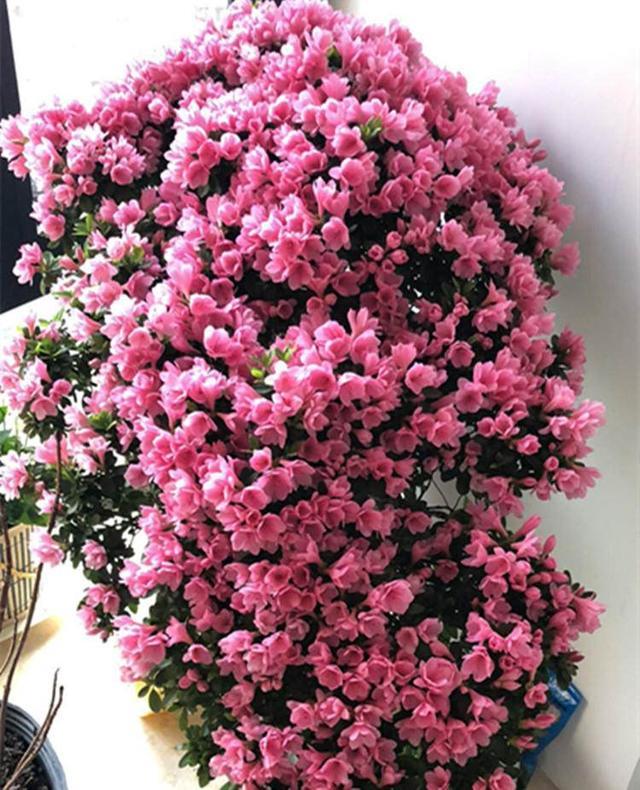
Azalea, with a dense crown and abundant flowers and leaves, can bear 30~40 flowers. To make an azalea bloom two to three times more, gardeners should follow the "six don'ts" in care.
1. Don't use a large pot
Choose an unglazed clay pot. It does not grow large, and its water requirement is not great; generally, it is enough for the spread of the azalea's blooms to be slightly wider than the pot rim.
2. Don't use coarse soil
The soil should be sticky but not greasy; acidic pine needle soil or weathered fine field soil is better as a growing medium. The growing medium should preferably be made of loam mixed with a small amount of clay, with a pH value of 5~6.
3. Don't use strong fertilizer
Use hoof pieces, bone meal, cake fertilizer and dried manure as base fertilizer; fertilize frequently and lightly, using a general-purpose organic nutrient solution for flowers, purely plant-fermented, rich in nitrogen, phosphorus and potassium, diluted 500 times before use, or fish pond water mixed with half water; apply 2~3 times a month during the growing season, and often spray foliar fertilizers such as monopotassium phosphate and photosynthetic micro-fertilizer.
4. Don't water too often
The pH value of the water should preferably be between 5.5~6.5. Western azaleas need little water and should not be watered much; keeping them moist is enough, water only when slightly dry, and when watering, water thoroughly; usually spray the leaves with water more often, and avoid rain and night dew; if the leaves are found withered and yellowed, immediately water with a 1/500 ferrous sulfate aqueous solution or fermented green grass.
5. Don't expose to too much sun
The leaves are thin and avoid strong sun; use reed curtains or 40% to 60% shade netting for shade, and give 1~2 hours of sun in the morning and evening.
6. Don't keep it stuffy
When the weather is warm, the azalea should be placed outdoors. If it is placed in a greenhouse (with the pot bottom raised) or indoors (under a window), it should be put in a well-ventilated place and kept at 80% relative air humidity.
The azalea flowering period starts in October and lasts until April of the following year. Like other varieties with a longer ornamental period, through flowering-period management and control, promptly remove the spent flowers after blooming, and apply a nitrogen-based fertilizer 2~3 times, once every 10 days. After August, the new branches lignify, which is the key period for flower bud formation; a light fertilizer based mainly on phosphorus and combining nitrogen and phosphorus should be applied 1~2 times. The fertilizer applied should be mainly organic nutrient solution.
In addition, when caring for azaleas, suitable light should be used to promote flowering. Azalea flower bud differentiation requires short-day conditions; from June to September, give 8 hours of short-day treatment each day. After flower bud differentiation, azaleas generally form buds after August. After autumn, move it to an environment with a temperature of 20 degrees. If it is refrigerated at a low temperature of 4°C~10°C, it must be placed in a 15-degree greenhouse in early November to ensure flowering for the holiday.
Azaleas have a strong ability to sprout new shoots and send out vigorous branches; each year when the new branches grow to 7~8 cm long, pinch them back, leaving only 3~4 new leaves, to promote the sprouting of new buds. During the peak of spring growth, pinch back 2~3 times, and promptly remove adventitious buds to prevent wasted nutrients.
If there are too many flower buds at the branch tips of the azalea, they tend to crowd each other, preventing the petals from opening fully. Therefore, keep one flower per bud and remove the rest, to encourage larger blooms. After the flowers fade, promptly remove the spent flowers, and properly thin out weak, diseased, dead, crossing, overlapping, sprouting and vigorous branches, to keep the tree shape attractive.