The double-flowered dwarf flowering cherry has multiple layers of petals, blooming in a dazzling and eye-catching display
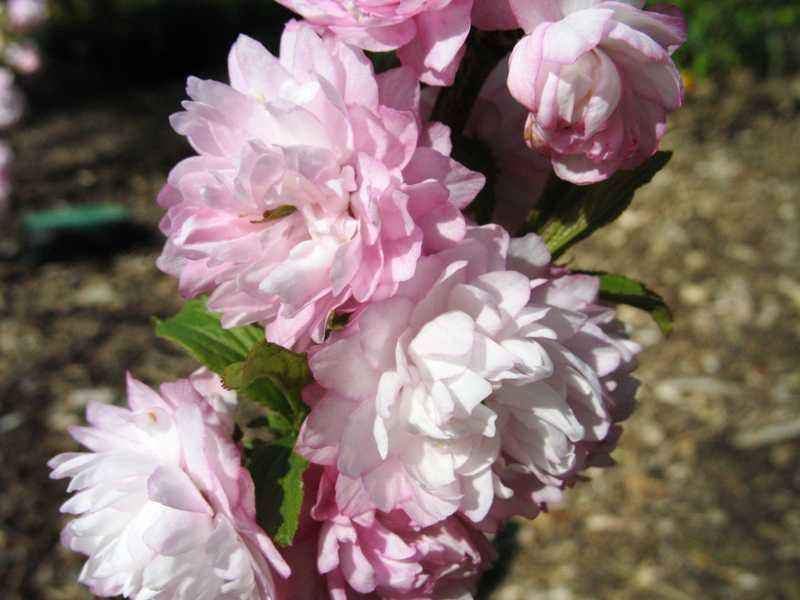
Dwarf flowering cherry (Prunus glandulosa): Rosaceae, genus Prunus (cherry), deciduous shrub, up to 2 m tall. Leaves ovate-oblong to elliptic-lanceolate, 5-8 cm long, apex acute and often rounded-obtuse, base broadly cuneate, margin finely serrate, both surfaces glabrous or the midrib beneath sparsely pubescent; petiole 4-6 mm long. Flowers pink or nearly white, about 2 cm in diameter, pedicel about 1 cm long. Fruit subglobose, 1-1.5 cm in diameter, red.
Dwarf flowering cherry
The dwarf flowering cherry has a certain degree of cold hardiness and strong adaptability, and prefers light. It is fairly cold-hardy and highly adaptable. It is very ornamental, commonly cultivated for viewing in gardens in various places, suitable for group planting on lawns, along roadsides, beside rockeries and at forest edges, and can also be used for foundation planting, pot culture, or as material for forcing flowers and cut flowers. It grows on hillsides, beside ditches or in thickets, and is also cultivated in gardens, at an altitude of 800-2300 m. It is distributed in China and Japan.
This species varies considerably in the wild state and especially in cultivation. Some have further divided it into several varieties or forms based on variations in flower color, single or double flowers, pedicels, branchlets and pubescence on the style. These characteristic variations show no fixed pattern in geographical distribution and can be treated as forms.
Dwarf flowering cherry
Pest and disease control:
Pests have been observed on all types of dwarf flowering cherry seedlings. For 1-year-old cutting seedlings, the seedbed is prone to pests and diseases in early September after the plastic sheeting is opened and during the second year of retention in the bed; spray with 10.25% concentration carbendazim or 0.1% concentration omethoate every two weeks for prevention. The most common pest is the tent caterpillar; during the growing period of large seedlings, spray once with 0.1% concentration omethoate for prevention.
Dwarf flowering cherry
Landscape uses:
The dwarf flowering cherry is very ornamental, commonly cultivated for viewing in gardens in various places, suitable for group planting on lawns, along roadsides, beside rockeries and at forest edges, and can also be used for foundation planting, pot culture, or as material for forcing flowers and cut flowers. In spring it blooms before the leaves emerge, the whole tree a brilliant mass, very beautiful, and in autumn the leaves turn red again, making it an excellent ornamental garden tree.