How do you arrange the scenery in a landscape bonsai? These key points must be mastered
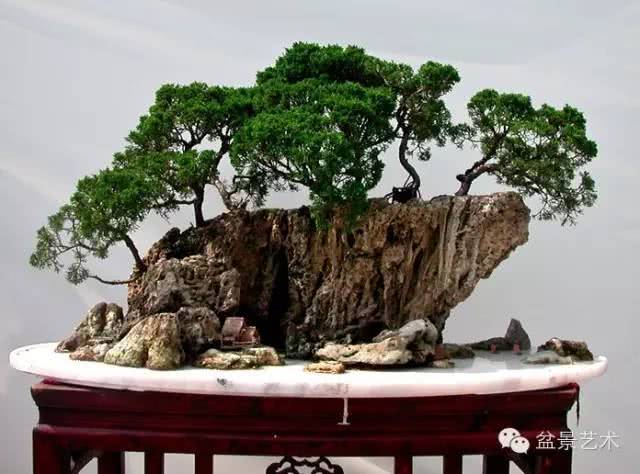
The editor has compiled a few more key points for mastering the arrangement, hoping they will be useful to bonsai friends
1. To make the gap play the role of tightly linking the left and right scenery into a whole, the handling of the gap in the middle of the open-and-close style is very important; if handled improperly, it will cause the scene to split into left and right. Therefore, the handling of the gap is very important, and it must be able to make the main scenery and secondary scenery on both the left and right sides become a closely connected unified whole. To achieve such an effect, when arranging the scene, the two opposing scenes on the left and right must be unified in spirit. Achieve a continuous momentum though the traces are broken, and a continuous meaning though the form is broken. In addition, the opening and closing of mountain peaks and trees should also have a basis in landform formation; although the traces are broken, their place of origin can still be found, so that the separated scenes on the left and right can be merged into one.
2. When using companion scenery to connect the gap, the companion scenery should not be too tall or too large.If the companion scenery is too tall and placed in the gap, the entire picture will appear blocked; if too large, it will clash with the main scenery and secondary scenery on the left and right sides, and be uncoordinated. The companion scenery in the gap must definitely come from the same line as the scenery on the left and right, forming a harmonious overall relationship with a clear primary-secondary distinction.
3. Paths or streams and rivers in the gap must never be in a straight line; they should wind and curve. If arranging a path or cutting a stream or river in the gap, do not handle it as a straight line, and do not handle it so that it extends directly toward the viewer, letting people see through it at a glance and completely separating the left and right scenery, so that it cannot play a connecting role. Therefore, whether it is the arrangement of a path, a stream, or a river, it should generally extend diagonally and have a slight winding curve.
4. The two opposing scenes should present a corresponding relationship. The height difference and width difference between the two scenes on the left and right of the bonsai should not be too large; although there are differences in height and width, they should not differ too much from each other, presenting a corresponding relationship. Through the corresponding relationship, the scenery will not appear lonely but will appear full of momentum and mutually complementing.