5 Ways to Make Succulents Grow Multiple Heads and Form Clusters, Which One Should Beginners Choose?
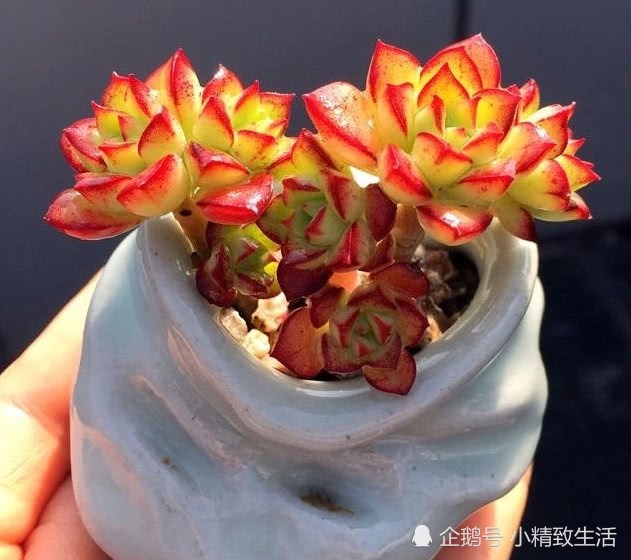
Many friends who grow succulents pursue that state of multiple heads and clusters, sometimes holding a flashlight and searching for ages just to see whether their succulents have sprouted new buds. Today, Little Exquisite Life has compiled 5 ways to make succulents grow multiple heads and form clusters, hoping they will be useful to everyone.
1. Beheading method
The most direct and most brutal way to make a succulent grow multiple heads is the beheading method. As mentioned in Little Exquisite Life's previous article, beheading can not only make a succulent grow multiple heads and form clusters, but also propagate it, turning one into two and two into four. When beheading, remember to leave two or three layers of leaves on the mother plant, because every place where a leaf meets the stem is a potential growth point, and side buds will naturally sprout easily from the growth points. If you cut too close to the lower part of the stem, the leaves there will have long since fallen off naturally, and the growth points are very likely to have already closed up and aged, so sprouting new buds may be very difficult. Most succulents are suitable for the beheading method, but the appearance produced by this method is always somewhat affected.
2. Pinching method
The pinching method is simply removing only the top few leaves of the succulent, destroying the plant's normal growth point and forcing it to grow side buds from other potential growth points. This method is also suitable for most succulents. For succulents like the Aeonium series, as well as Aeonium, Sempervivum and others that are already especially prone to growing multiple heads, using the pinching method can make the clustered effect come out more neat and uniform. This method is relatively gentle, but the pinching method does not come with the function of propagation, which is a bit of a pity.
3. Leaf cutting method
Leaf cuttings that produce small plantlets also easily produce clusters, and because leaf cuttings almost all sprout at the same time, there is no such thing as apical dominance, so the multiple-head effect of leaf cuttings is also very good. The leaf cutting method is also suitable for most succulents, but because leaf cuttings start from propagating small plantlets, the cultivation process is relatively long.
4. Natural method
You need enough patience and to let nature take its course. For example, the Aeonium series, Aeonium and Sempervivum succulents mentioned above are themselves relatively prone to growing multiple heads, while Echeveria 'Juliana' series, Echeveria pulidonis, Echeveria 'Tippy' and other red-edged ones are very prone to clustering.
5. Chemical method
At present there seems to be a drug called sprouting hormone that can stimulate the growth hormones of succulents to achieve the purpose of growing multiple heads, but Little Exquisite Life has never used it, and most veteran succulent growers also do not recommend this method.
The above are the 5 ways Little Exquisite Life has compiled to make succulents grow multiple heads and form clusters, hoping they are helpful to everyone.
Compiled and published by Little Exquisite Life.