Succulent Newbie Inspirational Before-and-After: Careful Cultivation, Witnessing Growth
Follow
Follow Baike · Meet Beauty (WeChat ID: duoroubaike)
Main text begins:
Thanks to the author [Half-Smile Ecstasy] for theoriginal submissionsharing
Submission date: April 14, 2018
Edited and compiled by: Baike Jun
Location: Guilin, Guangxi
I wanted to write an article about succulents before Spring Festival, but I kept putting it off and putting it off, until now. Fortunately, I finally got it written. There are two reasons for writing this article: one is to show off my results a bit and be a little smug; the other is to give newbies confidence that as long as you have patience, confidence, and pay attention to methods, even a newbie can grow beautiful succulents. At least, in my heart they are all beautiful!
My first encounter with succulents was three years ago. At that time, there were very few succulents around here. When I was looking for flowers at a flower shop, the owner said this one was good and didn't need much care, then handed me a pot of Sedum morganianum (Burro's Tail). At the time I thought it looked pretty good, so I bought it. To be honest, by the time I got home I had forgotten its name; I only remembered the shop owner saying to water it once every ten days to half a month. At the time I basically watered it once a week and it grew quite well. Later, a lot of white and pinkish things appeared. I didn't pay attention at the time, but now I know those were mealybugs. Its ultimate fate was of course to die. After that I didn't grow succulents for a long time. The lilies and large-leaf Cymbidium orchids I grew also died from root rot due to overwatering.
In 2016, my girlfriend started growing a few pots of succulents. Catering to her interests, I also bought a few pots to give her. But at the time I wasn't obsessed with them. When my girlfriend pointed at an Echeveria chihuahuensis and said it was pretty, I still thought these rosette-type succulents weren't attractive, that they all just looked the same. (Maybe because they weren't in good condition.) Then something happened that changed my attitude: my girlfriend's Orostachys iwarenge (Chinese Dunce Cap) was barely growing. Then one time we saw the moss in the pot of the flower shop owner's Orostachys iwarenge, and we realized that maybe letting it outside to get rain and dew would help it grow better, so she decided to put the Orostachys at my place for outdoor growing. Just like that, this pot of Orostachys iwarenge quickly filled the pot.
Comparison photos:
Later I repotted it and divided the offsets, producing many offspring, some of which were given away. From then on I developed some interest in succulents. Plus, since some of my girlfriend's succulents were in bad condition or had died, I started learning about succulents, learning how to grow them, and I followed Baike Jun. To be honest, my formal entry into the hobby was in June 2017, when I bought my first batch of succulents online. Coincidentally, the day they arrived was exactly June 22, the day of Dashu (Major Heat). As a newbie who had never grown many succulents, wasn't it brave to buy succulents at this time? Haha, reality was also brutal. Please look at the unboxing photos:
This is only part of the ones that turned to mush. Because I had read quite a few articles on Baike, I was mentally prepared for this kind of situation, so I only bought some small common varieties. Even if I really lost some, I wouldn't be too heartbroken.
After messing around for a while, the second batch arrived. When this batch arrived, the temperature was even higher than during Dashu. Never mind that the succulents couldn't take it; to plant these succulents I also shed who knows how much sweat. I rather admire myself.
After negotiating with customer service, I didn't give up on these succulents that had already started turning to mush. I began planting them following the steps of root trimming - disinfection - drying the roots - potting, and then I watched them every day, waiting for them to become beautiful. This is indeed something that requires patience and love. Having gone through scorching heat, mushiness, black rot, mealybugs, sunburn, frostbite, and chemical burns, I gradually went from a clueless beginner to having some understanding of succulents. Fortunately, with my persistence, in 2017 I waited for them to transform their appearance, and more importantly, I waited for my girlfriend to become my wife. Haha, thinking about it, it's quite an achievement! Without further ado, let's look at the comparison photos! (The experience is at the end of the article.)
Shuimitao 1, given away before it fully grew in (actually I can't tell Shuimitao from Echeveria chihuahuensis; when I bought it the seller said it was Shuimitao)
Shuimitao 2
Shuimitao 3
From another angle, it looks like jade
How about it, isn't that a earth-shattering change? Keep looking. Although I can't tell them apart, this one seems to be Echeveria chihuahuensis
The Sedum rubrotinctum below was originally straight, but after drying the roots for three or four days, it turned into a bent-over monster
After being tempered by time, it turned into a seductive beauty again
Echeveria 'Purple Delight' that had leaves turning to mush when I bought it
Very thick and plump leaves, and the color is not bad either
Ruby
The ruby with red flowers
Debbie, a beauty's name, but where is the beauty?
Here comes the beauty~~~
Ice plum hybrid, what a mess
Although it hasn't colored up, it now has good form
In spring I changed the soil, and under the sunlight it also became a bit more translucent
Red Lotus (Echeveria 'Hongzhilian'), bright green, and its head was even broken off by something
Changed to a different pot, instantly classy, right?
Echeveria 'Crisp Puff' (Sufiya)
Strawberry Curly (Echeveria 'Strawberry Curls')
Now it has shrunk into a bun, and the big center head even split
Echeveria 'Allen', looking thin and frail
Now it's very plump, just a bit off in color compared to Peach Egg (Graptopetalum amethystinum); but isn't it more gentle and refined than Peach Egg this way?
Echeveria 'Brocade', originally had long leaves
Now the leaf length isn't even half of what it was before, and it has sprouted pups at the bottom
Rose Lady (Echeveria 'Rose')
Now it finally looks elegant and graceful
Snow Field (Echeveria 'Snow Field'), grown in an ice-cracked thumb pot
Now it has shrunk into a tiny clump
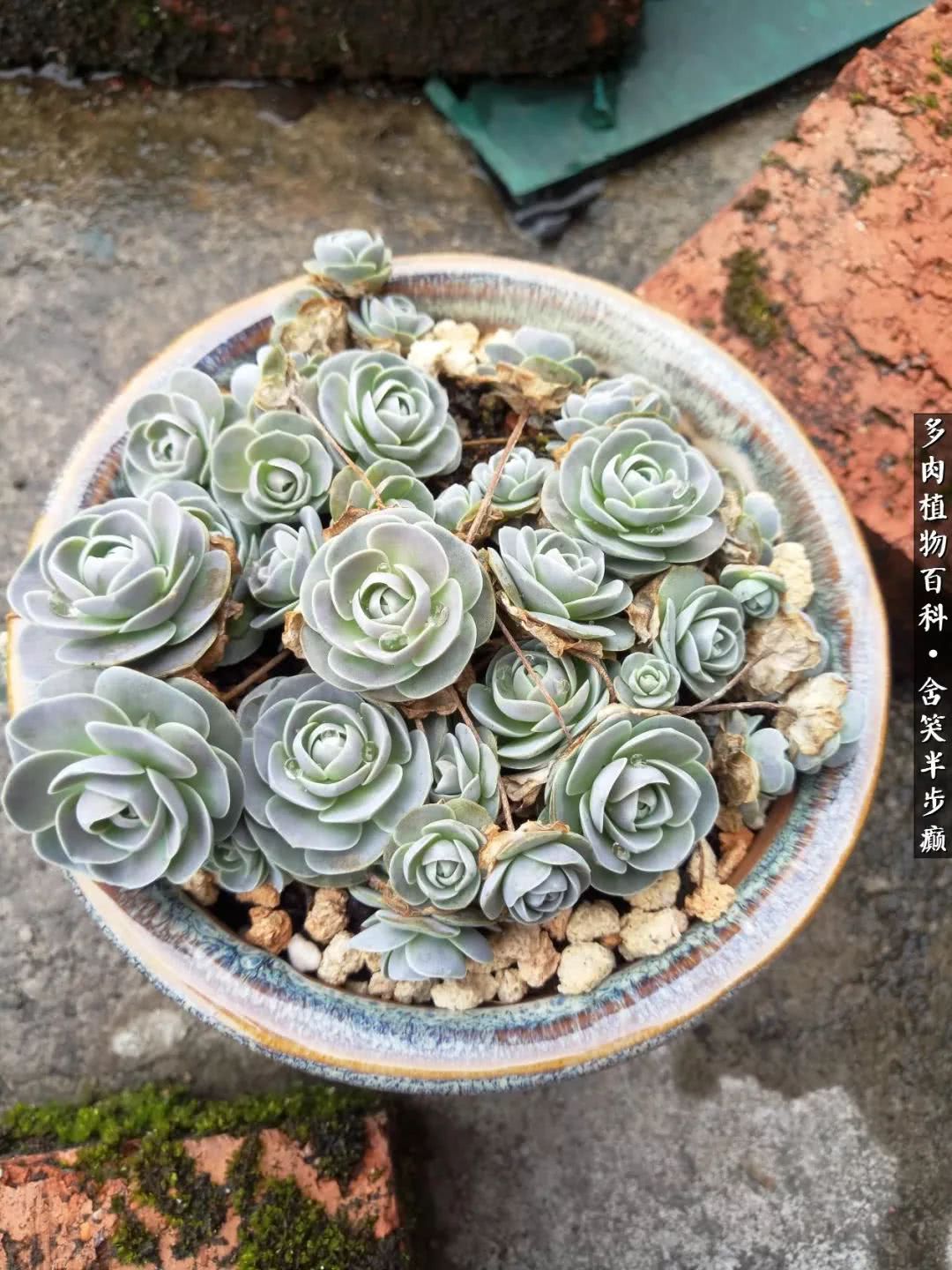
Blue Stone Lotus (Echeveria glauca)
Sprouting pups with good form and a touch of ethereal beauty
Is this Blue Paris? Its fate was quite rough. After discovering black rot, half of the root was removed longitudinally
This spring I repotted it and dug it out to look. Although the wound at the root is still obvious, the leaves are compact and it's in very good condition
Let's switch to a thumb pot
Sasha Queen (Echeveria 'Sasha'), a variety I quite like
Queenly presence
Flower Moon Night (Echeveria 'Hua Yue Ye'), when I bought it the seller said it was 12 cm in diameter, and when I measured it, it really was...
Now it's probably only 7 cm in diameter. So when buying succulents, everyone, don't just look at the diameter!
There are still quite a few comparison photos. I don't know if Baike has a length limit, so I'll post this many for now. If it gets published successfully, I'll write a second article and post more next time!
Now let me talk about my experience!
First, let's talk about choosing varieties for beginners. As a newbie, it's best to buy some common, hardy varieties that aren't easy to kill. If they do die, you won't be too heartbroken. Also, if you buy ones in bad condition, absolutely don't abandon them. If you nurse them back to health with your own skills, you'll feel an overwhelming sense of accomplishment. Looking at your results, you'll be immersed in it, feeling on top of the world, like you've taken drugs. (Although I've never taken drugs) (facepalm)
After half a year in the hobby, I now have over a hundred pots. Only about ten succulents have died at my hands, most of them during the acclimation period, and two died because I didn't handle repotting properly. For growing succulents, I think soil is very important. And the choice of soil must work together with water, adapting to local conditions and the environment.
I started growing succulents in June 2017, always placed under the metal sheet shelter on the rooftop. At the end of October I started outdoor growing (I had moved them out once in September, but a large batch got sunburned and took a long time to recover). Under the metal sheet shelter, since they couldn't get rained on, I used plain garden soil, plain peat, and grit plus peat, and they all grew well because I could choose the amount and frequency of watering myself. For outdoor-grown succulents, I use a mix of peat soil plus grit, with only maifan stone as the grit, at a ratio of 60% or more grit. Why? Because this way drainage is good and it's also breathable. Outdoor-grown succulents will face continuous rainy weather, so drainage absolutely must be good. My succulents once went through half a month of continuous rain watering, and not a single pot had problems. But with more grit, on windy and sunny days, the watering frequency needs to be higher. The principle of soil mixing is breathability and no water accumulation.
Regarding watering, you also need to adapt to the weather. Here the summer temperatures are high, and the water in the pots dries up quickly, so I water twice a week. In other seasons, if it doesn't rain, I also water two to three times a week. Seeing this, will someone ask, don't others all say to water once a week or once a month? There's a very important factor here: my succulents are on the rooftop, the air circulates, the soil has a lot of grit, water doesn't accumulate, and except in spring, the water basically dries up quickly. And in spring basically all succulents start growing like crazy, so more water isn't a problem. In short, watering should be arranged flexibly according to conditions. The principle is no water accumulation in the pot, and the roots should be breathable and not suffocated.
Regarding disinfection and sterilization, I've used carbendazim and chlorothalonil. When problems appear, take measures quickly by mixing with water and spraying the leaves plus drenching the roots. For prevention, I use potassium permanganate mixed with water. This has no phytotoxicity and can also supplement potassium.
Regarding pest control, I mainly encounter mealybugs and red spider mites. For mealybugs, Huahuashen and Jiebi Zhi both work. For red spider mites, I tried many pesticides with no effect. Later I used a pesticide my uncle gave me, and maybe the concentration was too high, because many succulents lost all their leaves, but the red spider mites also disappeared. To this day I still don't know what pesticide that was, so I won't recommend it. One thing everyone should note: pest control and sterilization are two different concepts, and the pesticides used are completely different. They can't be lumped together.
Alright, I'll save some words for next time, haha! (I hope there will be a this time and a next time for publishing.)
Finally, let's look at my Peach Egg and Winter Beauty (Pachyveria 'Winter Beauty').
Advertisement ADVERTISEMENT
This article is exclusively authorized by the authorexclusive authorizationWeChat public account: Succulent Plant Encyclopedia (ID: duoroubaike). The article content does not represent the views and stance of the public account
- Review of last issue's excellent pushes -
- Baike's essential articlesRecommendations -