When these situations occur in succulent care, it's time to fertilize
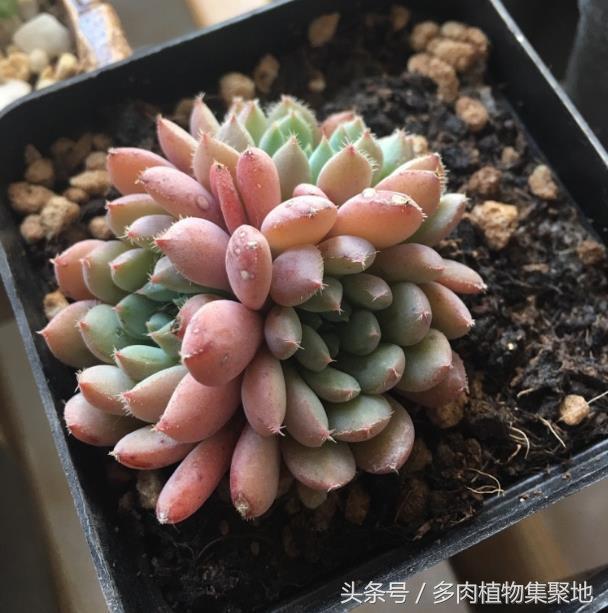
When a succulent flowers, you need to fertilize right away. Flowering and fruiting is an important life cycle for the plant, and it inevitably consumes a large amount of nutrients, so at this time, all the plant's tissues cooperate with this important action of producing offspring. These include: the stem thickens to prevent the heavy flowers and fruit from causing the plant to topple, the roots grip the soil more deeply to help the plant itself absorb more nutrients, and some succulent leaves drop off appropriately so they do not block insect pollination and the lighting of the fruit.
Is it hard for succulents to flower? Take everyone's favorite Echeveria as an example. Generally speaking, most varieties already meet the conditions for flowering after one or two years of growing. If your succulents have been growing for several years and still have never flowered, it is often because you believed the misconception that succulents come from barren native habitats and do not need fertilizer, so you gave your succulents a very shabby care routine: the soil mix is just plain medium, the water is just tap water, and the nutrients are insufficient. No matter how much the succulent wants to flower, it will be in vain.
After flowering, succulents consume a large amount of nutrients, so they often become less attractive. Therefore, during the flowering period, do not stop the nutrients (monopotassium phosphate); keep the nutrients up so it does not lose too much of its form. But after an old stem flowers, it may lose its form, because the roots may not necessarily be able to absorb the nutrients. If you are worried that the succulent will lose its form after flowering, or you are not interested in the succulent flowering, you can use scissors to cut off the flower stem from a position close to below the flower stem. Do not rush to clean up the remaining flower stem; it will slowly dry up and eventually fall off on its own. If you pull it off too hastily, you may instead injure the succulent.
Succulents need more nutrients to support their own flowering and fruiting. Flowering fertilizer is mainly phosphorus fertilizer and potassium fertilizer, and it is best to apply it in liquid form, which takes effect quickly. Gardeners who do not understand flower fertilizer can directly choose monopotassium phosphate; just mix 1 gram of fertilizer with 2 kg of water. Some gardeners say a 1:1000 ratio is better, but that is under greenhouse or conservatory cultivation conditions, where the plants grow vigorously and only then can this concentration be used. Succulents grown at home cannot absorb as fast as those in greenhouses and conservatories, so dilute it as much as possible.
Do not throw away the cut flower scapes. They can be placed in a bottle like cut roses, and the buds will slowly bloom. So if you do not plan to pollinate, you can cut them off and put them in a bottle when the succulent flowers are still in bud, so you can both see the flowers bloom and avoid consuming too many nutrients. After some succulent flower scapes are inserted into soil, they can survive again and propagate new life, but you must cut off the flowers, otherwise the flowers will consume the vast majority of its nutrients.
When the environment is relatively suitable, succulents grow quite fast, especially during the growing season, when succulents are in a state of crazy growth. If you find that your succulents do not have sufficient nutrients and are growing relatively slowly, you can appropriately supplement them with some nutrients so they can grow better.
In their native habitat, succulents generally flower within one year, mostly concentrated in spring. However, because they have left their native habitat, after climate, water and other environmental factors change, succulent flowering is relatively rare. But as long as the temperature and environment are relatively suitable, succulents can also grow flower scapes or bloom. At this time, many gardeners struggle over whether to pull off the flower scapes or pinch off the flowers, for fear that the succulent will die right after flowering.
This is a gathering place for succulent lovers, sharing succulent care tips. Welcome to follow and exchange ideas.