In Dai literature, the golden lotus (Musella lasiocarpa) is an embodiment of kindness and a symbol of punishing evil.
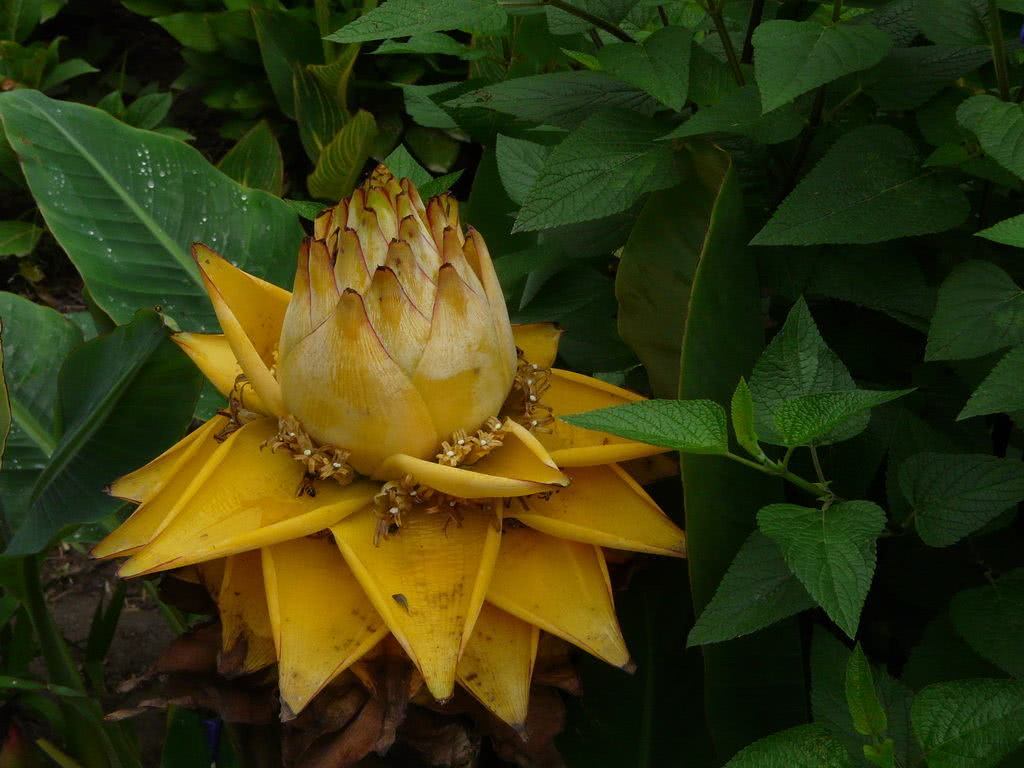
Musella lasiocarpa, native to Yunnan, China, is a specialty flower of China. The true small flowers are borne in the leaf axils of the pseudostem, fragrant and delicate, alternating yellow and green, adding a touch of exquisite beauty, with a flowering period lasting as long as half a year. Musella lasiocarpa has been designated by Buddhist temples as one of the "Five Trees and Six Flowers," and is also an embodiment of kindness and a symbol of punishing evil in Dai literary works. People in Yunnan also use its stem sap to sober up and detoxify, and to make hemostatic medicine. The tropical greenhouse of the Beijing Botanical Garden has now introduced and cultivated this beautiful plant.
Musella lasiocarpa
Morphological characteristics:
The plant is clump-forming, with horizontal rhizomes. The pseudostem is short, less than 60 cm tall, about 15 cm in basal diameter, with persistent leaf sheaths at the base. The leaves are oblong, up to 0.5 m long, about 20 cm wide, sharply pointed at the tip, nearly rounded at the base, symmetric on both sides, and covered with white powder.
The inflorescence is erect, borne directly on the pseudostem, dense and spike-like, 20-25 cm long; the bracts are dry and membranous, yellow or pale yellow; flowers are in 2 rows, with 4-5 flowers per row; the fused tepals are ovate-oblong, with 5 (3+2) teeth at the tip; the free tepal is slightly concave at the tip, with a short point in the depression.
The berry is triangular-ovoid, about 3 cm long, about 2.5 cm in diameter, densely covered with stiff hairs on the outside, and contains many seeds; the seeds are large, oblate-spherical, 6-7 mm wide, blackish brown or brown, smooth, with a large white hilum on the ventral side.
Musella lasiocarpa
Growth habits:
A light-loving plant that prefers ample sunlight and warmth; below 0°C, the aboveground parts will freeze. It prefers fertile, loose soil. It is easy to transplant. It mostly grows on mountain slopes or is planted in courtyards; at an altitude of 1500-2500 m.
Musella lasiocarpa
Landscape value:
When in bloom, it looks like a golden lotus surging out of the ground, creating a very magnificent landscape. In courtyards, it is suitable for planting near windows, wall corners, or beside rockery stones, or for planting in masses, and it is also suitable for container growing for ornamental display.
Medicinal value:
The flowers can be used as medicine and have an astringent and hemostatic effect. They are used to treat leukorrhea, metrorrhagia, and bloody stools. The stem sap is used to counteract alcohol intoxication and monkshood poisoning.