Do these few things well for bougainvillea and it will bloom early, flower for a long time, and produce a magnificent cascade of blossoms
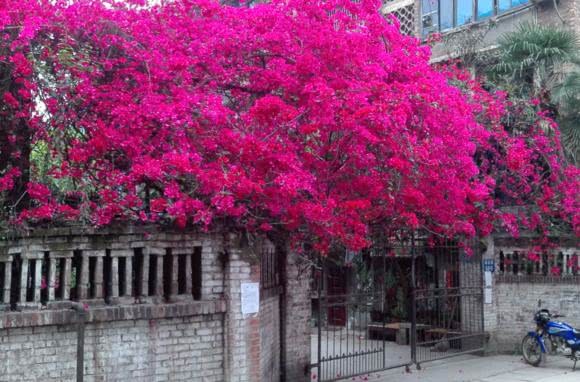
Bougainvillea comes in many varieties and colors, with flowers borne terminally, usually three clustered together inside the bracts; the bracts are leaf-like and papery, large and brilliantly colored like flowers, and are the main ornamental part. It loves fertilizer, grows vigorously, tolerates rough management, has few pests and diseases, a long flowering period, and abundant flowers. A few insights on making bougainvillea bloom early, flower for a long time, and flower profusely:
1. Choose varieties that are adapted to local growing conditions and flower easily.
There are many bougainvillea varieties. Some have a relatively high short-day requirement for flower bud differentiation and flower late, not blooming until after October, such as single deep red large-flowered; others are less demanding and flower readily, blooming as early as June, such as single large red, single rose red medium-flowered, and double large red; while variegated rose red falls between the two.
2. Safe overwintering is a necessary condition for early flowering
Generally, bougainvillea varieties overwintered in a spot with ample light can keep blooming above 15 degrees, will drop leaves at around 12 degrees, and some varieties are prone to cold damage below 8 degrees. Too great a day-night temperature difference during wintering and overly wet soil both damage the buds and delay flowering. Keeping above 8 degrees in winter with slightly dry potting soil favors early flowering. Move them outdoors after the temperature stabilizes in mid-April to prevent the flower buds from being frozen when taken outside. Bougainvillea that has overwintered well and been cared for properly can show a full bloom of many flowers and few leaves in May; ordinary ones can also bloom by the end of June.
3. Choose a sunny, warmer, well-ventilated environment for growing bougainvillea.
Such as a rooftop, a full-sun terrace where sunlight is intense and temperatures are high after late April; a flower rack in front of the window of an enclosed south-facing balcony, where glass reflection of sunlight and good ventilation help; a location facing the sun and backed by a high wall, where light and heat radiation are strong; all these environments favor early flowering, a long flowering period, and abundant flowers.
4. Fertilize reasonably and regulate watering at the right time to promote flowering
For fertilization, apply an appropriate amount of base fertilizer, top-dress promptly, and apply light fertilizer frequently to meet the plant's needs, emphasizing phosphorus and potassium and not overdoing nitrogen. In spring, when new leaves unfold and their color turns green, replace part of the soil and apply an appropriate amount of decomposed organic fertilizer as base fertilizer, so as to avoid sprouting leggy branches. After the branches and leaves are lush, regulate watering to promote flowering (water in the morning and mist in the evening, so the branches and leaves wilt in the afternoon). Apply or spray a light fertilizer solution. After a large number of flower buds appear, apply a light fertilizer based mainly on organic nutrient solution, then switch to normal watering of "water when dry, stop when wet." In the late full-bloom stage and after pruning back after flowering, top-dress promptly (apply a balanced fertilizer) so the plant quickly regains its growth vigor after full bloom and sprouts new buds; if the branches and leaves become lush again, regulate watering once more to promote flowering. Through artificially rhythmic water regulation and fertilization, you can effectively promote flower bud differentiation and achieve multiple flushes of bloom, flowering continuously one after another. (Do not regulate watering during the flowering period and from late September to before winter.) For plants whose vegetative growth is excessive and whose stems and leaves are leggy, you can increase the intensity of water regulation, such as stopping watering for 2-4 days to let them wilt. Afterward, water only enough to meet the minimum needs for survival; regulate water for about 15-20 days, wait until growth at the branch tips stops and leaf color turns yellow-green, then return to normal watering to promote flower bud differentiation.
5. Use a slightly smaller pot, which helps regulate water, prevents leggy growth, and makes flowering easier. "Small pot, enough fertilizer, frequent flowering; strong light, high temperature, early flowering."
6. Pinch early and prune moderately
At the six-leaf stage of new spring shoots, remove two and keep four to encourage branching and increase the number of flowering branches. Pruning mainly means removing leggy branches, inner-canopy branches, overlapping branches, and shaded branches, as well as pruning back after flowering. Staggering the pruning-back times of the various flowering branches helps sustain continuous blooming. The purpose of pruning is to suppress excessive vegetative growth and prevent wasted nutrients, and to help the plant receive direct sunlight and ventilation. Generally do not prune heavily during the growing season. Heavy pruning easily sprouts leggy branches and delays flowering.
7. Spray plant growth regulators on the leaves to promote early flower bud differentiation and flowering, with shorter intervals between flowering flushes; shorter internodes and a more compact plant shape. (Concentration around five per thousand, and avoid contact with copper utensils.)
8. Repot and change the soil in time
Every 2-3 years, repot, trim the roots, and change the soil to restore growth vigor, or repot in place annually and partially change the soil, replenishing decomposed organic fertilizer. Old plants of many years also need their canopy renewed and rejuvenated to prevent insufficient water and fertilizer and plant aging without flowering. Repotting and soil changing are mostly done in May when pruning back after flowering. (If there are no flowers, do it in late April when new leaves unfold and change color.)
9. Regulate the flowering period with short-day treatment
For example, to have flowers for "National Day" (October 1), start shading 50 days in advance, giving 6-8 hours of strong sunlight each day and shading for the rest of the time to 95 percent. After 50 days, when flower buds appear on the newly sprouted axillary buds, the plant can be cared for normally in sunlight until full bloom.