Clematis planted for 2 years blooms into a beautiful flower wall on the balcony - how to grow it well? Three insights
On a south-facing terrace in Beijing, I once grew many varieties of flowers, including vegetables like cucumbers and loofahs. But because winters in the north drop to minus ten-plus degrees Celsius, these either only last one season and have to be reseeded the next year, or have to be moved indoors in winter, which is a huge hassle. Last year, by chance, I came across clematis, and I felt this was the perfect match for northern gardens and roses:
(1) Cold-hardy, no need to move indoors in winter, and after vernalization the flowers bloom even better and the plants grow more robustly;
(2) Can be grown for many years, and easily blooms into a sea of flowers;
(3) Adapts to the alkaline soil of the north, especially Beijing where the tap water is often alkaline;
(4) Huge flowering quantity, and several kinds can be combined to beautify a terrace or garden;
(5) Pairs perfectly with roses;
So last year I started getting into clematis, mainly choosing early-flowering large-flowered varieties, gradually selecting 7 or 8 kinds, 1-2 year old seedlings:
(1) I tried not pruning in the first year, or basically only light pruning (cutting off flowers), mainly to grow the stems, letting them grow freely;
(2) Appropriate slow-release fertilizer, mainly using liquid fertilizer once a week;
(3) Stop fertilizing in midsummer, replenish water morning and evening;
(4) In winter, leave them on the terrace to be hit by Beijing's ice, snow, and smog, and see their tolerance and performance the next year;
This spring, the long-awaited flower wall finally appeared!!! Early-flowering varieties, as expected, bloom on last year's old stems! So fellow gardeners, don't prune randomly anymore, be sure to keep plenty of stems, so that lots of nutrients can flow back to the roots, and only then can a beautiful flower wall bloom the next year.
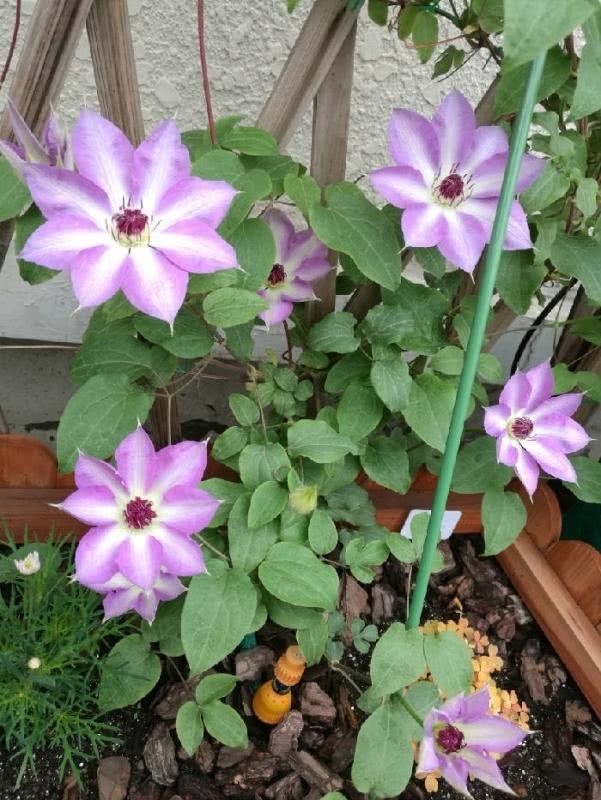
This is Miss Bateman, an English variety, the first one I got, and also the most robust one. In about three months it covered the fence, and its stems grew very thick. After a whole winter, not a single stem died, and it was also the first to bloom in spring!
Pink Champagne and Kiyosumi-ji
Roko-kolla and China Red
Broad-petaled Emperor and Narrow-petaled Emperor
Akashi and Malay Garnet
Summary:
(1) About clematis wilt: last year both Kiyosumi-ji and Emperor had clematis wilt, especially Kiyosumi-ji, whose above-ground parts all disappeared after a rain in June. But I ignored it and did nothing, letting it go dormant properly. In nature, doesn't it also get clematis wilt, and doesn't it also come back full of life! Sure enough, this one rested for a full 4 months, showing no movement at all, as if dead. By October, several large shoots suddenly emerged from underground! Much more robust than the previous stems, shooting up and quickly climbing the fence! So clematis lovers must be patient with their clematis; it will definitely surprise you afterward!
(2) About growth: many people wonder why my clematis doesn't grow well, but there's really no need to worry. Last year Pink Champagne and Akashi kept growing poorly, with thin stems, and the tips often wilted and drooped. After a winter, with Beijing at minus ten-plus degrees Celsius, they went through a good dormancy, and in early spring they sent up large shoots, the very thick kind. They quickly climbed up and opened extra-large flowers. So, many times clematis may be quietly growing roots, which you can't see, and all you need to do is fertilize and water normally and let it grow naturally. After building up strength, it will definitely burst forth!
(3) About fertilizing: I basically just use liquid fertilizer, once a week. Stop fertilizing in midsummer, replenish water morning and evening;
(4) About soil: the pH of the soil affects flower color. I tested it, and it's the group of photos with Akashi and Malay Garnet - when the soil was more acidic, the flowers were lighter in color, and after I then watered with slaked lime, once the soil was more alkaline, the flower color deepened. This method can produce different flower colors on the same clematis!!! An unexpected discovery!