Pistacia chinensis Bonsai: Making Methods and Care Tips
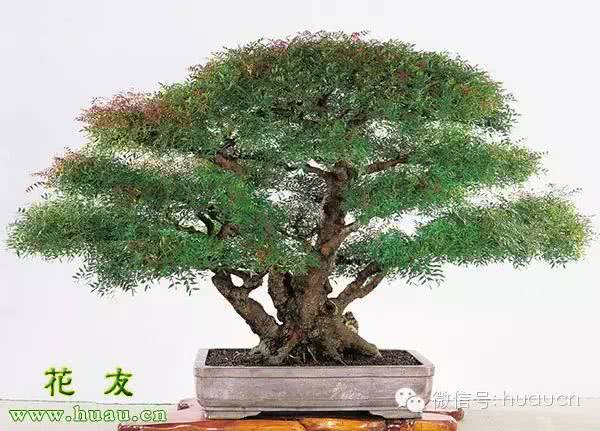
Pistacia chinensis, also known as Chinese pistache, Chinese pistache, Chinese pistache, Chinese pistache, cockscomb tree and other names, is a deciduous tree in the family Anacardiaceae, genus Pistacia. Its crown is nearly spherical, and its bark peels off in thin flakes. It is native to China and widely distributed, from the Yellow River basin in the north to Guangdong and Guangxi and the southwestern provinces in the south, where it grows both wild and cultivated, with the largest numbers in Hebei, Henan, Shandong, Shanxi and Shaanxi. Pistacia chinensis likes light and tolerates shade when young; it likes warmth and fears severe cold; it grows well on fertile, moist and well-drained limestone mountain land. Pistacia chinensis has a graceful tree form, an open crown and a majestic posture, with luxuriant branches and leaves. In early spring its purple-red or pale green female and male inflorescences are extremely beautiful; in spring the young leaves are red, in summer the leaves are emerald green, in autumn the leaves are golden yellow, and in winter the bare branches are neat and elegant. It is an excellent greening tree species for cities and scenic areas, suitable as a shade tree, street tree and mountain scenic tree, and as a bonsai species it has extremely high ornamental value. Here is a brief introduction to the making and care methods of Pistacia chinensis bonsai.
Bonsai: Vitex negundo Bonsai Making and Care Management
I. Sources of Seedlings
Pistacia chinensis is usually propagated by seed. Spring sowing is generally from late February to mid-March. Because making bonsai requires only a small number of seedlings, a small arched shed can be used for raising seedlings. Inside the arched shed, sow in furrows, with a row spacing of 20-30cm and a sowing width of 5-6cm, at a sowing depth of 3cm, then cover with 2-3cm of soil after sowing. Then cover the arched shed with plastic film to help keep warmth and moisture. The seedlings only emerge completely 1 month after sowing, with a germination rate of 50%-60%, and the plastic film can be removed once the seedlings emerge. During seedling growth, weed and loosen the soil once every 10-20 days. When the seedlings are 10cm tall, carry out the first thinning, with a seedling spacing of about 10cm. Later, apply fertilizer and water 2 times to promote seedling growth. When the seedlings reach 15-20cm in height, carry out the final thinning and final spacing, removing weak seedlings and keeping strong ones. Because Pistacia chinensis is a tall tree and grows fast at the seedling stage, 1-year-old seedlings generally reach 60-80cm in height. Seedlings generally need to be cultivated in the seedbed for a full 2 years before they can be potted and shaped, so after the seedlings leaf out in the second year, attention should be paid to dwarfing and strengthening them, and the terminal buds should be removed in time to inhibit the seedlings from growing taller. More side branches should be retained, and potassium fertilizer should be supplemented to help the seedlings harden and thicken.
II. Potting Soil Selection and Mixing
Pistacia chinensis has strong adaptability and is not strict about soil; it can grow in acidic, neutral and slightly alkaline soils. But Pistacia chinensis is a tall tree, with a tall and thick stem and a well-developed root system. Because the volume of a flower pot is limited, the root growth of potted Pistacia chinensis is inhibited, and the limited potting soil must contain sufficient fertility to maintain its needs for growth and fruiting. Select loose, fertile garden soil and sift it, add 1/3 fully decomposed organic fertilizer (such as compost, barnyard manure, green manure, etc.), mix in 1/5 crushed plant straw, and moisten the above raw soil with 5% human and animal urine or a 1% urea water solution, until the moisture level is such that it forms a ball when squeezed in the hand and falls apart when the hand is opened. Pile it in a sunny place, cover it tightly with plastic film, and ferment at high temperature for 15-20 days before use.
III. Choosing a Pot
Choose different containers according to the different positions where the bonsai is placed. For viewing on a desk or windowsill, choose a ceramic or earthenware flower pot with a diameter and height of about 30cm and drainage holes at the bottom; for viewing in a courtyard or on a balcony, containers such as small wooden boxes, wooden buckets, small vats and flower pots can be used; for ordinary commercial Pistacia chinensis bonsai, unglazed clay pots or purple clay pots should be chosen.
IV. Potting and Shaping
1. Raising the Stock
Around the Spring Equinox, dig out the strong seedlings that have grown in the seedbed for a full 2 years; when digging, take care to protect the side roots and fibrous roots. To ensure that the bonsai seedling height does not exceed 80cm, all branches and trunks above 50-60cm on the newly dug seedlings should be cut off. Before planting, cover the drainage hole of the flower pot with two overlapping pieces of broken tile, so that it can drain water without leaking soil, and place a layer of coarse sand at the bottom of the pot to increase air permeability, which helps the seedling survive and grow. Then fill in 1/2 pot of soil, with the potting soil higher in the middle and lower around the edges, spread out the seedling root system, keep the root and trunk upright, and after filling with soil, lift the seedling gently with the hand and shake the pot to firm the soil. The potting soil should be 3-5cm below the pot rim so that it can be watered thoroughly. The newly potted soil is very loose, so it can be pressed firm gently by hand, and then watered slowly to prevent the surface soil from being washed into a big pit. After the first watering has seeped down, water again until water flows out from the bottom hole. Be careful to prevent half-watering, with the top wet and the bottom dry, which affects survival and growth. After watering thoroughly, place it in a shady place first to let the seedling recover. After another year of cultivation, shaping can be carried out once the new branches and leaves are luxuriant.
2. Processing and Shaping
Shaping is best carried out in April of the spring of the year after potting. A naturally growing Pistacia chinensis crown is spherical, but because potted Pistacia chinensis needs repeated tip pinching and height limitation for dwarfing, its side branches grow longer and more luxuriant. Based on this characteristic, the side branches can be twisted and wired. Generally retain 4-5 layers of side branches on the main trunk, and imitate the natural crown by adjusting the growth vigor and angle of the side branches of each layer, so that the lower side branches grow at a slant, the middle side branches are basically horizontal, and the upper side branches extend diagonally upward, and combine this with slight pruning according to the tree form, so that it grows into a spherical shape close to but far larger than the crown-to-trunk ratio of the natural growth state, making a well-matched and appropriate natural-style bonsai. You can also design a pattern according to the growth form of the seedling, creating momentum according to the stock and following the shape according to the design, with orderly bends and straight lines, making it into slanting-lying, curved-trunk and other postures. In early summer, wire the new branches again and further shape them in combination with pruning.
Bonsai: Boxwood Bonsai Bud Forcing Techniques
3. Repotting and Changing Soil
Pistacia chinensis has a well-developed root system and grows fast. For bonsai that have been cultivated continuously for several years and have already taken shape, the nutrients in the potting soil have been exhausted, the granular structure of the potting soil will change, air permeability will decrease, and the root system will no longer have room for further growth and expansion, which will affect the growth and survival of the seedling. Therefore, shaped Pistacia chinensis bonsai are best repotted and given new soil once every 2 years, and repotting and soil changing should be carried out before spring budding. Take 1 flower pot slightly larger than the original, fill it with 1/3 pot of cultivation soil, pull up the bonsai seedling that has grown for many years together with its roots and soil (the potting soil should not be too wet when pulling it up, to avoid the potting soil falling off), place it floating on the 1/3 pot of soil, carefully remove part of the original soil from the seedling, injuring the fibrous roots as little as possible, and add some new soil appropriately so that the potting soil is about 1-2cm lower than the pot rim, to facilitate watering, allowing the roots to grow into the new soil, promoting further development of the root system, thereby strengthening branch and trunk growth and encouraging the stem to thicken and the branches and leaves to flourish.
V. Care of Pistacia chinensis Bonsai
Pistacia chinensis likes light, loves warmth and fears severe cold, and the seedlings tolerate shade. A finished bonsai should be placed in a sunny, ventilated and moist place. In summer it must not lack water or be exposed to the sun, and in winter it should be moved into a greenhouse or a well-sealed balcony inside a building to overwinter, and attention should usually be paid to keeping the potting soil moist. During the growth period, fertilizer and water management should be strengthened, and once every 20-30 [days] apply thin cake fertilizer or rotted human and animal urine. In every growing season, attention should be paid to pinching the tips and limiting the height of the seedling to promote its development toward a dwarf and sturdy direction. The bonsai should be pruned in time in autumn and winter. According to different appreciation requirements, use thinning, short pruning, retrenchment and other methods to cut off excess side branches, parallel branches, crossing branches, overly dense branches, leggy branches and dead branches, highlight the main trunk, and fill out the ornamental branches, so that it has a higher artistic style. Pistacia chinensis is dioecious, so when making bonsai, attention should be paid to matching female and male plants in proportion. Male branch buds can also be grafted onto female branches, and combined with artificial pollination, the fruit-setting rate and seed-setting rate can be increased, so that the same bonsai can achieve multiple effects at the same time: foliage viewing, flower viewing (female and male inflorescences), fruit viewing and trunk viewing. Pistacia chinensis has strong stress resistance, and the volatile aromatic substances contained in its leaves and bark have strong insect-repellent and insecticidal effects, so it rarely suffers from diseases and insect pests. According to the above methods, after several years (usually 6-8 years) of cultivation, shaping and careful care of Pistacia chinensis, an ornamental bonsai with an excellent crown can be made. Because the leaves of Pistacia chinensis contain a relatively high amount of volatile aromatic oil, they can release a rare and peculiar olive fragrance into the air, and the leaves can also adsorb and absorb large amounts of harmful gases such as SO2 and coal smoke from the air. As an indoor bonsai, placed on a desk, windowsill, balcony and other places, it can effectively purify and freshen the air, which is beneficial to people's physical and mental health.
·END·
An interactive platform for flower-growing, flower-planting and green-plant enthusiasts to chat, show off and be a bit smug. An online home for sharing flower cultivation methods and household flower-growing tips. A fresh flower subscription platform.
Fresh flowers: Hyacinth|Stock|Plum blossom|Carnation|Camellia|Kalanchoe|Jasmine|Gardenia|Peach blossom|Balloon flower|Osmanthus|Calla lily|Lily|Forget-me-not|Clivia|Apricot blossom|Honeysuckle|Aglaia|Peony|Sunflower|Chrysanthemum|Serissa|Crown of thorns|Tulip|Narcissus
Green plants: Poinsettia|Money tree|Pothos|Spider plant|Alocasia|Lucky bamboo|Asparagus fern|Aloe|Ivy|Anthurium|Monstera|Bougainvillea|Silk tree|Peace lily|Schefflera|Boxwood|Sago palm|Rubber plant|Maidenhair fern|Snake plant|
huau.cn
……
Search the public account "Flower Friends" or "huaucn" to get the latest information
Business cooperation, promotion. Please contact WeChat private ID:ihuaucn