Marshland wild grass looks like a donkey's hoof; only old farmers know it; now it sells for 45 yuan per jin, a rare commodity
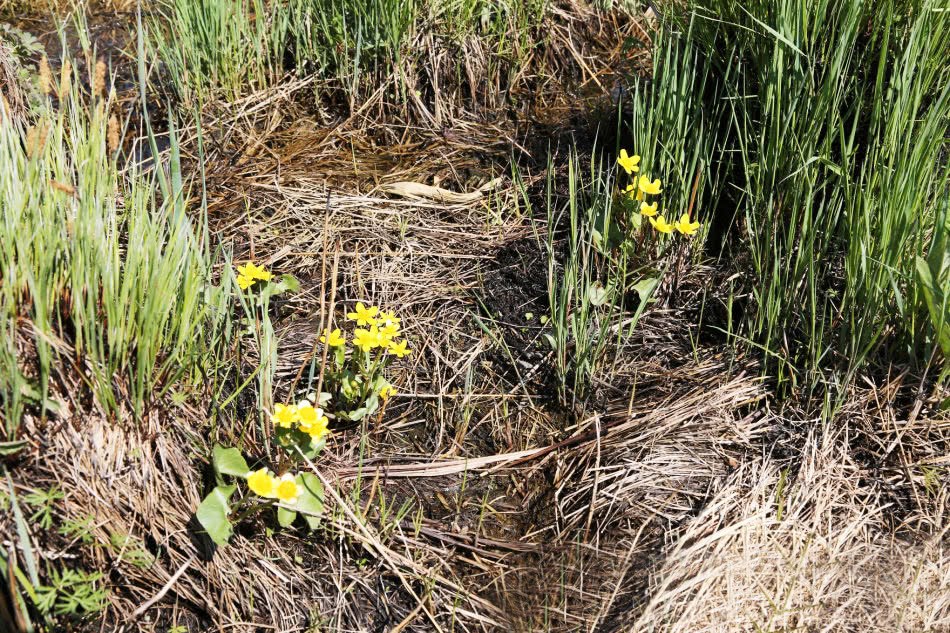
Friends who live in rural areas are surely no strangers to wild grass. In the rural countryside there are all kinds of wild grasses, and many farmer friends are very fond of them, because some can be eaten as wild vegetables, and some can be used as herbal medicine. However, there are also many wild grasses that quite a few farmer friends do not recognize; only old farmers know them. Below, the author introduces one such wild grass. It is generally rarely seen, because its growing location is very remote.
In Latin this wild grass is called palus, meaning "marsh," describing how Caltha palustris mostly grows in marshes, wetlands and other damp, muddy places. After spring arrives each year it begins to grow, and in May it begins to bloom. The author only saw this peculiar wild grass yesterday when going into the mountains. Many younger farmer friends asked said they did not recognize it. Later, after asking an older farmer friend, the author learned that this wild grass is called "donkey's hoof grass" (Caltha palustris).
The reason Caltha palustris is called this name is that, if you observe it carefully, once its leaves have fully formed they look like a donkey's hoof and also like a horse's hoof, hence the names donkey's hoof grass or horse's hoof grass. Caltha palustris is actually not very widely distributed in China; it is mainly distributed in the rural mountains of Heilongjiang, eastern Xizang, northwestern Yunnan, Sichuan, western Zhejiang, southern Gansu, Shaanxi, western Henan, Shanxi, Hebei, Inner Mongolia, Xinjiang, western Hubei and other places, and its growing locations are wetlands and marshes in mountain forests at an altitude of 1300 m to 2000 m. Therefore ordinary people find it hard to see, and naturally do not recognize it; only old farmers know it.
Although the name Caltha palustris is not very elegant, and can even be said to be rather rustic and common, do not underestimate it, because its uses can be very great. The author consulted relevant materials, and it is recorded in "Chinese Materia Medica" that the whole plant of Caltha palustris can be used as medicine. Its taste is pungent and its nature is cool. As medicine it has the effects of dispelling wind and scattering cold, relieving summer heat, and invigorating blood and reducing swelling. It can be used to treat wind-cold, heatstroke and sha, bruises and injuries, burns and scalds, dizziness of the head and eyes, general body pain and many other symptoms.
Moreover, current research has also found that Caltha palustris contains a substance called triterpenoid saponin, which has the effects of lowering cholesterol and anti-inflammation, and this has also greatly raised the value of Caltha palustris. It is understood that extracts of Caltha palustris now sell for about 45 yuan per jin, which counts as a rare commodity.
Dear friends, have you seen Caltha palustris? Do you know about Caltha palustris? You are welcome to leave comments and exchange ideas!