Chang Cheng-yang / A Self-Sufficient Economy That Makes Good Use of Local Plants: Baan Hua-Aow Community Learning Centre, Thailand
When we set off from Sampran Riverside for the Baan Hua-Aow Learning Centre, a Thai friend travelling with us raised his voice to remind us on his own initiative, "This is a place Ms. Aung San Suu Kyi has visited!" After returning to Taiwan, I looked up the information and indeed found that in 2016, Aung San Suu Kyi, then State Counsellor and Minister of Foreign Affairs of Myanmar, accompanied by the wife of the Thai Prime Minister, visited the Baan Hua-Aow Community Learning Centre, and the Thai media reported on this extensively at the time.
Sampran Riverside was originally a fairly large resort in Bangkok. When business gradually declined and the previous generation of operators was assessing whether to close it down, the young third-generation operators took over and decided to shoulder a new social responsibility, playing the role of a bridge and supporter for the organic industry. On the one hand, they set up the Sook Jai Market, a weekend organic farmers' market, on the resort grounds; on the other hand, they had the resort's meals use organic ingredients. At present, they have already achieved 80% of ingredients coming from organic agriculture, and the organic produce from Baan Hua-Aow village is one of their sources of supply. Therefore, after visiting Sampran Riverside, we came to Baan Hua-Aow village in Nakhon Pathom.
Doing Organic: Harnessing the Power of a Whole Community
When we arrived at Baan Hua-Aow village, members of the centre were cutting open coconuts at the entrance, so that each of us members of the delegation from various Asian countries could enter the community learning centre with one in hand. Compared with learning centres in Taiwan that have also developed on the basis of agricultural production, this space has a familiar agricultural atmosphere, but it also has features that stand out because of differences in national conditions and other factors.
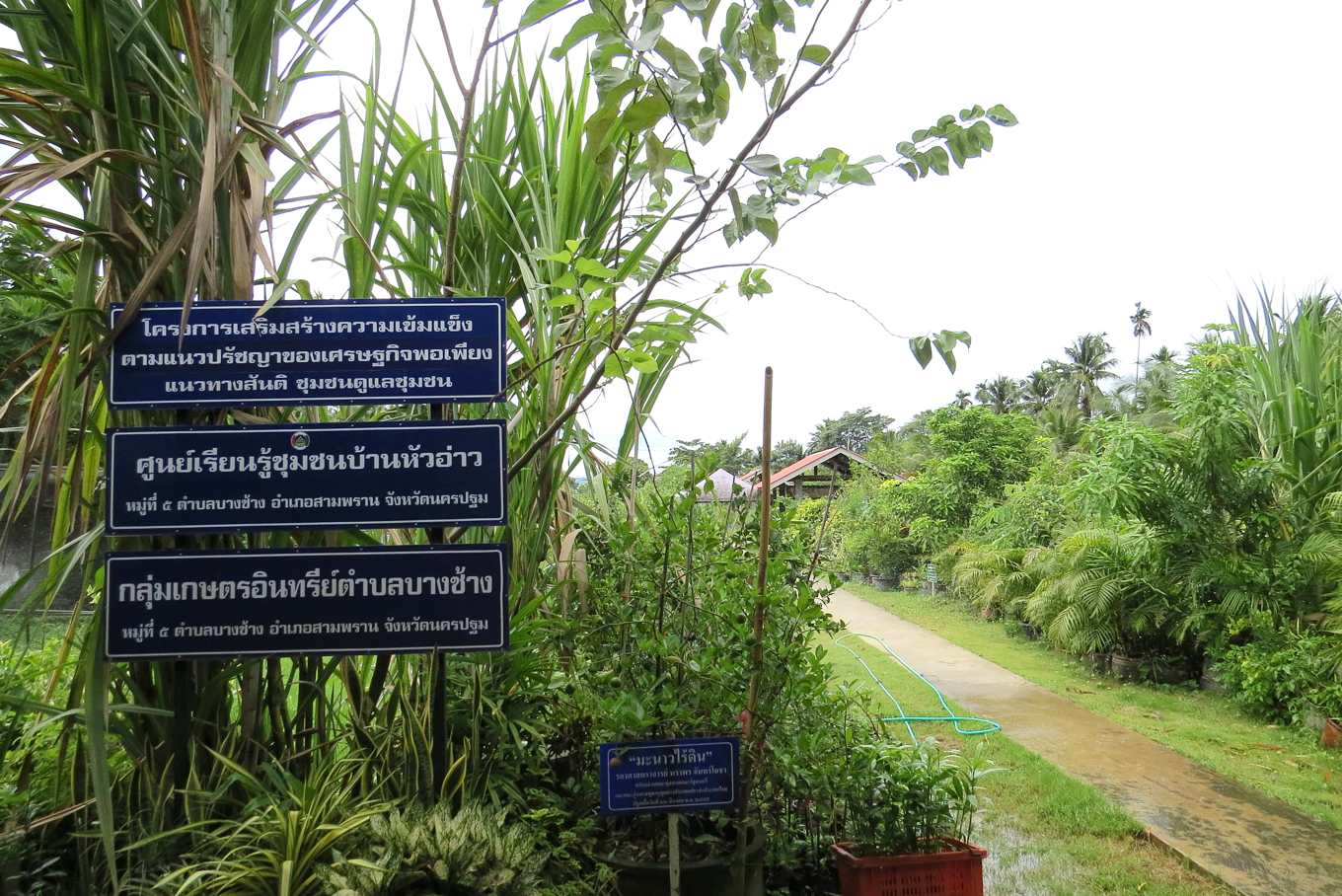
The first thing that came into view was the centre's three-tiered signboard. From top to bottom, it read "The community enforcement project under the sufficiency economy philosophy," "Baan Hua-aow learning centre," and "Baan Chang organic group (Baan Chang is an area within the Baan Hua-Aow community)." The three signboard names, from the three dimensions of spirit, space and organisation, cleverly and completely explained the rich content of what we were visiting.
(This article thanks Chen Chang-han and Orakarn Suttiwerawat for their assistance with Thai translation.)
The original text was published in Green Advocates Monthly, May 2018, issue 174