Beginner's guide to beheading succulents: 5 pieces of advice from a grower with 6 years of experience
Beheading succulents has many purposes: beheading can turn one into two and two into four; succulents that have grown leggy need beheading; succulents with black rot need beheading; beheading a succulent can also turn a single head into a cluster of heads. So how exactly should you behead your succulents? What issues should you pay attention to when beheading? Next, Little Exquisite Life will discuss each of these with you one by one.
1. Where to behead a succulent
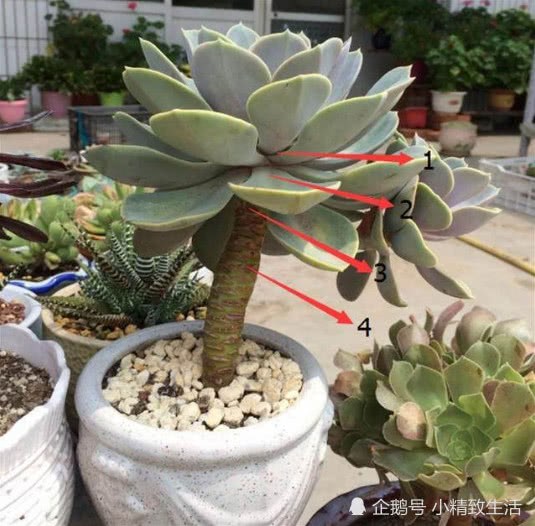
As you can see in the picture above, 4 beheading positions are marked, and beheading at each of these 4 positions leads to a different result. Beheading at position No. 1, also called "pinching the head," will make the mother plant rapidly sprout a large number of side shoots, a truly spectacular sight, but the head that is cut off will find it very hard to root again and survive; beheading at position No. 2 leaves a layer of leaves on the mother plant, so the mother plant can recover faster and will sprout side shoots, and the new head that is cut off can also root smoothly and become a brand-new succulent; at position No. 3, the head of the succulent is cut off completely, and the new head can root very easily, but the mother plant will produce very few side shoots; with position No. 4, the new head roots even more easily, but the chance of side shoots is even smaller, and the mother plant finds it very hard to recover. You can decide where to behead according to your needs: if you simply want rapid head clustering, you can choose position No. 1; if you want to propagate, you can choose position No. 2; for black rot and other diseases, choose the beheading position according to the actual situation.
2. The season for beheading succulents
Spring and autumn are the most suitable seasons for beheading succulents, as this is the peak growing season for most succulents; after beheading, the mother plant can quickly recover and grow side shoots, and the new head that is cut off can also root quickly. Beheading in summer, however, easily leads to black rot or turning to mush, so unless it is absolutely necessary, beheading in summer is not recommended.
3. Tools for beheading succulents
If you have access to one, a medical scalpel is recommended; if you cannot get a medical scalpel, a utility knife will also do. Scissors are not very recommended, because scissors have a crushing effect and can easily damage the tissue near the wound, which may very likely cause a large section to wither.
4. How to behead a succulent
After choosing the beheading position, remove a ring of leaves nearby, as this makes it easier to make the cut. Hold the succulent steady, and use a scalpel or utility knife to cut along the chosen position; after cutting, leave the mother plant in a ventilated, shady environment for a week, avoid getting the wound wet, and once it has recovered, care for it as normal. The new head that was cut off should also be placed in a cool, ventilated spot to air-dry until the wound is completely dry and has shrunk back before potting it up.
5. Potting up beheaded succulent cuttings
Now let's talk about potting up. When potting up the cut-off new head, if it directly touches the potting soil, it may get infected with fungus, fail to root, and then die. So the correct way to pot up a beheaded cutting is to make a small dip in the surface of the potting soil, with the width and depth of the dip such that the stem of the cutting is close to the potting soil but not yet directly touching it, then seat the succulent on top of the small hollow; that way, when new roots grow, they will actively burrow down into the potting soil on their own, and the stem will not rot from directly touching the soil. After potting up, it needs to sit in a ventilated, shady environment, and it will basically root and start growing in 2-3 weeks, at which point you can care for it as normal.
The above are some methods and points to note about beheading succulents; I hope they are useful to fellow enthusiasts.
Compiled and published by Little Exquisite Life.