How do you care for succulents? Let me teach you the correct care methods.
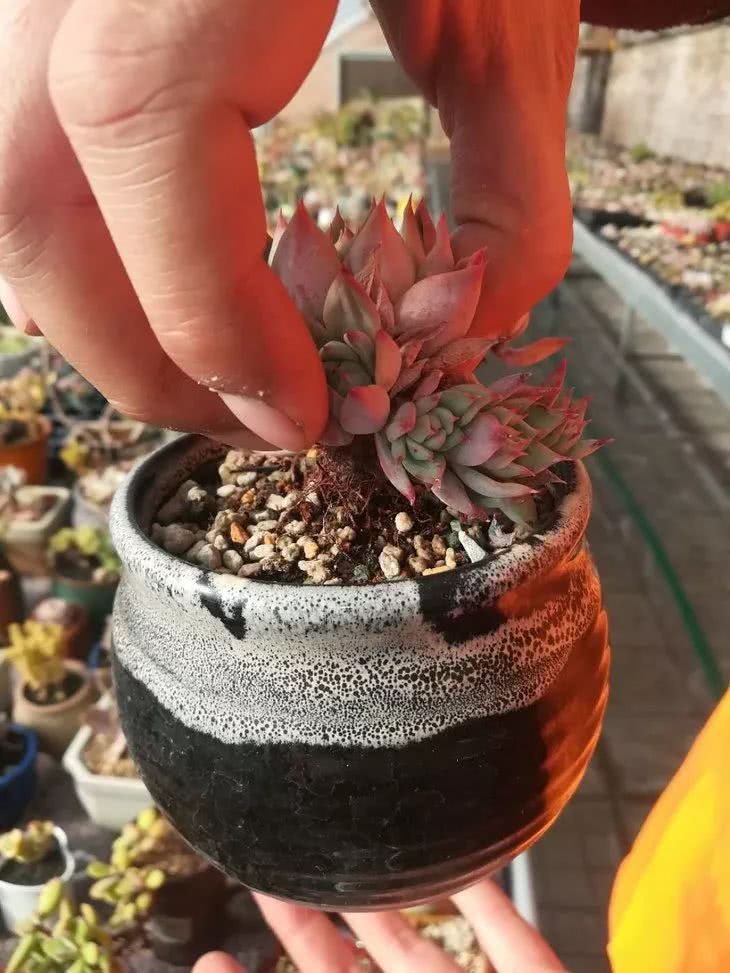
A few days ago, a good friend brought his wife and kid to wander around my greenhouse. While browsing, he seemed to take a fancy to one of my small clustered succulents and picked it up, holding it in his hands the whole time.
The moment I saw it, I snatched it right back and said to him, "The roots of this plant are already dead. I've been putting up with it for a long time and never got around to operating on it. Even if you took it home, you wouldn't be able to keep it alive."
Of course he didn't believe me. So, under the watchful eyes of several people and a phone camera, I dissected this succulent.
On the surface, the outer leaves of this succulent looked slightly dehydrated, there weren't many dead leaves, and there were quite a few withered aerial roots near the soil surface. You could lift the succulent and the pot would come up with it. Although its overall appearance wasn't very lively, it seemed like it could still scrape a passing grade.
When I tipped the succulent out, I found that some of the aerial roots at the bottom were still alive, and some had grown little white root tips. This seemed to show the succulent still had some vitality. But that still didn't change my conviction to trim the roots and repot it.
I pulled the succulent forcefully out of the pot. Sure enough, a large number of roots broke off in my hands. This showed that these well-developed roots had indeed withered and died.
Although these fallen roots were well-developed, they had clearly long since withered and died.
Pulling harder, I found that even the thicker main roots could be snapped off completely. It seemed this wasn't just a simple case of withered roots needing repotting. This situation called for the knife.
After clearing away all the roots, I prepared for surgery.
For a fairly thick stem like this, this kind of heading knife is the handiest tool. NO, this isn't scissors, this is a heading knife. The part my finger is pointing at is the blade; the other side has no blade and is flat, acting like a cutting board. This knife has been with me for over 2 years, the quality is rock solid, and it slices through heads like a breeze.
Since none of the roots were any use, let's just start operating on the main stem.
The color of the cut stem was not satisfying. Although it wasn't completely black, it was a typical color of tissue that had lost its vitality over a long time. With a stem like this, you basically can't hope for it to produce new roots.
Breaking off one of the offsets, you could see where the offset connected to the main stem. The color of the wound was dark, lacking the vibrant white of fresh tissue. It looked like I needed to keep cutting.
It stayed that sickly color the whole time. None of the 7 offsets could be saved, and I also broke off about 3 rings of leaves before I finally cut to a passing grade.
Here's another family photo, everyone can see how the stem color changed.
For the remaining little head, the stem still has 1 cm left. Let it dry. According to the formula for drying roots, this little head needs to dry for 10 days before planting to be safe.
Alright, the heading is done, not a single offset was saved, and only a bunch of little single heads are left. But the final result is still good: the succulent escaped the fate of death and ended up with more plants in the end.
Before being unpotted, this succulent could be lifted by the pot, and you could even see a few new roots. By rights it could have scraped a passing grade, so why did I cut it up without hesitation? What was my reasoning? Let's sum it up.
I had been observing this succulent for more than 3 weeks. During this period, I even made a point of increasing the amount of watering, yet this succulent not only showed no change, it even showed signs of becoming duller.
Growing succulents is like this: we provide the water and the overall environment for them to grow. If I firmly believe I haven't done anything wrong, then something must be wrong with the plant itself.
When tidying up the roots, if you don't check carefully, the main roots still look solid, but with a little force, the main roots break off from where they were growing. This shows that although these roots were still alive, they were barely alive, and they could no longer transport water upward. The few new roots were just the root tissue struggling on its own, already disconnected from the succulent above.
When making the first cut, your standard must be high. Many hobbyists, when heading a plant, have nothing to compare against and always feel that tissue like this can pass. To keep the offsets from falling off, they reluctantly try to root tissue that has no vitality. Such lifeless tissue naturally cannot root successfully.
Comparing all the cross-sections of the stem, you can tell from the color that the tissue was becoming fresher and fresher.
This is what I wanted to say today: you should spot hidden problems early through observation, then give the succulent a period of recovery. During this time, make sure there are no oversights in your care. If there is still no progress, then decisively take action and start messing with it.
That's my sharing for today. I hope it's helpful to everyone.