The flower language of the Siam tulip is trust, noble purity and elegance, and tranquility.
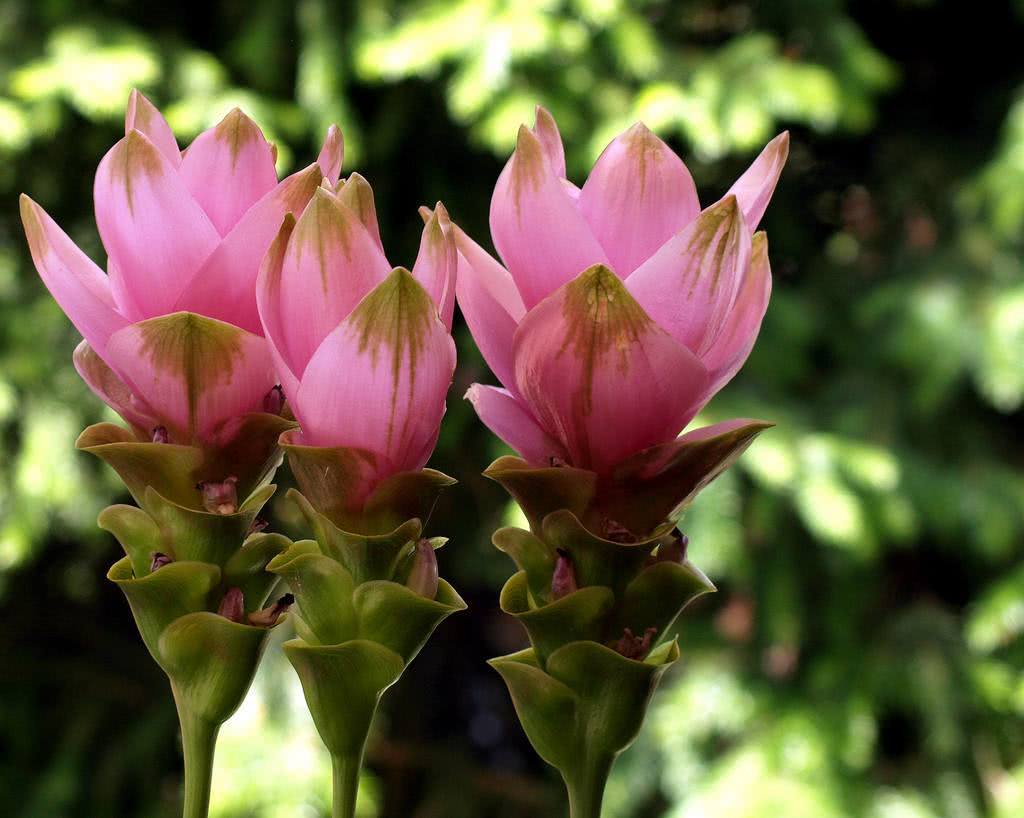
The Siam tulip is a perennial herbaceous plant in the ginger family (Zingiberaceae), genus Curcuma, a tropical bulbous flower native to the Chiang Mai area of Thailand, and is mainly used as a Buddhist flower. Because its pink bracts closely resemble a lotus flower and it belongs to the ginger family, it is called "ginger lotus" (Siam tulip). The Siam tulip has a spike inflorescence; the upper bracts are peach-red broad ovate sterile bracts, and the lower ones are honeycomb-like green bracts containing small purple-white flowers, with a flowering period from June to October. Because of its unique flower shape, bright flower color and long flowering period, the Siam tulip is highly favored by people in Japan and Taiwan, China, and small-scale cut flower cultivation exists in Guangdong, Fujian, Yunnan, Guangxi, Shandong, Zhejiang and other places in China. In recent years, Zhejiang has carried out garden, flower border and flower sea applications of the Siam tulip, and the related supporting techniques are mature.
Siam tulip
The flowering period of the Siam tulip is roughly from early June to the first ten days to mid-October, which is exactly the period when summer cut flower varieties and yields are relatively low, so it can just make up for the shortage of summer cut flowers. In particular, because its flower shape resembles a lotus and its flower color is pleasing, it is often used as a flower for worshipping gods and Buddha, so on the first and fifteenth days of each lunar month or on religious festivals, market demand increases noticeably, and there may even occasionally be a situation where supply falls short of demand.
The Siam tulip is named because its inflorescence stands gracefully and its pink bracts resemble a lotus flower; at the same time, because it is native to the tropics and its flowers resemble tulips, it is also called the "tropical tulip". It is a perennial bulbous herbaceous flower. The plant height is 30-80 cm, and the flower stem is usually taller than the leaves. Underground there are spindle-shaped or round spherical rhizomes, and the corms have two rows of opposite buds. The buds have a habit of growing toward one side, and multiple buds can be produced in succession, but after spring planting, usually the first first-generation bud sprouts first; this bud often has 5-7 leaves, and buds that grow later have only 3-4 leaves.
Siam tulip
As a new type of flower, plants of the genus Curcuma have very obvious advantages in garden applications: (1) large flowers and bright colors, unique flower shape, and both flowers and foliage can be enjoyed; (2) they generally bloom when the weather is hot in summer and autumn, which exactly makes up for the gap when other flower resources are relatively scarce at that time; (3) long flowering period. The natural flowering period of the Siam tulip is generally about 3 months, and the flowering period of Curcuma alismatifolia varieties is even longer; (4) fast growth. Curcuma flowers generally bloom about 100 d after planting, and artificial sprouting can also be carried out first before planting in the garden, which can significantly shorten the open-field planting time; (5) the seed bulbs do not readily degenerate. Unlike many other bulbs (such as lilies and tulips), the seed bulbs do not show degeneration and can be used repeatedly; (6) easy to cultivate and simple to manage. Propagation and cultivation mostly have no special requirements; as long as the cultivation season and methods are mastered and the necessary water and fertilizer management is carried out, they can grow and bloom normally, and pests and diseases are also relatively few.
Siam tulip
Because many Curcuma flowers come from tropical regions, in China, except for the southern coastal provinces, the seed bulbs cannot overwinter naturally in most areas. In East China, the seed bulbs are generally harvested and stored in November and December, and can be planted in the soil in April and May of the following year. In garden applications, the seed bulbs can be buried under grass or herbaceous flowers, and once the seedlings grow to more than ten cm tall, the faded herbaceous flowers can be removed; the plants can also first be cultivated at a flower production base, and before flowering the seedlings can be transplanted to arrange flower borders. This method is suitable for Siam tulip types with relatively shallow root systems as well as 'Solomon's Curcuma' and others. 'Red Torch Curcuma' has a relatively deep root system, so it is best to plant it in place; it can also be planted under grass or herbaceous flowers, and whether the grass and herbaceous flowers are removed or not is fine. In addition, they can first be planted in pots, and when they bloom, the pots can be moved together to arrange flower borders to meet the needs of various festival activities; long rectangular flower pots are ideal.