Introduction to the Echeveria succulent cultivar Prism
Text
Images: This Girl Is a Bit Sweet
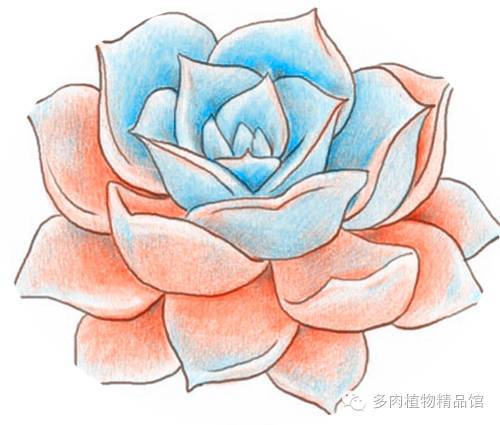
Prism, a succulent plant in the Crassulaceae family, genus Echeveria, tends to form clusters, leaf tips point inward, easily confused with TP, a small to medium-sized cultivar, plant in a rosette shape, leaves ovate, slightly thick, leaf underside with a slightly arc-shaped bulge, with ridge lines, leaf front tip acute, leaves powdery blue-green, leaf tips easily turn red. When Prism is in its colored state, the rosette is tightly wrapped, leaves plump and thick, leaf tips curve inward, the leaf tips and the outer leaf undersides easily turn red. Prism blooms in late spring and early summer, with a scorpioid cyme, small bell-shaped flowers, orange.
Growth habits:
Prism is robust and not difficult to care for. During the spring and autumn growing seasons, give as much full light as possible; with sufficient light, Prism's rosette can be more compact and plump, and the color more powdery and beautiful. If light is insufficient, the center of the plant easily spreads open, losing Prism's characteristic wrapped form.
Care method:
During the spring and autumn growing seasons, Prism can be watered thoroughly; when the potting soil is about 70-80% dry, water thoroughly. Avoid prolonged complete drying. During the rainy season, avoid prolonged rain exposure to prevent waterlogging and leaf rot. Prism is not difficult to get through summer; in summer, provide appropriate shading, ventilation and water control. Avoid a stuffy hot environment, avoid long-term damp potting soil, and avoid water accumulating in the leaf center.
Soil mix:
Choose a loose, breathable medium, such as peat/coco coir, granular soil, at a ratio of about 55. Prism can be propagated by leaf cuttings or stem cuttings, preferably done in spring and autumn. Generally, when choosing a pot for succulents, it should not be too large or too small. Just 1-2 cun larger than the plant's diameter is fine.
Differences between Prism and Tippy (TP):
Prism and Tippy actually still have obvious differences. When Prism is in its colored state, the leaves feel relatively shorter, the rosette is very wrapped, the leaf tips curve inward, and the color is more powdery blue-green. Tippy's leaf shape is longer, like radiating outward, the outer leaves cannot wrap up, and the color feels more green. But a Prism that has been grown thin will look quite similar to Tippy.
Tippy
Prism
This article was compiled by the Succulent Plant Boutique Gallery. Copyright belongs to the original author. For some articles, the source cannot be identified and is marked as sourced from the internet. If there is any infringement, please contact us immediately and we will handle it promptly.