What is the green sprite that dots the lawns of South China?
May in Shenzhen has already entered the rainy season, with torrential rain every day for a week straight. It has been a long time since I last saw sunshine, and my mood is not as bright as usual.
One morning, while walking in the small park next to my residential compound, I passed by the bamboo fence beside the lawn and was suddenly greeted by a plant whose name I had never known before, now sending up a flower scape, on which the first small olive-green flower had bloomed, along with many buds yet to open. Oh! My heart surged with excitement - so this was Eulophia graminea! Instantly my mood soared sky-high, and even my footsteps felt much lighter.
Liuliuqing
This is the third time I have seen Eulophia graminea in bloom. The first time was at the foot of Wutong Mountain; I did not know what flower it was then and merely glanced at it before hurrying past. The second time was in a parking lot green belt in Qianhai, where four Eulophia graminea flower scapes grew together, tall and striking. I never expected to find its lovely figure right at my doorstep this time.
Eulophia graminea in the parking lot green belt, its flower scapes actually taller than the shrubs
Eulophia graminea (Eulophia graminea) may not be well known to plant enthusiasts in the north, but for plant lovers in South China, it is one of the famous "three treasures of the lawn" in the orchid family. The other two treasures are Zeuxine strateumatica and Spiranthes sinensis. Some also call them the "three rascals of the lawn" - the reason they are called the "three rascals" is that they are not as noble as the orchids in people's impressions, but rather are very down-to-earth orchids that are easy to grow and easy to see.
In this small park at my doorstep, in early spring during February, one could often see small Zeuxine strateumatica sprouting from the grass, growing humbly, so inconspicuous that you might not even notice their existence. Before that, I had never seen Eulophia graminea or Spiranthes sinensis, until last winter when I saw Eulophia graminea there for the first time - though at the time I did not recognize it. As for Spiranthes sinensis, a flower enthusiast who grew up in Guangdong said that she often saw Spiranthes sinensis as a child, but now it is very hard to find them in the city, largely because the landscaping workers are too diligent - as soon as Spiranthes sinensis starts to grow, it faces being mowed down or pulled up.
Eulophia graminea with long leaves Liuliuqing
Checking the electronic edition of Flora Reipublicae Popularis Sinicae, I learned that Eulophia graminea is a plant of the genus Eulophia in the orchid family, with about 200 species worldwide and 14 species in China. Besides Eulophia graminea, there are also Eulophia zollingeri, Eulophia yunnanensis, and others. Specifically for Shenzhen, the electronic edition of the Flora of Shenzhen records only two species: Eulophia graminea and Eulophia zollingeri, and what we see in the city is basically the species Eulophia graminea itself.
Like many orchids, Eulophia graminea has conical or spherical pseudobulbs, resembling a lone garlic bulb. The first time I saw it in the small park was in winter, when it had 3-5 long leaves and had not yet bloomed. I did not know it was Eulophia graminea and thought it was just an ordinary grass. So I always found it very strange that this grass had such ordinary leaves - how could its base bulge out so large? This question puzzled me for a long time, and now the mystery is finally solved. The large pseudobulb is also a key identifying feature of Eulophia graminea; in most cases, the pseudobulb is green and partially exposed above the ground.
Pseudobulb and withered leaves
Pseudobulb hidden in the turf and newly emerging flower scape
Eulophia graminea blooms from April to May. In most cases, the flowers and leaves of Eulophia graminea do not meet - when the flowers bloom, the leaves have already withered, and the flower scape grows out from the side of the dead leaves. Not long after the flowers wither, the leaves will grow again.
In most cases, Eulophia graminea blooms without leaves Liuliuqing
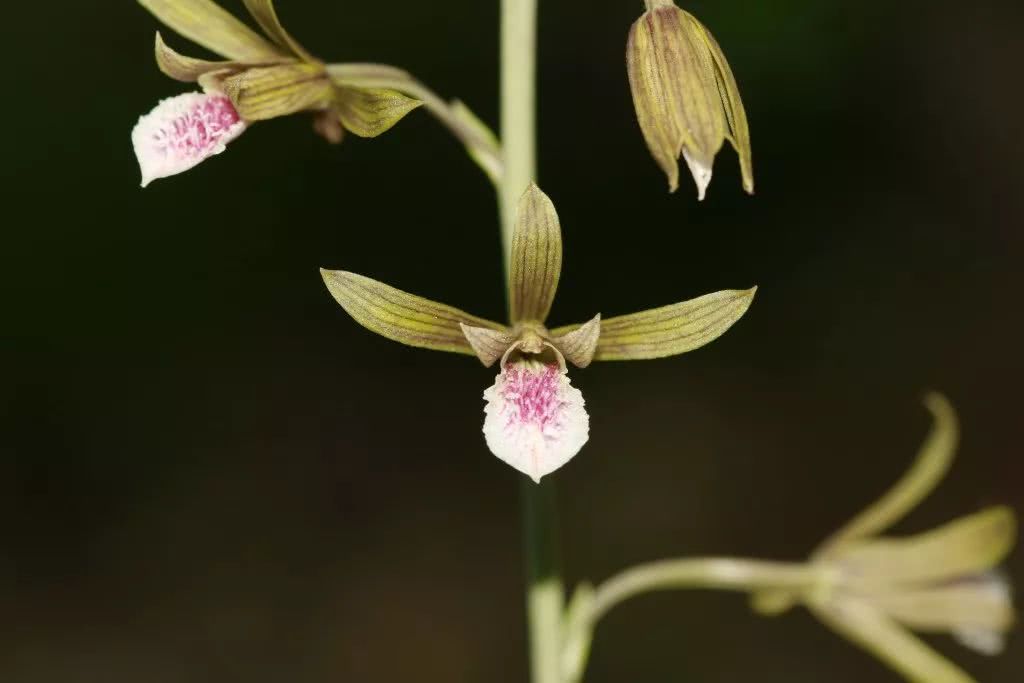
The flower scape of Eulophia graminea can grow to 40-60 cm tall, densely covered with flowers. The flowers are not large, olive-green, with two lateral sepals and three sepals - the lateral sepals slightly longer. The sepals all have yellow-brown stripes, while the lip is white with purplish-red lamellae. If observed from the side, one can also discover its small spur, which curves slightly downward.
-Chao-
Although Eulophia graminea is a "weed" in urban lawns, I think its beauty is elegant and wild, standing aloof from the world, with the bearing of a mountain orchid; its beauty is also slender - tall flower scapes, several stalks growing together and standing gracefully, like a jade tree in the wind.
-Chao-
The next morning on my walk, I came to visit this Eulophia graminea again, hoping to see it open a few more flowers. Unfortunately, whether from wind and rain or from someone bending it, the flower scape was tilted. I used the black string from the nearby bamboo fence to straighten and secure it, hoping it could return to its original appearance. But when I came back in the evening, the upper half of the flower scape had been ruthlessly broken off by someone, completely snapped away, leaving only the lower half - I could not help but sigh. Indeed, "the tall tree in the forest is the first to be destroyed by the wind" - it grew under the fence by the path, too conspicuous.
Fortunately, on the third day, I found another Eulophia graminea among the spider lily clumps in the small park. Its long flower scape was somewhat lodging, mixed in with the spider lily leaves, and it was hard for most people to see its flowers, so it survived. Luckily, this Eulophia graminea was at the end of its flowering period, with both flowers and fruits on the scape, so I could observe its fruit - the fruits were very plump, like little drumsticks. I quietly put the flower scape back in place, did not disturb it again, and hoped the landscaping workers would not disturb it either - just let it stand aloof from the world...
The surviving Eulophia graminea in the park
Eulophia graminea fruit Liuliuqing
Observing Eulophia graminea is a very joyful process - you never know where they will be or when they will suddenly appear before you. Just as a British plant enthusiast described in the CCTV documentary "China's Wilson": "These green leaves and flowers give me peace; this place brings us tremendous joy."
Ordinary as Eulophia graminea is, the great hermit hides in the city. Blooming in early summer in South China, it is like a green sprite, dotting the lawn and adorning our lives.
Author: Xuehua Fangfei
Images: Xuehua Fangfei, -Chao-, Liuliuqing,
Thanks to -Chao- and Liuliuqing for kindly providing images
This work is licensed under the (CC BY-NC-ND 4.0) license agreement. Please retain this statement when reposting.
iPhone users can tip the author via the QR code below