Succulent commodity prices keep falling, which varieties are worth buying?
The price of one pot of succulents last year can now buy two pots this year.
Succulent prices have dropped, and commodity varieties are half price.
Last year Pachyphytum 'Bainesii', Opalina, Green Apple and the like cost 50 to 60 yuan, now they are 13 to 20 yuan.
Succulents that cost five or six hundred yuan last year can now be bought for 100 yuan.
The difference between what we call commodity varieties and expensive varieties lies in how they are cultivated.
High-end varieties with high ornamental value propagate slowly and suit a niche group of people.
The cheap ones cost only a few yuan, while the expensive ones can cost thousands or even tens of thousands of yuan, and their prices remain stubbornly high.
In the future the succulent market will clearly polarize into two extremes.
So, today let us look at which commodity varieties are suitable to buy now:
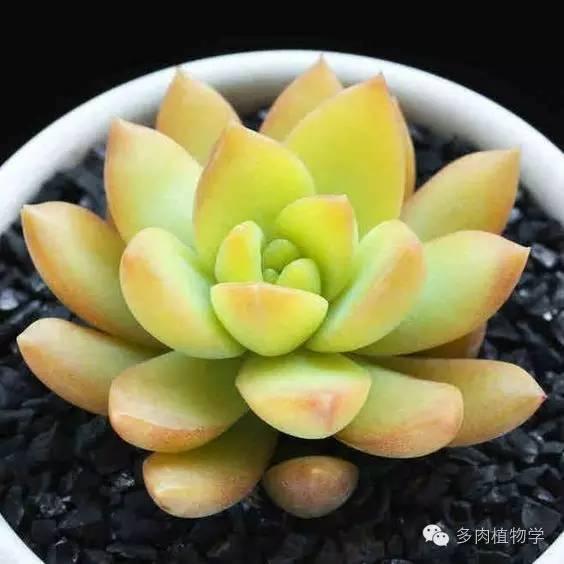
Sedum adolphi 'Golden Glow'Among all the commodity succulents, I think Sedum adolphi 'Golden Glow' is quite outstanding. Plant a single rosette in a pot, and after growing it for a while it easily develops its best coloring.
Multi-headed ones also easily grow into old clumps.
Whether they are green or yellow, they each have their own unique beauty.
Cotyledon tomentosa (Bear's Paw)From late spring onward, I stopped caring whether it was in good condition or not. I put it in a sunny spot, and whenever I felt the soil was dry I watered it. A beheaded seedling that originally had only 3-5 leaves now has countless leaves.
Cotyledon tomentosa is fairly easy to grow in summer. I deliberately placed one large pot and two small pots on the bay window. After the summer solstice I basically never opened the window, the sun shone directly during the day, and at night the air conditioning was on indoors, so the day-night temperature difference was large. Whenever they were thirsty I gave water. Although the small ones are bright green without red claws, they are very plump. The large one has a bit of red claw and is also very plump.
As long as the soil drains well, you avoid watering when the sun is out, and you pay attention to the temperature difference, they will all live well.
Graptoveria 'Titubans' (White Peony)Its growth rate is astonishing and its propagation ability is especially strong. It really grows into an old clump very quickly. Its appearance is also very likable.
Sedum rubrotinctum (Jelly Beans)To be honest, I personally do not like Sedum rubrotinctum that much, it just does not appeal to me.
But I recommend it to everyone because it is very easy to grow and its propagation ability is also very strong. Any single leaf that drops off can grow on its own, and its growth rate is astonishing too.
When it colors up it turns red, and growing into an old clump is just around the corner.
Sedum 'Rain Heart'Haworthia cooperi (Haworthia)I hope beginners can start by growing a small Haworthia. Do not worry about which variety it is, just get hands-on and give it a try first.
At first you may experience things like the color darkening and the leaves being especially thin. As long as you can rescue them when problems arise, afterward they basically need little care and can all look lovely.
A Haworthia that has just settled into its pot will show various problems. Try to place them where direct sunlight cannot reach, then gradually move them to a spot with bright indirect light, and after that just put them directly in direct sunlight. From then on they can grow toward the sun. (Except for outdoor growing in summer.)
Remember you cannot let them go thirsty, or they will get angry.
Sedum pachyphyllum (Jelly Bean Plant)Sinocrassula yunnanensis (Chinese Sedum)Echeveria 'White Phoenix'Echeveria 'Lola'Dudleya (Liveforever)Graptopetalum 'Rusbyi'Pachyphytum 'Peach Beauty'
Crassula perforata (String of Buttons) / QianchuanCharacteristics of Qianchuan: the leaves are rounded with an obvious curve; when water and fertilizer are sufficient the leaves become even plumper and the leaf tips are no longer obvious.
Echeveria laui (Snow Lotus)Snow Lotus actually has a fairly high survival rate from leaf propagation. When I first started growing succulents I heard that Snow Lotus had a low survival rate from leaf propagation, so I did not dare try. It was only after I tried once later that I found it was not scary at all!!
Kalanchoe tomentosa 'Black Rabbit Ears'It grows very fast, and being fuzzy makes it very cute too.
Echeveria 'Little Red Riding Hood'Sedum japonicum 'Tokyo Sun'Cotyledon papillaris 'Daruma'Echeveria glauca (Blue Echeveria)
Echeveria 'Ice Berry'Echeveria 'Chihuahuaensis'Echeveria 'Red Makeup'·END·
"Succulent Botany"
The most academic WeChat public account in the succulent field
Cute Succulent News | Expensive Variety Cute Photos | Succulent Growing Tutorials | Disease Research | Leaf Propagation Exploration
Cooperation WeChat ID 343660451