How to sow petunia seeds? Detailed guide to sowing methods and key points
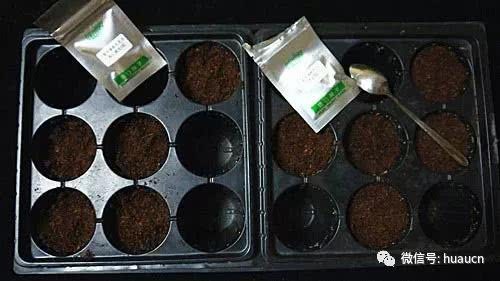
Many gardening enthusiasts have asked about how to sow petunia seeds, hoping for as much detail as possible. Below, a gardening enthusiast has recorded the sowing process based on years of experience growing petunias, which is very helpful for fellow gardeners.
Because petunias grow rapidly, it is best to choose a larger seedling tray or small flower pot for sowing. I used a 6*6cm seedling tray, which can be used all the way until the seedlings are ready for transplanting.
Petunia: Petunia growing and care methods
1. Transplanting
Before sowing petunias, first moisten the sowing soil (do not make the sowing soil too wet; "soaked through, moistened" means it is best when you can't squeeze water out of it). When sowing, you must place one seed per cell to avoid damaging roots during later seedling separation. Many gardening enthusiasts have asked: how do you manage one seed per cell? Prepare a pair of pointed tweezers, and you can easily pick up pelleted seeds.
If the seeds are not coated, first moisten a toothpick with water, then use the wet toothpick (without excess water) to pick up one seed and place it in the seedling cell -- also quite easy, right?
After placing pelleted seeds on the surface of the cell soil, use a dropper to drip a few drops of water (two or three drops will do, do not use a spray bottle, use a dropper), and the coating will dissolve. This allows earlier germination and ensures the germination rate. Petunia seeds are not covered with soil when sown. You can cover with a lid, but it needs to be opened for one hour each day for ventilation.
2. Misting
Before germination, mist water every day to maintain a certain humidity, which helps the seeds germinate. Use a small spray bottle for misting, with a fine, dense spray to avoid washing the seeds away. Do not fill the soil in the seedling cells too full at first; if the seedlings become leggy, you can add more soil to prevent them from falling over.
3. Watering
If you want to harvest a flower ball in the future, you must first make the seedlings strong, so management during the seedling stage is very important. As we know, the roots, stems, and leaves of plants are vegetative organs, with functions of absorption, storage, transportation, and assimilation. Whether a seedling is strong depends on whether its root system is well developed.
My criteria for deciding whether to water are:
Look at the color of the surface soil in the seedling cell becoming lighter, which means water only after the surface soil has dried. Look at the photo below; the one in the red circle has just been watered, and its color is noticeably darker than those on the left and right.
Taking my home as an example: northern China, indoor heating, enclosed balcony, 5~6 hours of light per day. At night I put them indoors, and during the day I put them on the balcony to sunbathe. Because I used large seedling cells 6cm high and 6cm in diameter, plus Beijing had 7 consecutive days of smoggy weather after sowing, I basically did not water during the 10 days after sowing.
Dry conditions grow roots, wet conditions grow stems -- this is a truth I remembered from the moment I started growing flowers.
4. Sunlight
After the seeds germinate, they can be exposed to sunlight. At this time, be sure to give more sunlight and water less, which helps the seedlings establish a strong root system. The frequency of watering should be comprehensively considered based on different environments, seasons, and the size of the seedling cells, among other factors.
Petunia: Common pest and disease control for petunias
5. Fertilizing
I do not advocate fertilizing too early; that only amounts to pulling up seedlings to help them grow and is counterproductive. Generally, start 3~4 weeks after emergence by sprinkling a few granules of mini Osmocote. This slow-release fertilizer has an NPK ratio of 12-11-17, and also contains magnesium and other trace elements, which can promote root growth and prevent salt sensitivity in seedlings. When the seedlings are a bit larger, you can apply some 1:1000~1500 diluted Peters Professional every ten days to half a month.
Remember: apply light fertilizer frequently.
·END·
An interactive platform for flower growing, planting, and green plant enthusiasts to exchange ideas, show off, and brag. An online home for sharing flower cultivation methods and household plant-growing tips. A fresh flower subscription platform.
Fresh flowers: hyacinth|stock|plum blossom|carnation|camellia|kalanchoe|jasmine|gardenia|peach blossom|balloon flower|osmanthus|calla lily|lily|forget-me-not|clivia|apricot blossom|honeysuckle|milan|peony|sunflower|chrysanthemum|serissa|crown of thorns|tulip|narcissus
Green plants: poinsettia|money tree|pothos|spider plant|alocasia|lucky bamboo|asparagus fern|aloe|English ivy|anthurium|monstera|bougainvillea|silk tree|peace lily|schefflera|boxwood|sago palm|rubber plant|maidenhair fern|snake plant|
huau.cn
……
Search the public account "Flower Friends" or "huaucn" to get the latest information
Business cooperation, promotion. Please contact WeChat private ID:ihuaucn