Wild Cymbidium faberi can also have shorter leaves without hormones or chemicals
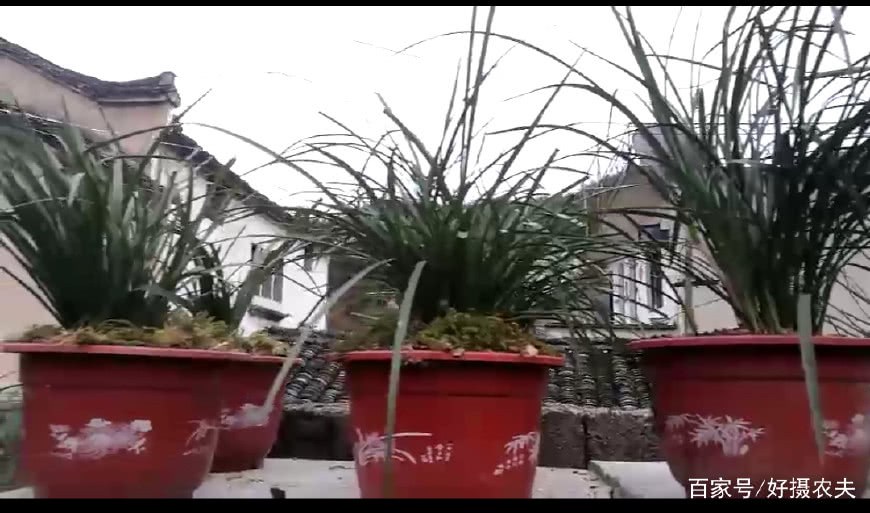
This is a screenshot from a short video taken in early April this year. Sorry, I didn't take photos at the time, so the screenshot isn't very clear. Can you tell which pot is Cymbidium goeringii and which is Cymbidium faberi? In fact, most orchid growers would misidentify this picture. The two short pots on the left are Cymbidium faberi, while the tall pot on the right is actually Cymbidium goeringii.
Usually, we understand that Cymbidium faberi has tall, large leaves, while Cymbidium goeringii has relatively short, small leaves. But did you know? Their leaves can be changed through acclimatization, and this starts with the growth habits of orchids. Everyone who grows orchids knows the saying "shade grows leaves, sun strengthens roots," but have you truly understood this saying? Haoshe Farmer will tell you through personal experience.
The pot of Cymbidium goeringii on the right was found by the farmer on a mountain this year. At the time, it was growing in a patch of woods, and this patch of woods has now been cut down. The trees were very tall, and its growing location was very shady and damp. Growing in this kind of environment, this Cymbidium goeringii had to strive desperately for sunlight. We know that orchids are plants that need sunlight, so it could only grow its leaves as long as possible. This is somewhat similar to slender tall trees in dense forests.
The two pots of Cymbidium faberi on the left, however, are acclimated plants that have been cultivated for two years. When they were first collected from the mountain, their leaves were also very long, and they had likewise been growing in woods. After being brought down from the mountain, the light conditions changed, and they received more sunlight (I have always kept them outdoors). The leaves of the newly sprouted growth afterward were not as long as before, but the leaves felt more vigorous, not in that loose, sprawling form.
Regarding "shade grows leaves, sun strengthens roots," it is actually just like cacti in the desert and vines in tropical rainforests: one, in order to reduce evaporation, must evolve small leaves and deep roots; the other, in order to compete for sunlight, evolves large leaves.
Many orchid growers, when talking with Haoshe Farmer, say they like Cymbidium faberi with short leaves. In fact, its leaf type can be completely changed through artificial acclimatization. The method is very simple. If you master it well, the leaves can look better, and short leaves are not easy to break, while the flower stems emerging from the clump look more beautiful.
1. Increase light. Of course, do not expose them to the sun between 11 a.m. and 3 p.m. in summer; that is no fun. Increasing light is the most direct way to dwarf the leaves.
2. Appropriately apply more phosphorus and potassium fertilizer. You can spray the leaf surfaces with monopotassium phosphate (as mentioned before), and you can also use a diluted superphosphate extract as fertilizer.