Often mistaken for red beans, one of the world's five most toxic plants: eating half a seed causes poisoning, do not pick it
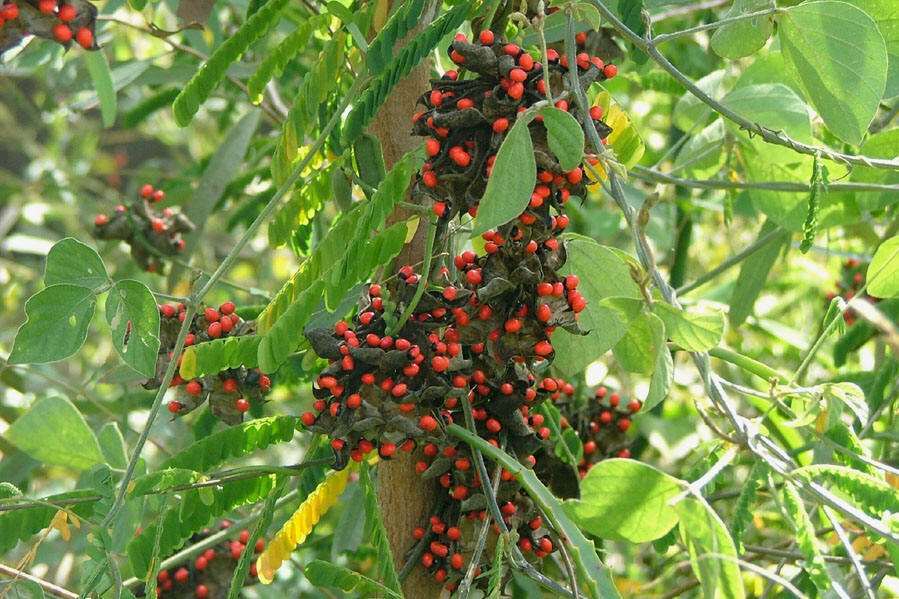
Everyone has heard the famous poem "Yearning" by the Tang dynasty poet Wang Wei: "Red beans grow in the southland, how many branches spring forth when spring arrives. I wish you would gather more of them, for this thing best represents yearning." This poem gave red beans a special meaning, representing love, representing the feeling of yearning. Many people think the red beans mentioned in the poem are the adzuki beans we commonly eat in daily life, but the truth of this remains to be verified. Because in the south, three kinds of beans are all called red beans: adzuki bean, sea bean (Adenanthera pavonina), and rosary pea (Abrus precatorius). Among them, only the adzuki bean is edible; the other two are not, and the rosary pea is also highly toxic.
The rosary pea is mainly produced in tropical regions and is commonly seen in the Guangdong and Guangxi regions of China and Yunnan. Its flowering and fruiting periods are similar to those of red beans, so it is easily mistaken for red beans, but on closer inspection, you will find they are very different. One third of the rosary pea's seed is black, so farmers also call it "mandarin duck bean", "black-headed chick", "ghost eye seed" and other names. For local farmers, this is a highly toxic plant passed down by word of mouth, and they generally do not touch it.
The reason the rosary pea is toxic is that it contains a toxic substance called "abrin", and just 3 micrograms can be fatal, while the toxin contained in one rosary pea is greater than 3 micrograms. Eating half a seed will cause poisoning, so it is quite dangerous. But do not worry too much, because the seed coat of the rosary pea is very hard, and touching it will not cause poisoning; only if you chew it up and swallow it will you be poisoned. This toxin is also very harmful to animals, especially horses, which are extremely sensitive to it; 15 grams will cause poisoning. So if you see it, do not eat it as a red bean, and do not feed it to animals.
But the rosary pea is not entirely useless. Because of its bright colors, the red and black colors are very special, and it is often processed into bead string ornaments, which people love. However, this highly toxic thing is always specially processed, and it is not recommended that you process it yourself, because it is said that in Africa, when a worker was processing rosary peas, he accidentally pricked his finger, causing poisoning and death. But this kind of handicraft is also very rare. I remember seeing someone selling it when I was a child, and now I have never seen it again.
The rosary pea is one of the world's five most toxic plants, ranking second. The first is the castor bean. They are relatively common in rural areas, so if you see them, do not pick them.