How to grow and care for a Murraya paniculata bonsai, and points to note
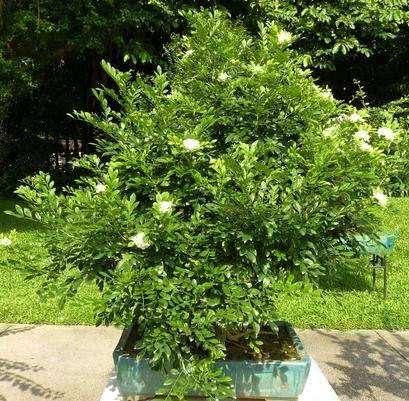
I don't know whether you have heard of Murraya paniculata before. Many people may not have, but you have heard of qilixiang, qianlixiang and wanlixiang. Actually, let me tell you a secret: those are all other names for it. Besides the ones just mentioned, it has many other names too, some of which may sound familiar, while others you have never heard of at all.
Whether or not you have heard of it, today I will take you to get to know it. To know it, understanding its appearance is essential. The color of the branches depends on whether they are new growth of the current year: if so, they are green; otherwise, they are gray. The two sides of the leaves are basically asymmetrical, and the leaves are obovate. The flowers are mostly white and umbel-shaped. That is a rough picture of its appearance. Now let's talk about its growing conditions.
First, in our Chinese tradition there has long been the theory of yin and yang and the eight trigrams. Murraya paniculata belongs to the yang, so it is not suitable for places that are in shade all year round. It needs plenty of suitable sunlight, and the best temperature is between 20 and 32. If it is too cold in winter and the temperature outside is only a few degrees above zero or even below zero, move the bonsai indoors to warm up, otherwise it may freeze to death. You may see roadside trees in winter wrapped in a thick layer of rope by sanitation workers; that is to keep them warm.
Watering and fertilizing Murraya paniculata need to be used together. After each fertilizing, it must be watered. It is like people: you cannot just give them food without water, nor just water without food. Both are very important and neither can be left out.
But both need to be in the right amount. Whichever it is, too much or too little is unsuitable. As for fertilizing, it is especially worth reminding that you must wait until the fertilizer is fully decomposed before applying it, and the fertilizer must be diluted. For a new bonsai that has not yet grown roots, do not fertilize it.
Basically all bonsai are pruned to make them grow more beautifully, and Murraya paniculata is no exception. General pruning is nothing more than cutting branches and pinching out buds, and so on. All this pruning is done so that it grows more luxuriantly and greets visiting admirers with a more graceful form. However, when pruning, be careful not to accidentally cut it bald, which would be very awkward. Try to learn to be a deft-handed person; pruning a bonsai is a technical job that shows craftsmanship.
Also, the most headache-inducing thing about growing a bonsai may be the problem of pests. You cannot just spray pesticide from time to time and leave the house smelling of it. In this respect, prevention is key. Just as people fall ill only when they have to, the emphasis is on usual preventive measures. So providing a good growing environment is especially important.
Besides these, is there anything else you would like to know? If so, your comments are welcome.