Succulents so plump and translucent they look like jelly - perfect for windowsill growers
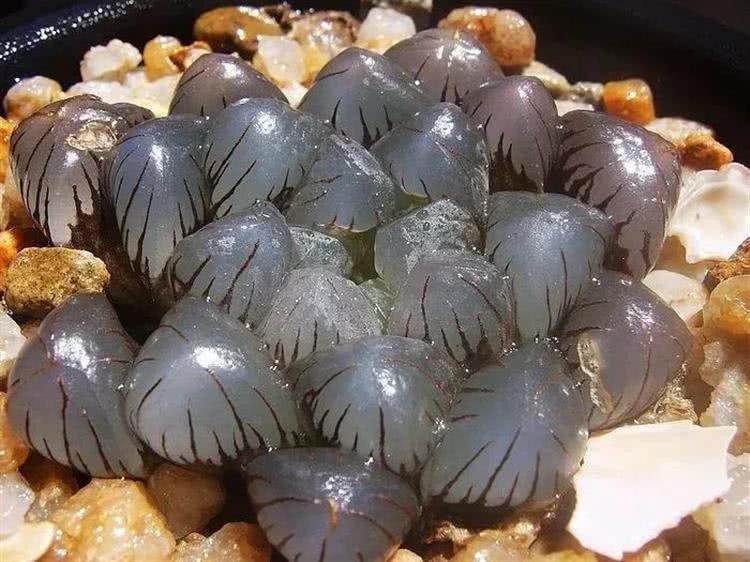
[Guide] Plump and juicy Haworthia cooperi, want to get to know it?
Many people like succulents, but because of environmental issues, they keep putting off growing them, such as office workers, students, etc. After all, most succulents have relatively high light requirements. However, some succulents are very well suited to being grown on windowsills, balconies and similar spots - namely the Haworthia genus succulent Haworthia cooperi!
Haworthia cooperi comes in a rich variety of types, with crystal-clear leaves whose bright windows look like living works of art. It is a succulent star that everyone loves. Succulents need light to grow, but Haworthia cooperi does not need light the way Crassulaceae succulents do, making it a succulent very well suited to indoor growing. Today let us go through the members of the Haworthia cooperi family that show up most often, one by one.
Purple-skinned Haworthia cooperi
Purple-skinned Haworthia cooperi is essentially a general term for a type of succulent. If broken down further, it can be divided into two kinds: large purple-skinned Haworthia cooperi and small purple-skinned Haworthia cooperi. The biggest difference between the two lies in the size of the window surface. As the name suggests, the large purple-skinned Haworthia cooperi has a fleshier and thicker window surface than the small one; everything else is completely identical. The colour is a noble purple, but if it is exposed to the sun for a long time, the colour of purple-skinned Haworthia cooperi will turn somewhat black.
Large-window Haworthia cooperi
Large-window Haworthia cooperi - just from the name you know its window surface is very large. In fact, large-window Haworthia cooperi is a hybrid succulent variety, mostly a nearly transparent green in colour, very beautiful. But because its window surface is so large, it often grows in a rather scattered way. Still, whether viewed up close or from afar, large-window Haworthia cooperi is very beautiful.
Cicada Haworthia cooperi
Cicada Haworthia cooperi has a smaller window surface, thin as a cicada's wing. Its markings are crisp and clean, and it tends to stretch out (etiolate) only slightly.
Hime Haworthia cooperi
Hime Haworthia cooperi is the most common Haworthia cooperi on the market today, and it also comes in large and small succulent types. The large Hime Haworthia cooperi has a larger window surface, the small one a smaller window surface. It is worth noting that the colour of Hime Haworthia cooperi is a bright green, not the purple of purple-skinned Haworthia cooperi.
Round-headed Haworthia cooperi
The window surface of round-headed Haworthia cooperi rivals that of large-window Haworthia cooperi; its window surface is also very large. The only difference from large-window Haworthia cooperi is that the tip of round-headed Haworthia cooperi is more rounded, with sparse fuzz and a smooth, fine window surface.
Grass Haworthia cooperi
Grass Haworthia cooperi has a rough window surface and looks as ordinary as grass. Though it does not look particularly refined, it still has its own charm. Grass Haworthia cooperi clusters easily and stretches out (etiolates) only slightly.
Haworthia cooperi 'Shou'
Haworthia cooperi 'Shou' is a hybrid of Haworthia cooperi and Haworthia retusa. It is basically green, similar in shape to grass Haworthia cooperi, but it has fuzz, and its window surface is rougher than that of grass Haworthia cooperi. So far no purple Haworthia cooperi 'Shou' has been found.
Ice Lantern Haworthia cooperi
Ice Lantern Haworthia cooperi is a relatively rare succulent type on the market lately. Its ice-clear, jade-pure appearance is deeply loved by everyone, and its form looks like ice-carved lanterns gathered together, very beautiful and moving.
Because Ice Lantern Haworthia cooperi has thick cells and releases heat slowly, in summer take care not to expose it to long periods of high-temperature sun. Normally place it in a cool spot with good indirect light. When watering, water only when the soil is dry, and water thoroughly when you do. The most suitable growing temperature for Ice Lantern Haworthia cooperi is 15-28°C; above 35°C or below 5°C will harm its growth.
Fellow succulent lovers, have you grown crystal-clear Haworthia cooperi? Of the several succulents above, how many have you grown? Do you think Haworthia cooperi is easy to grow? Is it really well suited to balcony growers and windowsill growers?