Add a little vinegar when watering succulents, and the leaves will easily change color and look even more beautiful
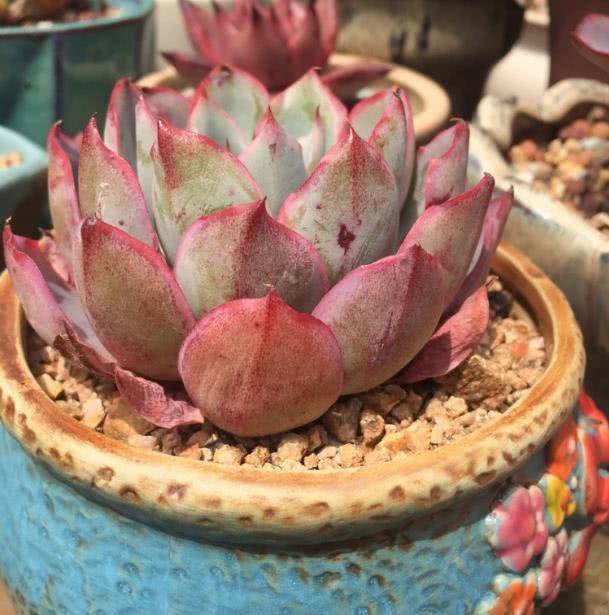
There are many ways to make succulent leaves more beautiful. Generally speaking, a large temperature difference is the fastest, but improving the soil's pH is also possible. Mix white vinegar with water, and succulents really can change color. Since white vinegar is relatively easy to obtain, economical and useful, if you grow some rather special types of succulents, such as the stacked-stem types that prefer fairly strongly acidic soil, you can consider diluting white vinegar 100 times and caring for them separately.
Granular soil substrates also have the effect of improving alkaline soil, such as akadama, pumice, volcanic rock, perlite and other substrates. The greatest advantages of akadama are low fertility, slight acidity, good aeration and water retention. These four points have almost already met the physiological needs of most plants, and for the physiological characteristics of succulents, it is almost a perfect match. When ordinary beginner growers use akadama for succulent cultivation, they can grow them well without much guidance. Therefore, akadama can also be called "foolproof soil." Its characteristics greatly lower the threshold for succulent cultivation, and coupled with its price being neither high nor low, akadama can also be said to be an important factor promoting the rapid development of succulents in China.
If you want succulents to look good, you need low temperatures combined with light. Succulents color up best in winter and early spring. After summer, they go through a period of recovery. When low temperatures arrive, they grow more slowly, their form becomes more compact, and the color also comes out. This is exactly when the succulents are at their most beautiful. In Suzhou, the most beautiful season is often around March. But specifically, it still depends on each person's different growing environment, the weather conditions each year, and the specific varieties. Because the factors for coloring are not absolute, and some varieties are most beautiful in winter, or even become more brilliantly colored in summer instead.
Now let's talk about large temperature differences. Only with sun is it possible to achieve a temperature difference in cold weather. If you have a greenhouse, the temperature difference can be pulled even wider. When I was growing them in a rooftop greenhouse, one year, because there was not enough space, many succulents were squeezed onto the top layer close to the greenhouse film. On bright winter days when the greenhouse was not ventilated enough, the temperature in these spots could rise to around 40 degrees, dry and hot, and at night it cooled down fastest to approach the outside environment. The succulents in this area quite uniformly showed an overall color that was not very red but rather on the yellowish side. This effect also became an unexpected gain from practice.
Pumice is a crucial additive for moisture retention in succulent soil. Because their surface and core have very tiny "stomata," just like a sponge, pumice also acts as a "ventilation system" in the soil. This means oxygen can circulate very freely through the soil, allowing the succulent roots to absorb oxygen with ease. But if the area where your succulents are located is in the rainy season, or the rainy season is about to arrive, your soil mix needs 60% pumice plus 40% soil.
Actually, I still rather like coconut coir. It is cheap, less prone to clumping than peat moss, and also eco-friendly, and it can be mixed with peat moss. But it has low fertility, and when used in larger amounts it retains water fairly strongly. There is also a troublesome problem: coconut coir tends to grow mushrooms, and those growing in the ground in greenhouses would probably cry. Because I always use a top dressing and grow them relatively dry, I have never been troubled by mushrooms.
This is a gathering place for succulent lovers, sharing succulent care tips. You are welcome to follow and exchange ideas.