For jasmine, watering is a challenge you cannot slack off on in any month
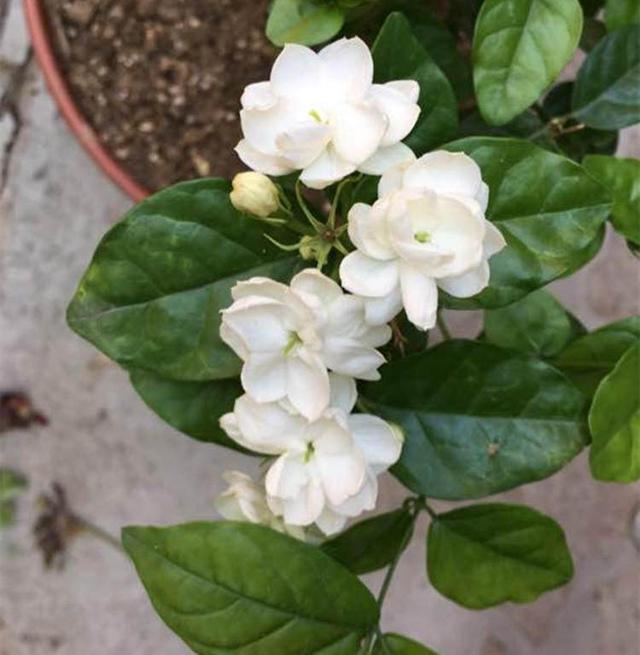
Many flower lovers always run into problems when growing jasmine, and the truth is they simply do not know how to water it. Water is the lifeblood of jasmine, and whether you water it properly determines whether it can survive. Based on jasmine's habits of liking moisture, fearing waterlogged soil, and liking airy conditions, the principle of watering is: do not water if the potting soil is not dry, and water once it is dry.
When watering jasmine, water thoroughly so that the potting soil stays in a state of alternating dry and wet. Why let the potting soil alternate between dry and wet? This is because jasmine needs both moisture and air. If the potting soil is constantly in a wet state, air finds it hard to enter the soil, and then jasmine will not grow well and may even die.
Beginners at growing flowers may develop two kinds of bias: first, watering too frequently, causing the potting soil to stay wet for a long time, so the jasmine shows yellowing leaves, small and wrinkled leaves, and green veins; this situation is more likely to occur in spring and autumn when temperatures are lower, so special attention is needed; second, watering too little, so the potting soil cracks open, and then the jasmine will drop its leaves and dry up.
The general principles of watering were discussed above, but how should you handle it specifically? This must be decided according to the season, climate, and the growth of the jasmine. As far as jasmine's growth habits are concerned, watering is a challenge that flower lovers need to attend to every month.
From mid-April to mid-May, the temperature starts to warm up but is still not high; jasmine is sprouting branches and growing leaves, and its water consumption is not very large. At this time, water once every 2-3 days. For watering time, anytime from 10 a.m. to 2 p.m. is fine. But during this period, jasmine's branches and leaves are growing continuously, and the temperature is gradually rising, so the amount of water should increase accordingly.
In addition, at this stage, jasmine needs supplemental nutrients. Generally, use an organic flower nutrient solution; normally dilute it with water at 500 times and water the soil, and during the flowering period you can dilute it with water at 800 times and water it in; if you need to spray the leaves, dilute it to 1000 times to promote absorption by jasmine's roots and leaves, so that with sufficient nutrients it grows quickly.
From late May to early June is the period when the spring flowers open, and the temperature is relatively high, so jasmine's water requirement increases compared with the earlier period. At this time, water once every 1-2 days. For watering time, before 10 a.m. and after 3 or 4 p.m. During this period, watering should also be handled flexibly; on sunny and windy days, increase the amount as appropriate; on cloudy days, reduce it as appropriate.
From mid-June to late August, it is exactly the "dog days" weather, with the highest temperatures, and jasmine is in its peak flowering period, so its water requirement is very large. During this period, water every day, and water enough and thoroughly, and even water once each in the morning and afternoon; when watering, also pay attention to sprinkling some water on the leaf surfaces. Only in this way can the flowering period be extended and the fragrance be made even richer. But there are often showers at this time, so if water accumulates in the pot, it should be poured out.
From early September to mid-October, the temperature gradually drops. Although jasmine is still blooming autumn flowers, the number of flowers gradually decreases, and its growth activity is also weakening. At this time, water once every 1-2 days. If there is continuous autumn rain and water accumulates in the pot, it should be poured out in time, and use thin wire to poke 1-2 holes in the potting soil to help drainage.
From late October to mid-November, the temperature turns cold, and you should pay attention to controlling moisture to promote solid jasmine branches and prepare for safe overwintering. Water once every 3-4 days, more in the early stage and less in the later stage.
From late November to early March of the following year is the period when jasmine is protected from the cold and overwinters. At this time, moisture must be strictly controlled; otherwise, with too much water, the soil temperature drops, which is unfavorable for jasmine's overwintering. Water once every 5-10 days (water about once every 5 days if placed in a sunny spot by a window, and about once every 10 days if placed in a shaded spot). From mid-March to early April, after jasmine has overwintered, the root system begins to become active, and you can water once every 3-5 days. At this time, when adding water, fertilize the jasmine accordingly by adding liquid fertilizer to the water, diluting it to 500 times, and pouring it directly at the roots.