Which countries do imported soybeans mainly come from? This article gives you an overview
On this question, Science Xingnong feels it is necessary to introduce to everyone the relevant situation of China's soybeans and international soybeans, so that everyone can have a deeper understanding.
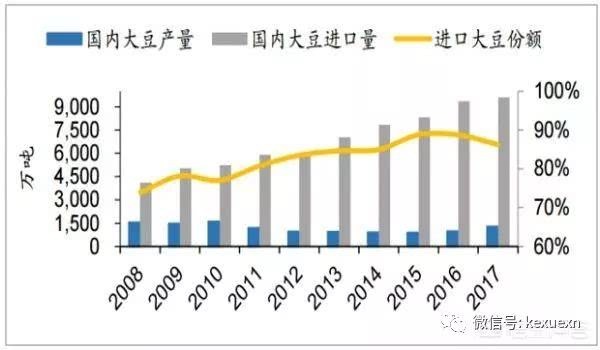
Everyone should understand a realistic problem: China's soybeans are heavily dependent on imports. Taking 2017 as an example, the total domestic soybean output was 13 million tons, while the import volume reached an astonishing 95.53 million tons. The dependence on foreign imports was as high as 80%, and this dependence is still gradually expanding, because as Chinese people's demand for protein and meat products grows, the required amount of soybeans and soybean meal is increasing, while China's soybean production capacity is limited after all.
From the current worldwide perspective, the countries with strong soybean production capacity include the United States, Brazil, Argentina, Canada, Ukraine, Uruguay, Russia, and others. Judging from the situations of the above countries, the soybeans of Ukraine and Russia are non-GMO soybeans, while Brazil, the United States, Canada, and Argentina have basically popularized GMO soybeans. Uruguay's situation is rather unique: China has not yet established diplomatic relations with that country, so although that country's soybean volume is not small, China has so far not imported any GMO or non-GMO soybeans from that country.
Based on the analysis of the above situations, China's sources of soybeans are basically imports from the United States, Canada, Brazil, Argentina, Ukraine, and Russia. Next, a brief introduction follows.
Russia
Russia's grain exports take place every year, and China has also been continuously increasing its imports of Russian soybeans in the past two years. However, although Russia has a very large area, its soybean volume is really not much: in 2017, its annual soybean output was 3.6 million tons, and China imported 500,000 tons of soybeans from that country.
Ukraine
Although Ukraine's soybeans are non-GMO, limited by its land area, its soybean output is not high, and China's imports from Ukraine are also very low.
United States
Judging from the situation in 2017, the soybean import volume from the United States was as high as 33 million tons, basically accounting for more than one-third of China's total imported soybeans. It is reported that this year the United States has seen a reduction in soybean production, and due to China-US relations issues, the soybean volume from the United States will be even lower.
Brazil
Brazil can be said to be the main supplier of China's soybean imports, exporting more than 50 million tons to China in 2017, accounting for as much as 53.3%. According to estimates by the United States Department of Agriculture, this year Brazil's total soybean output will reach 11,700 tons, making it the world's largest soybean producer.
Here, as a digression: after Brazil promoted GMO soybeans, Brazil's soybean industry not only did not decline, but its output and quality gradually improved, putting it at the forefront of the world, and now it is about to become the world's largest soybean producer. Is this case also worth our country learning from?
Argentina
Argentina's soybean output is also very high, at roughly the level of 6 million tons, accounting for 6.9% of China's soybean imports. It is reported that this year Argentina's soybean output reached 50 million tons, and this was achieved even under the circumstances of a severe drought this year in Argentina that reduced production.
The above is a little view shared with you by Science Xingnong, and we hope it is helpful to you.