Climbing plants look like a waterfall, and it turns out they rely entirely on aerial roots to cling and climb
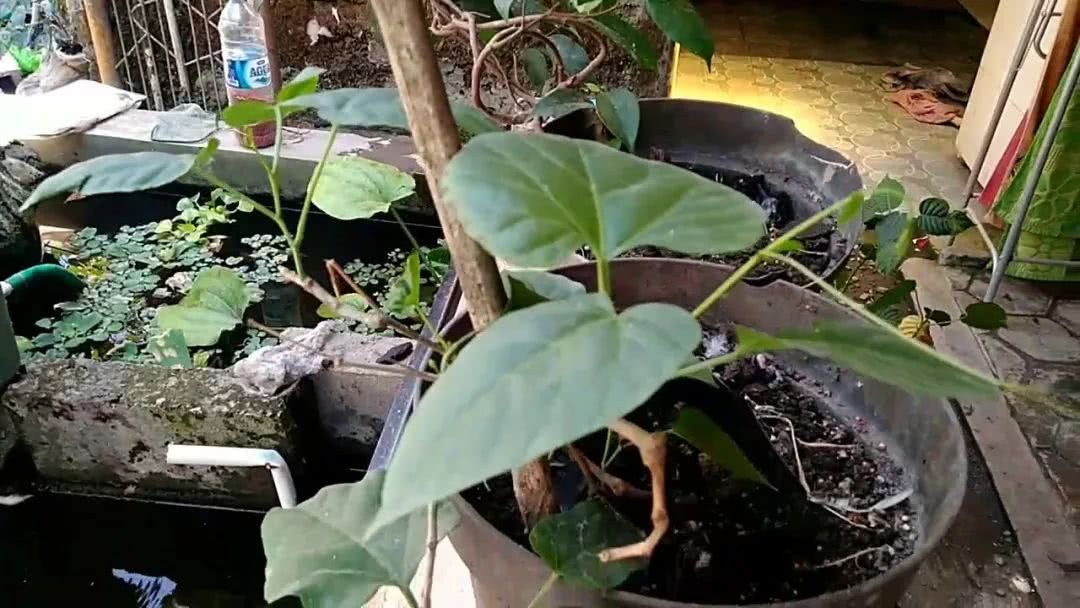
The plant introduced below is Cissus sicyoides, which people like to call "a curtain of sweet dreams," because it can climb and grow on walls, producing a large mass of red aerial roots that form a very dreamy scene, making its ornamental value excellent.
Above is a Cissus sicyoides just starting from a stem cutting; the leaves are still fairly large, the stems are relatively sturdy, with heart-shaped leaves and serrated leaf edges. In summer and autumn it can also produce small white flowers, though the flowers have little ornamental value.
Its stems produce slender reddish-brown aerial roots. If grown in a greenhouse, its slender aerial roots hang down, and in a large mass they form a waterfall-like shape, looking elegant and charming. When a breeze blows, the aerial roots sway in the wind. Such a poetic plant, no wonder people call it "a curtain of sweet dreams."
Cissus sicyoides is a climbing vine with extremely strong vitality. If its aerial roots take hold in the soil, it will keep multiplying and spreading into a large mass. It is a courtyard plant that is especially easy to grow, and it grows well in the warm, humid environment of more southern regions.
As for the drawbacks of this plant, it is afraid of cold. The minimum care temperature is best kept above 10 degrees, so it can maintain a year-round evergreen state. The growing environment should keep sufficient light and the soil should have good drainage. Of course, a support should be set up at the planting site to let it climb and grow, and in the early stage of growth its stems should be trained to climb upward.
The one above is a plant decoration at a small shop in the south. You just need to plant a Cissus sicyoides nearby; you do not even need to buy curtains, because the aerial roots of Cissus sicyoides can grow into a waterfall-like curtain.
When cultivating Cissus sicyoides, be sure to use well-drained soil and avoid waterlogging, otherwise it is prone to root rot. The growing location should be ventilated, with as much light as possible, and the care temperature is best kept above 10 degrees. In cold winter it will continuously drop leaves and growth will slow down. If the temperature is too low, growth will stop, and if there is frost it can easily freeze to death.
This plant grows especially fast when summer temperatures are high, and it can easily cover an entire area. It also needs regular pruning to avoid becoming too dense, and its branches, leaves and aerial roots should be kept ventilated and exposed to light.
During the growing season, water should also be supplemented regularly. Especially in the summer growing season, the soil needs to be kept slightly moist, avoiding long-term drought.
Cissus sicyoides is actually a perennial climbing plant in the grape family. It is a tropical plant originally native to the Americas, with very slender branches and leaves and charming heart-shaped leaves. The most important feature is its red aerial roots, which grow especially fast.
The large shopping mall above is planted with Cissus sicyoides and other climbing plants. This plant has extremely vigorous vitality and is easy to cultivate, but its drawback is that it is not cold-tolerant.
Propagating this plant is also extremely simple. You can just cut off a section of stem and insert it into the soil to propagate it.
Insert the stem cutting into moist sandy soil, keep the soil moist and the environment warm, keep the growing location ventilated with relatively high air humidity, and after growing it for a period of time also set up a support for it. Cissus sicyoides will keep clinging and growing upward, and after a year it will continuously produce aerial roots.