Want your bougainvillea to bloom profusely? Do these 4 things and the flowers will crowd the pot and bloom for over half the year
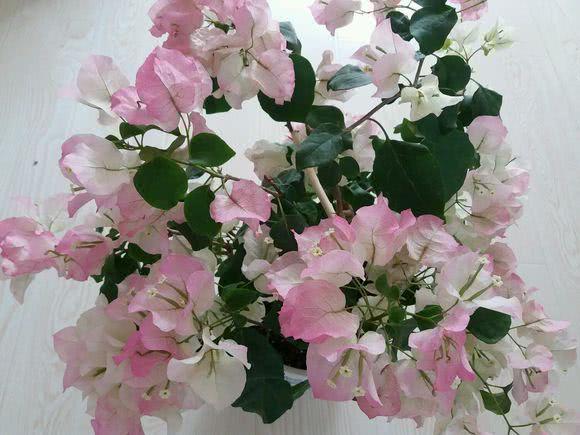
Bougainvillea, an evergreen climbing shrub of the Nyctaginaceae family, has branched stems with sharp thorns, and the branches arch and droop. The leaves are simple and alternate, ovate, with entire margins; densely covered with fine hairs. The flowers are small, usually 3 clustered in 3 larger bracts, and the bracts come in bright red, purple-red or white, etc., looking like both flowers and leaves, which is why it is also called leaf flower; it is a flowering plant grown mainly for its showy bracts. So how should you care for it to make bougainvillea branch out lushly and bloom all year round? You can refer to this method: do these 4 things, and the flowers will crowd the pot, blooming for over half the year at a time!
1. Control the temperature
Bougainvillea likes a warm environment and grows well at around 15-30 degrees. It tolerates high temperatures; if the temperature exceeds 35 degrees, it needs shade or a spray of water to cool it down. Blooming requires a temperature above 15 degrees. To extend the flowering period, place it indoors in a warm spot in early winter and keep it in sufficient light, so it can continue blooming through New Year's Day and the Spring Festival.
2. Pay attention to light
Bougainvillea likes light. Normally there is no need to shade it, and even full sun is fine; the better the light, the more explosive the blooming. The main thing to note is that in winter you should put the bougainvillea in a bright place and keep enough light hours each day, preferably more than 6 hours; otherwise, with insufficient light the plant grows weakly and flowering is affected.
3. Water scientifically
Watering should be scientific, that is, a combination of watering, water control and heavy watering. After Qingming Festival, bougainvillea is moved out of the greenhouse for open-field cultivation. During the vegetative growth period, water once a day, just enough to ensure normal growth of branches and leaves. In summer, water about 2 times a day, once in the morning and once after 6 p.m.; in autumn, as the temperature begins to drop, water according to the condition of the potting soil, keeping the soil slightly dry; in winter, reduce watering, do not water until the potting soil is dry, and you can switch to misting.
4. Fertilize properly
Bougainvillea has a long flowering period and blooms heavily, so it consumes a lot of nutrients and needs regular fertilizer supplementation. During the spring growth period, apply a nitrogen fertilizer once every 15 days; during the flowering period, do not apply nitrogen fertilizer, and add phosphorus fertilizer several more times; in autumn and winter, apply less or stop fertilizing. When flower buds appear in the leaf axils, you can fertilize more, mainly with phosphorus and potassium fertilizer, and avoid nitrogen fertilizer, so as to prevent the plant from growing leggy and affecting flowering. From August to October, even more heavy fertilizer and water are needed: use dilute fertilizer instead of water, water the flowers with alum fertilizer water or cake fertilizer water, and add phosphorus fertilizer several times.
A reminder from the editor: bougainvillea has strong vitality and will become as dense as a forest within a few months, so it needs timely pruning. Generally, just pinch off the tips in time according to the plant's growth and thin out overly dense branches; of course, you can also shape it into whatever form you want. After its flowering period ends, it should also be pruned in time, which can promote new branches, so that the bougainvillea will bloom abundantly the next year. Alright, that is all for the introduction to bougainvillea care. If you flower lovers have better suggestions, you can leave a comment below!