These 6 succulents are really interesting, how many of them do you grow?
Take a look at those strange succulents~
Life is occasionally dull, and novel things always bring us joy. Occasionally discovering those strange succulents, one cannot help but marvel at the endless charm of nature. Today let's share with everyone some of the quirky yet charmingly adorable succulents of the succulent world.
[Bulb]
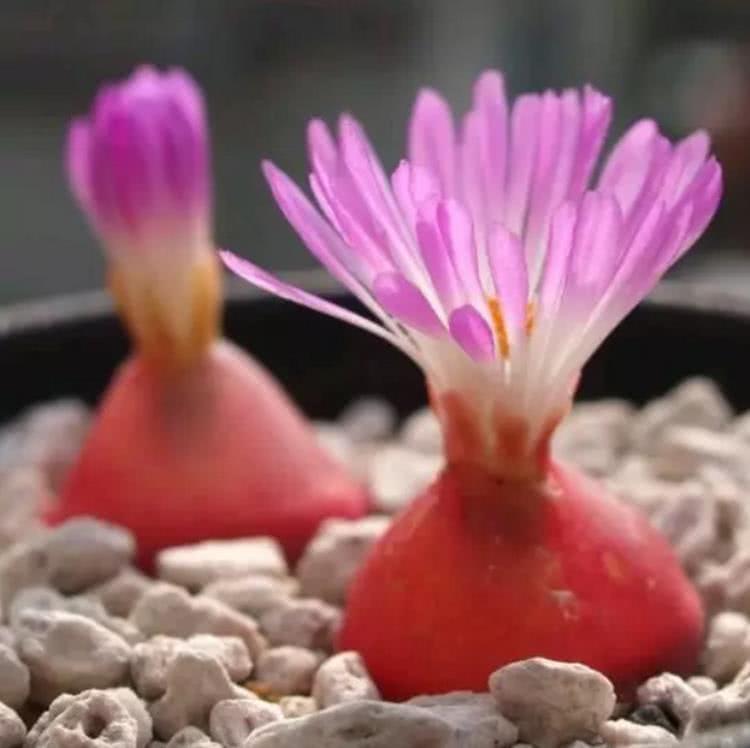
The Bulb is a succulent of the genus Conophytum in the family Aizoaceae, with a bright green, semi-transparent epidermis. During the summer dormancy period, in an environment with ample light, the epidermis turns red.
The Bulb's flowers are large, light purplish-red with a white center, blooming in spring or autumn. The flowers usually open during the clear daytime and close at night; if the growing environment has insufficient light or during overcast and rainy days, it is difficult for them to bloom.
A blooming Bulb, semi-transparent in appearance; under direct light you can see that it is semi-transparent, shimmering with a faint reddish luster. Because the plant is crystal clear and looks sparkling, it is named for its resemblance to a lightbulb, and because its plant shape closely resembles Japan's Mount Fuji, it is also known by the alias "Mount Fuji."
[Spring Grass]
Spring Grass, also called Spiral Grass, is named for its leaves that grow in a spiral resembling a spring. It is a succulent of the genus Ornithogalum in the family Liliaceae, and is a newly introduced ornamental small potted plant in recent years.
Its form is unique, with quaint bulbs. Depending on the variety, the plant's leaves may resemble springs, drifting kelp in water, curled long hair, or wrought-iron artwork; their lines are smooth and graceful, full of variation.
Spring Grass's flowers are elegant and fresh, suitable for growing in small pots and for decorating windowsills, desks and other places; it is strange and interesting.
[Little Red Lips]
Little Red Lips is a succulent of the genus Conophytum in the family Aizoaceae, also called Lipstick. Its blue-green color with a smiling little mouth makes it especially appealing.
This big-headed plant with slightly parted cherry lips produces a small yellow daisy-like flower from within its mouth every year. It has an extremely high rate of appearing in photos, has been hyped up to a rather expensive price by wealthy collectors, and is not easy to keep alive.
[Liudie Yu]
Liudie Yu is a pair of tender pink little|butts|, a succulent of the genus Lithops in the family Aizoaceae. Some flower enthusiasts describe it with the phrase "Born with natural beauty that is hard to hide, delicate enough to burst with a touch, easy to show off."
When the flowering season comes, a small daisy-like flower will emerge from the gap in the "butt," and then you will see the wondrous sight of a "butt blooming."
[Buddha's Head Jade]
Buddha's Head Jade is a succulent of the family Apocynaceae. It was originally a succulent of the genus Pseudolithos, and has now been separated out to become the independent genus Buddha's Head Jade.
This succulent, Buddha's Head Jade, has no leaves but possesses fleshy stems. When young, the fleshy stem is spherical, and the plant gradually becomes cylindrical afterward. The texture is tender, and the epidermis is grayish-green, with dense triangular or hemispherical, conical tubercles. The plant resembles the spiral hair coils on the head of a Buddha statue, and the name "Buddha's Head Jade" is derived from this.
The flowers grow among the tubercles on the upper part of the plant, with a flat, shallow-dish-shaped corolla divided into five lobes, pale yellow to yellow-green in early summer, with deep purple spots. The flowering period is from June to August, especially flourishing in June.
[Baohui Yu]
Baohui Yu is a succulent of the genus Baohui Yu in the family Aizoaceae, native to South Africa, a single genus with a single species. It is a perennial succulent herbaceous plant. The plant is 8-15 cm tall. The leaves are semicircular and fleshy. The entire succulent is covered with fuzz and can grow to the size of a quail egg.
The flower is solitary, slightly pinkish-white. The flowering period is from late summer to early autumn. Its care is slightly more difficult than succulents such as Lithops; the growing medium needs to be well-draining and breathable, and it needs a well-ventilated environment to get through the summer.
[Turtle Shell Dragon]
Turtle Shell Dragon has light brown tuberous roots. When young, it is spherical; after the succulent grows into a mature plant, the epidermis becomes cracked, forming many independent small blocks like stacked stones, just like a turtle's shell, and its name is derived from this.
Turtle Shell Dragon's stem is green and trailing, 1-2 m long. The leaves are heart-shaped and triangular, 6-7 cm long. The flowers are dioecious, tiny, opening in strings of 10-15 blooms, and give off a faint candy-like fragrance, but the number of female plants is fewer than male plants. Turtle Shell Dragon is a deciduous vine succulent, a typical representative of succulents with enlarged stem bases, very strange and rare.