What kind of succulent plant is the golden rat tail cactus?
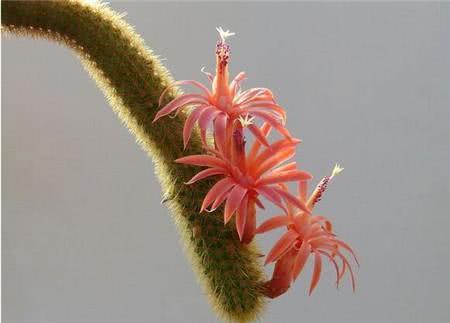
The golden rat tail cactus is a perennial succulent plant in the cactus family. It originates from Mexico in the Americas, and its stems are slender and soft. Its flowers are brightly coloured, and it can be grown as a hanging plant to create a striking display, with a flowering period from April to June.
The stems are slender and cylindrical, 1.5-2.5 cm thick, up to 1.5 m tall, much branched, climbing or creeping and drooping, bright green, with 16-18 low ribs, covered with golden bristle-like fine spines. A single stem resembles a golden snub-nosed monkey's tail, while the whole plant looks like a gathering of snakes. The flowers are lateral, funnel-shaped, with pink inner petals and orange-red outer petals marked with bright red stripes.
Golden rat tail cactus
During the growing season, water on the principle of alternating dry and wet, and apply a light fertiliser once a month, mainly phosphorus and potassium fertiliser. Long-term insufficient light is unfavourable for flowering, so it should often be placed in a sunny spot for care. Provide appropriate shade in midsummer, restrict watering in winter, and keep the potting soil slightly moist. Pay attention to preventing and controlling leaf spot disease, red spider mites and whiteflies.
Golden rat tail cactus
Soil: fertile, well-drained sandy loam and forest soil, avoid waterlogged ground, tolerant of drought.
Water: do not let it lack water in summer, keep the potting soil moist, and mist regularly to maintain humidity. In winter, water once every ten days, and be careful not to spray water onto the stem surface.
Sunlight: loves light, tolerates strong sun and also partial shade, but long-term shade makes the stems grow thin and slender.
Golden rat tail cactus
Fertiliser: before potting, add decomposed organic fertiliser to the nutrient soil, fertilise once a month during the growing season, and do not fertilise during the dormant periods in winter and summer.
Temperature: prefers a warm climate with a large day-night temperature difference, and is not cold-tolerant.
Uses: a well-known hanging cactus, suitable for beautifying the environment of living rooms, tea rooms and restaurants, letting it hang and grow to form a beautiful display.