Geraldton waxflower symbolizes family affection, friendship, and faithful, pure, and evergreen love
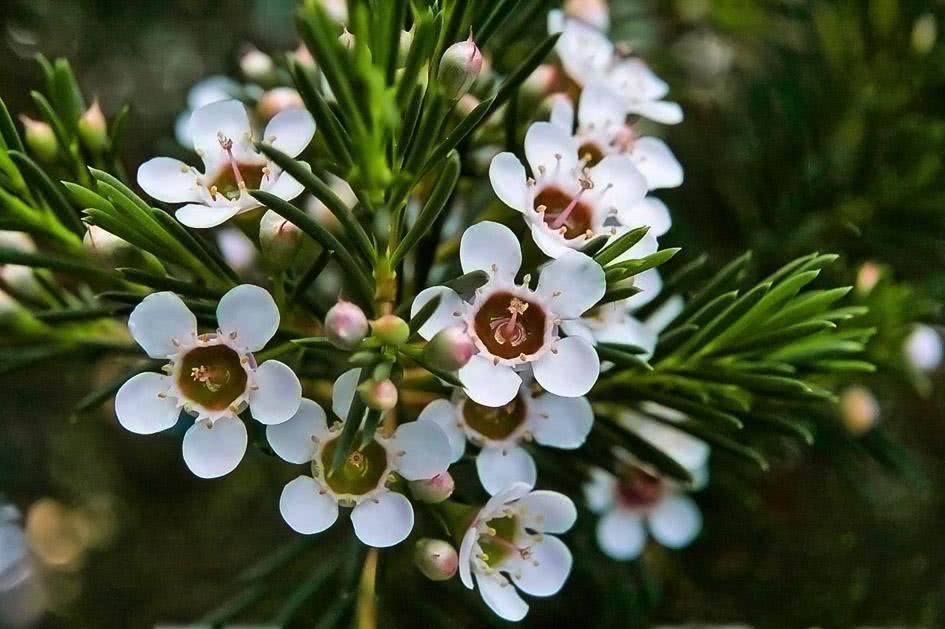
Geraldton waxflower, also known as waxflower, wind waxflower, Australian waxflower, or goldfields waxflower, is a perennial plant of the Myrtaceae family native to Western Australia. Geraldton waxflower plants are widely cultivated in Australia and are very common in local home gardens and the cut flower industry.
A perennial evergreen upright shrub, very drought-tolerant, tolerant of poor soil, and highly adaptable. Plants grow 0.5 to 4 m tall. It grows quickly; in the year of planting, the plant can grow to more than one meter tall, within three years it can reach up to 3 m, and at four years the trunk diameter reaches 4-5 cm. When grown naturally, it can form a large thicket. The leaves are opposite, linear, and resemble pine needles, with a fresh fragrance, and remain evergreen all year round. In its native habitat, the flowering period is from June to November each year. Its flowers resemble plum blossoms, with 5 petals; the petals are waxy and glossy, pink or white, sometimes showing a faint pinkish purple. A 15 cm tall seedling in its first year can already bloom.
Geraldton waxflower
Because of its strong adaptability and tolerance of cold and poor soil, Geraldton waxflower is very easy to grow in Mediterranean climates. It prefers well-drained, loose soil and full sun. It can also adapt to growing environments with higher humidity than its native habitat (such as Sydney), but the plant's lifespan may be shortened. It is suitable for container growing. Because its branches are relatively slender, it tends to lodge easily, so appropriate support should be added during cultivation.
Geraldton waxflower
In horticulture, Geraldton waxflower can be used as a rootstock for grafting plants of the Myrtaceae family.
Although the original varieties of Geraldton waxflower come only in pink and white, artificial breeding has also produced purple-flowered varieties; blue, yellow, and red flower types obtained through dyeing are also very common in the cut flower market. When Geraldton waxflower is harvested for cut flowers, the flowering period can last more than 1 month, and such an extremely long vase life is almost unmatched among cut flower varieties currently on the market.
Dyed Geraldton waxflower
Geraldton waxflower has an exquisite and unusual form and an elegant, spreading posture. Whether displayed alone in a vase or used as a foil in flower arrangements, it is very suitable, and in bouquets it can create a striking focal effect. Recommended companion flowers: eucalyptus leaves, silver dollar eucalyptus, eucalyptus fruits, pincushion protea, balloon cotton bush, South African protea (Leucadendron), small roses, Irish bluebell, banksia, blue globe thistle, lisianthus, tulip.