The bignonia vine covers the wall, with lush vines full of green vitality.
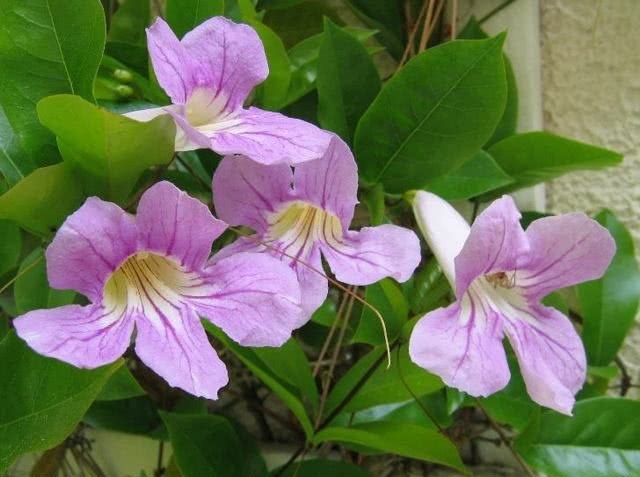
Bignonia is an evergreen vine that climbs by a single tendril formed from the modified terminal leaflet of its trifoliate compound leaves. The leaflets are entire, elliptic-oblong, 5-9 cm long. Terminal and axillary panicles; the corolla is funnel-shaped and bell-like, pale purple, about 6-8 cm long and 5-8 cm in diameter; the stamens are included. The capsule is broad, 8-14 cm long, with a spiny surface; the seeds are flat and winged.
Optimal growing temperature: 22-30°C. Soil: not demanding about soil, but fertile soil rich in humus is best. Water: prefers moisture.
Native to Brazil and Argentina. It likes heat and fears cold. It is cultivated in gardens in Guangdong and Fujian, China.
Propagation methods: seed sowing and cuttings.
Potted plants can be shaped into shrubs for decorating balconies, rooftops, bedrooms and studies, and are also suitable for flower stands and trellises for ornamental cultivation; in gardens they can be used for three-dimensional cultivation on trellises, flower stands, and the like.