Succulent leaf cuttings are very simple; pay attention to these key points to effectively increase the survival rate
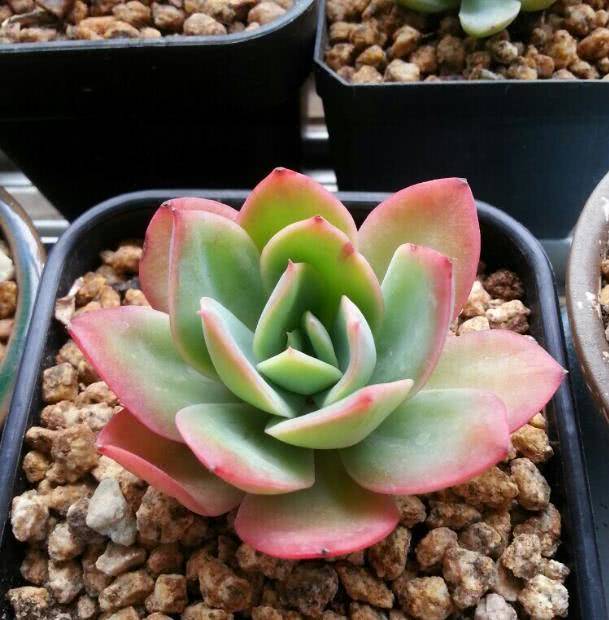
Today, our topic is succulent leaf cuttings. Leaf cuttings are used for species that can produce adventitious buds and adventitious roots from leaves, and most succulents can do this. Leaf cuttings are a common artificial propagation method for succulents, with a high probability of budding. Because it is asexual reproduction, its traits are inherited from the mother plant, which can maintain the uniformity of the plants. When do you need to use leaf cuttings? Of course, when you want more succulents. Next, the editor will explain the method of leaf cuttings in detail.
To successfully propagate a large batch of beautiful and cute succulents from leaf cuttings, you still need to put in some effort. Generally speaking, when the small seedlings reach about 1-2 cm in diameter, you can consider repotting them. Depending on the variety's size, this value may still have a certain range of flexibility. We can also judge by observing the condition of the original leaf of the leaf cutting. If the mother leaf that was twisted off from the parent plant has already begun to slowly wither and lose its vitality, then it is time to repot the small seedling.
Many gardening enthusiasts know that beverage bottles can be used for succulent leaf cuttings. In fact, this method is suitable when the temperature is too low and you cannot resist pulling leaves off succulents for leaf cuttings. Now it is spring, the weather is warm, and leaf cutting propagation is very simple; just lay them flat. Place the succulent leaves flat on the soil, with ventilation and air permeability. The leaves are less prone to black rot, and leaf cuttings sprout quickly, because sprouting from leaf cuttings requires scattered light. When the growing point area of the succulent leaf turns red, that is a sign that it is about to sprout.
When growing roots for mature succulent plants, do not be afraid of trouble. You can first let the succulents grow in soft and fertile soil, with the peat component preferably at 7 parts. Wait until the succulents have grown a certain root system, and the root system is long enough, then change the soil and add a large proportion of granular soil. The succulent root system is already sufficient to maintain rapid growth of the succulent, and can also let the succulent roots grip the soil and grow robustly. When you later control water for the succulents, the root system is not easy to dry out.
The leaves selected for leaf cutting propagation must first have a growing point, and the wound is best left to dry for a while, then just lay them flat on the soil surface. Note that before the leaf cuttings have rooted and sprouted, do not water them or spray water, as they are especially prone to turning to water or black rot. Attentive gardening enthusiasts may observe that small leaves often root earlier than large ones. Why? Because small leaves have fewer nutrients, and in order to survive, the mother leaf secretes more hormones to urge the roots to emerge. Once roots grow, they can absorb nutrients from the outside to support its continued growth.
The speed of rooting in leaf cuttings is also related to air humidity. When air humidity is high, they can root even if casually tossed aside without soil. Some people also use water to induce rooting, relying on the evaporation of water vapor in a bottle to induce rooting, and the speed is relatively fast. So even in summer, everyone can try these little tricks; fast rooting for succulents is still relatively easy.
This is a gathering place for succulent plant enthusiasts, sharing succulent care tips. Welcome to follow and exchange ideas.