Detailed Guide to Potting Techniques and Care Precautions for Nandina Bonsai
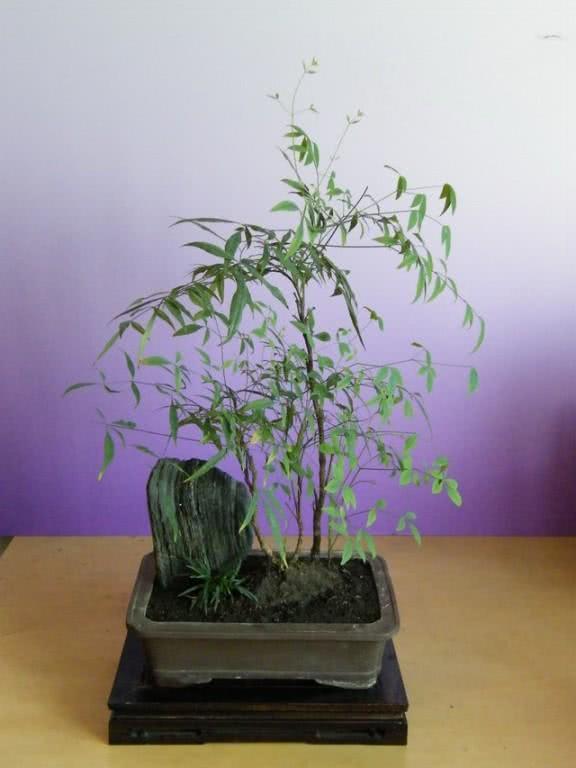
Nandina (Nandina domestica) is a shrub that stays green all year round. Its flowering time is generally at the end of spring and the beginning of summer, and autumn is the harvest season, which it is no exception to, as it bears fruit in autumn. It is mainly produced in the Jiangnan region. Because its form is straight and upright, its leaves are like feathers, graceful and elegant, and its shape resembles bamboo even more, it is also known by the alias Tianzhu.
Cuttage is a common method used to propagate nandina. Generally, in spring, well-grown branches are selected as cuttings and inserted into relatively loose and moist soil, though care must be taken to provide shade; some also carry out cuttage during the plum rain season, and the cuttings used in this period are generally softwood branches. Generally, they will sprout after one month, after which they can be transplanted. Of course, natural old stumps can also be selected as the raw material for bonsai, but old stumps collected in the wild need to be treated with care; generally they are first cultivated as stock, mainly by cutting off the branches and trunks and then cultivating them in open ground first. Once tender leaves are found emerging on the new branches that grow out, they can be potted.
During the potting process, an appropriate pot must first be selected. The depth of the pot will affect the plant. Generally, a relatively shallow or medium-depth glazed ceramic pot in light blue-white as the main color, rectangular or round, is used, as this helps improve the overall aesthetic appeal of the bonsai. As for the soil, it must be sufficiently loose to facilitate drainage and aeration, which is beneficial to root growth. The type of soil is mostly humus soil.
The planting time is generally chosen in February or March. Base fertilizer must be applied within the pot soil, and the main root is allowed to be slightly exposed above the soil surface. After this, it can be shaped. Its shaping is generally carried out through pruning and assembling plantings, and the time is in spring when it is about to sprout, so that the density of the branches will be reasonable and orderly, with a greater sense of layering.
The forms of nandina bonsai are diverse, but no matter what form of production is used, in the middle and first ten days of March, before its new branches and leaves sprout, the plant will be dug out, then pruned, and afterward transplanted to semi-shaded, relatively moist and cool land. By the end of March of the following year, it can be potted. A nandina bonsai that grows well and has a beautiful shape is generally kept in its most suitable environment.
It is best to place it in a semi-shaded environment with moderate temperature and suitable humidity. Because it is not a plant with extremely high light requirements, it needs suitable light; exposure to the sun or lack of light will make it grow slowly, or even die, and then it will not bear fruit. At the same time, attention must also be paid to its pollination time. Its flowering time is in May to June, when Jiangnan is often rainy and drizzly, which greatly affects its pollination, so at this time it is best to place it under the eaves, and in winter place it indoors to prevent the leaves from falling off.