Complete Guide to Weigela Varieties and Propagation Methods: Blooming All Summer Long, Truly Beautiful
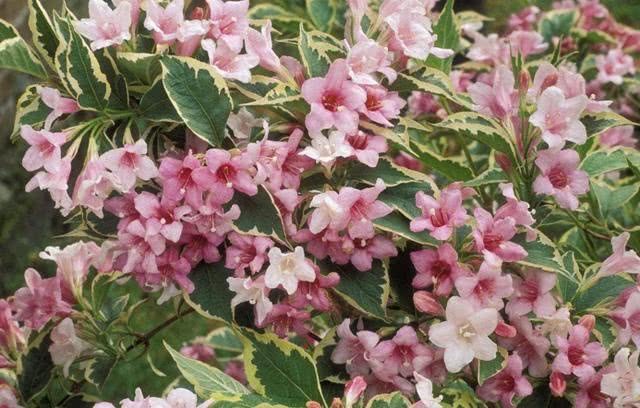
Weigela is often also called five-color crabapple; its flower colors are vivid and highly variable, and it has many varieties. Its blooming period can last from spring all the way into summer, so it is planted in parks, gardens, and beside lakes. So what exactly are the weigela varieties? Below are several common weigela varieties:
1. Variegated Weigela
Compared with other types of weigela, variegated weigela is a taller plant and can grow to 2-3 m when mature. The leaf edges are white or pale yellow, with slightly pointed tips; the calyx is green; during the growing period, the flower color gradually changes from white to pink. Because each flower blooms at a slightly different time, when the plant is in bloom you can see the flowers divided into two colors, red and white, which is especially beautiful.
2. Purple-leaf Weigela
The leaves of purple-leaf weigela are light purple, and the flowers are rose pink.
3. White-flowered Weigela
Its flowers are white, and when in bloom they have a faint fragrance.
4. Red Prince Weigela
Red Prince weigela is relatively short, generally growing to about 1-2 m. One rather interesting point is that the newly growing branches are light red, while the old branches tend more toward grayish brown; the leaves are round or oval, and during the growing stage the leaves are golden yellow. When it blooms in summer, its blooming period is fairly long, lasting from early April all the way to early October.
5. Downy Weigela
There is actually not much difference between downy weigela and weigela, but one important difference is that both sides of the leaves of downy weigela have slight fuzz, and it blooms earlier, usually flowering between April and May.
The great variety of weigela brings excellent ornamental value, so many people want to grow some and place them on a balcony or in a courtyard. So how should weigela be cultivated? The main planting methods for weigela are cutting, sowing, layering, and division, while seed propagation is used relatively rarely.
Cuttings:
In summer, choose well-growing weigela branches and cut them into cuttings with a length between 12-14 cm. Insert the branches about halfway into the soil, then water them, and afterward just keep the soil moist regularly. When planting weigela in a season with more rainfall, use relatively tender branches and cut them to a suitable length of about 16 cm. Before cutting, be sure to disinfect, as this gives the seedlings a higher survival rate. Pay attention to the drainage of potted plants to avoid water accumulating in the potting soil and causing the plant to die.
Division:
The division propagation method is generally used in early spring or in autumn and winter. Dig the plant out of the pot and divide it into several clumps, then transplant them to the desired place. If it is in February or March of spring, choose relatively mature branches from the plant for cuttings; if it is in June or July of summer, choose tender shoots that have just grown for cuttings. At the same time, pay attention to pruning the plant as a whole, cutting away dead branches and long branches to ensure that the remaining branches and leaves can absorb sufficient nutrients.
Layering:
Compared with the two methods above, layering propagation has no special time requirements and can be done at any time within a year. People often choose branches on the back side of the flowers to press down. Because the lower branches of weigela often show a prostrate, pressed-down posture, pressing them into the soil during the growing stage for layering propagation makes the branches easy to survive.