What is the Kleinia stapeliiformis? Let us introduce you to this succulent plant
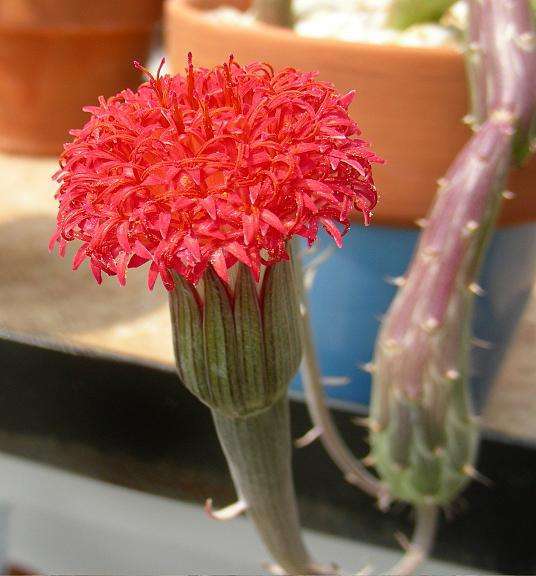
Kleinia stapeliiformis is a succulent plant in the Asteraceae family, genus Kleinia. The plant forms a low, fleshy shrub, with cylindrical stems that are slightly pointed at both ends and prostrate, rooting wherever they touch the soil. It lies flat on the ground and is jointed, with each segment 10-30 cm long and 1.5-2 cm in diameter. The skin is grayish-green or brown, with dark green linear longitudinal stripes. The leaves are linear, 0.2 cm long, and wither early, but after withering they do not fall off; instead they persist on the modified stems like small thorns. The peduncle bears 1-2 flower heads, 3 cm in diameter, with orange-red or blood-red flowers. It is native to East Africa and the Arabian region. A small number have been introduced and cultivated in southern China.
Kleinia stapeliiformis
Growing environment:
It prefers a sunny, warm and dry environment, but is also tolerant of partial shade and drought, and dislikes waterlogging. In the hot and humid summer season, the plant enters a dormant or semi-dormant state, so it should be shaded appropriately, watering should be restrained, and ventilation should be improved. In winter, keep it indoors in a sunny spot, keep the potting soil moderately dry, and it can overwinter safely at around 10°C. Normally, water and fertilizer should not be excessive; slightly dry soil is preferable, and there are no strict requirements as to whether to fertilize. Because this species has a relatively shallow root system, it is best grown in a shallow pot, with sand or small pebbles spread on the surface of the potting soil. The potting soil should be a well-drained sandy loam, and a relatively large amount of coarse sand can be mixed into the soil. Since the plant grows quickly, overly dense clumps can have some crowded stem segments thinned out at any time, to keep the plant well-spaced and graceful in form.
Kleinia stapeliiformis
It likes warmth and plenty of sunlight, and when placed indoors it must receive direct sunlight. During summer dormancy, watering should be restrained, and fertilization should be done with caution at ordinary times. A relatively large amount of coarse sand can be mixed into the soil, and it is best to also spread sand on the pot surface; if conditions allow, growing it directly in a sand bed is better than growing it in a pot. In winter, it is best to maintain a temperature above 10°C, but if the potting soil is kept dry and there is plenty of sunlight, it can also tolerate low temperatures of 3-5°C. Propagated by cuttings.
Kleinia stapeliiformis
Landscape uses:
Kleinia stapeliiformis, also known as 'Chu Ying', has a distinctive appearance and beautiful flowers, and is very eye-catching. It can be planted in a shallow pot, allowing the stems and branches to extend and coil around, to adorn a desk or tea table with a special charm.