The Most Photogenic Flowers I've Photographed in Recent Years
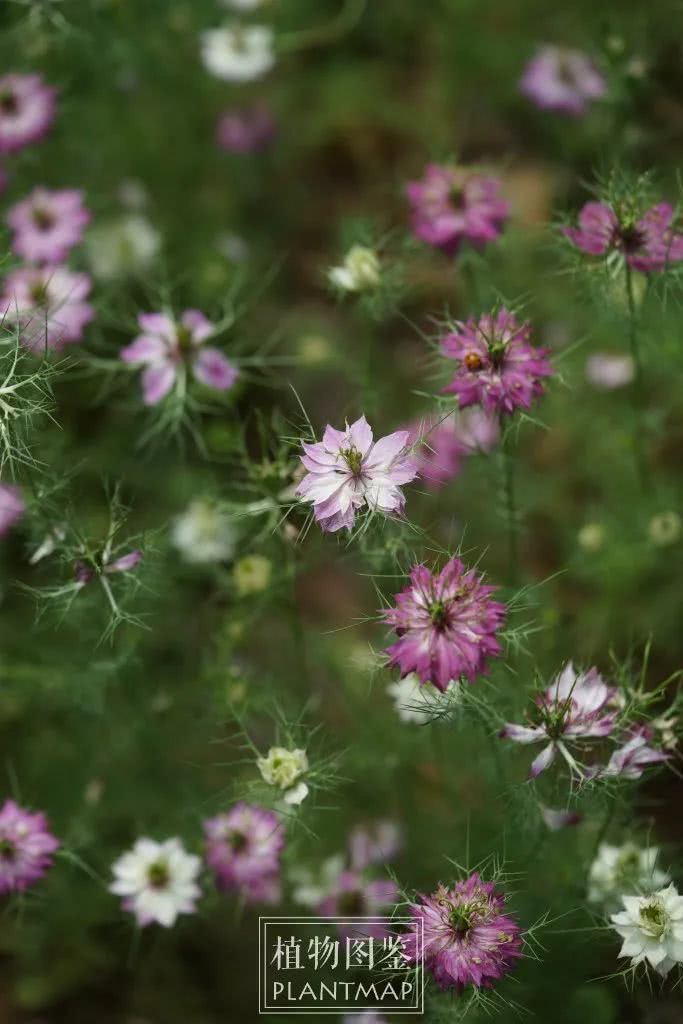
Love-in-a-mist is probably the most photogenic plant I've photographed in recent years. Besides the wonderful flowers, credit also goes to its fine, smoke-like leaves, which allow us to get a soft, dreamy background when photographing love-in-a-mist flowers.
[ Love-in-a-mist Nigella damascena] Ranunculaceae >> Nigella
Love-in-a-mist is native to the Mediterranean and West Asia [1], and is a member of the high-appeal family Ranunculaceae. It was introduced to China mainly for ornamental use as a cut flower, or cultivated as a medicinal and economic plant.
So far, every time I've seen love-in-a-mist, it's been either in a flower shop or in the herb garden of a botanical garden... If love-in-a-mist could be developed into a landscape plant and planted in a large field in the currently popular flower-sea style, it would be a truly magical sight.
By the way, magical - that's probably the word that best describes love-in-a-mist flowers. Its flowers and leaves don't seem like something of this world, so much so that its English common name is "Devil in the Bush." The recent sci-fi film "Annihilation" also used love-in-a-mist to portray genetically distorted mutant plants.
Screenshot from the film "Annihilation"
Most of the love-in-a-mist we see are double-flowered, with flowers in colors such as blue, rose red, and white. Its petals (tepals) overlap in layer upon layer and come in varying shapes - they can be the spoon-shaped form of ordinary petals, or fringed as if cut, or multi-branched like deer antlers. At the center of the petals are the stamens and a clown-hat-like ovary with 5 stigmas.
The spiky leaves of love-in-a-mist are also an important part of its magical character, especially the ring of bracts below the flower. If you look closely, it's not hard to find that there are only 5 bracts below the flower, but these five leaves split, split, and split again, forming such an intricate mist.
After the flower fades, the ovary of love-in-a-mist begins to swell, and the 5 bracts close inward, wrapping the fruit inside. The fruit of love-in-a-mist is green at first, then gradually develops 5 purple-black banded stripes.
When fully mature, the seeds inside the love-in-a-mist fruit are black - this is the origin of its Chinese name. The oil pressed from the seeds can be used as a spice and has certain medicinal value.
Author Roger Culos, source see [2]
According to other sources, Nigella glandulifera, a plant of the genus Nigella, has a long history of cultivation in Xinjiang and is one of the traditional medicinal materials of the Uyghur people.
[1] Dictionary of Chinese Seed Plant Families and Genera. Chinese Digital Herbarium
[2] Author Roger Culos
https://commons.wikimedia.org/wiki/File:Nigella_damascena_MHNT.BOT.2007.40.38.jpg#/media/File:Nigella_damascena_MHNT.BOT.2007.40.38.jpg
Author: Jiang Mouren
Images: Jiang Mouren (unless otherwise noted)
This work is licensed under the (CC BY-NC-ND 4.0) license agreement. Please retain this statement when reposting.
iPhone users can tip the author via the QR code below