A peculiar wild fruit of the north that no one picks when fresh, yet once air-dried becomes a "fortune fruit" worth 40 yuan per jin
Warm reminder
Hemu Report aims to share and popularize information about various plants and their uses, for reference only. If medicinal use is needed, it is recommended to consult a professional physician to avoid problems!
When it comes to wild fruits and fruits, there is one thing they have in common in the eyes of the public: most of them will drop after ripening, or else rot on the tree. Whether it is cherries, loquats, or durians and bananas, none of them stay on the tree for long after ripening. But in northern China, there is a peculiar wild fruit that not only does not drop after ripening, but slowly air-dries on the tree, and after air-drying it becomes extremely sweet, turning into a wild fruit that everyone scrambles for. This wild fruit is a specialty of Xinjiang, China, relatively expensive, and it is hard to buy the authentic kind. Have you ever eaten it?
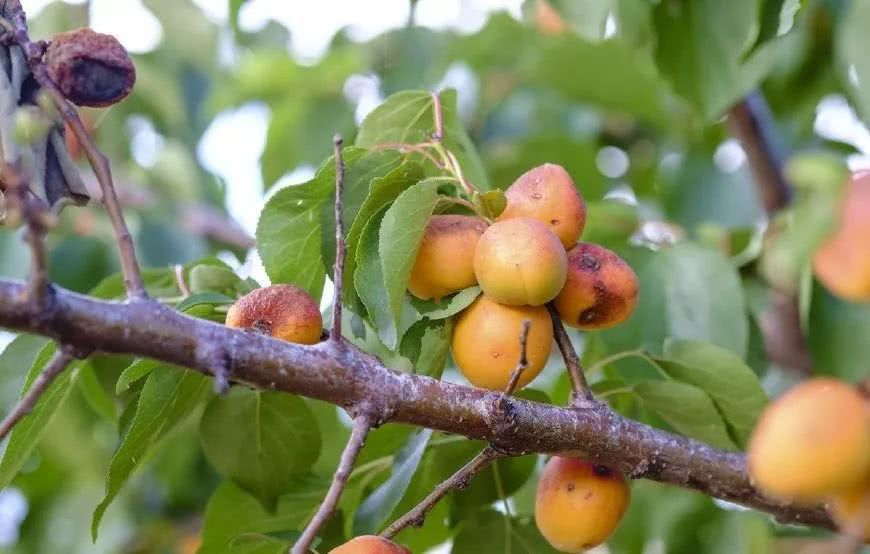
This peculiar wild fruit is the "tree-dried apricot," commonly known as the "hanged-dried apricot," which is quite an odd name. However, it is a rare wild sweet apricot, mainly distributed in the Ili River Valley, known as the "Jiangnan beyond the Great Wall," growing relying on melted snowwater from the Tianshan Mountains and rainwater, in a beautiful and pollution-free environment. The reason the tree-dried apricot does not drop after ripening is mainly thanks to Xinjiang's unique climatic conditions. The ripening season of this apricot coincides with summer, with long sunshine hours, hot climate, and high transpiration, so the fresh apricot gradually loses water on the tree and then air-dries.
The tree-dried apricot is very sweet, with a sugar content as high as 27%. This is because the local temperature difference between day and night can reach over 20 degrees; in Xinjiang there is a folk saying, "wear a cotton jacket in the morning and gauze at noon." After being exposed to the sun during the day, the temperature drops sharply at night, causing sugar to accumulate to a high degree, so the taste is extremely sweet. These dried apricots all come with pits, and the pit inside is very thin, breaking with a light bite, and then you can eat the almond. This almond is a sweet almond, non-toxic, and can be eaten directly. One apricot eaten two ways, no waste, very satisfying.
However, the yield of tree-dried apricots is not high. Although large areas of wild apricot trees are distributed around the Ili River Valley, relative to the whole market, the output is not considered high, so the price is expensive. Fruit farmers in Xinjiang pick the naturally air-dried apricots from the trees and sell them as a specialty to other places, at a price of around 40 yuan per jin, making it a "fortune fruit" that increases local farmers' income. However, food lovers should note that there are many "fakes" on the market, so pay attention to distinguish them when buying. Tree-dried apricots are very dry, with no sugar added, and at the same time have a rich fragrance; when eaten they seem to melt like sugar, yet the taste is sweet without being cloying.
The fresh fruit of the tree-dried apricot is generally not picked by anyone, because the fresh fruit is very small and somewhat sour in taste, not as good as the dried apricot, so farmers wait until it air-dries before picking it. Dear readers, have you ever eaten this peculiar wild fruit?
Text/Hemu Report, Images/Internet
If you like Hemu's articles, welcome to follow!