Step into Maihua Yucun and admire the beauty of Huizhou penjing
Huizhou Penjing
In the Huizhou of old, centuries of flourishing development had already produced brilliance and influence in many fields. Today I want to talk with you about the penjing art of our Huizhou.
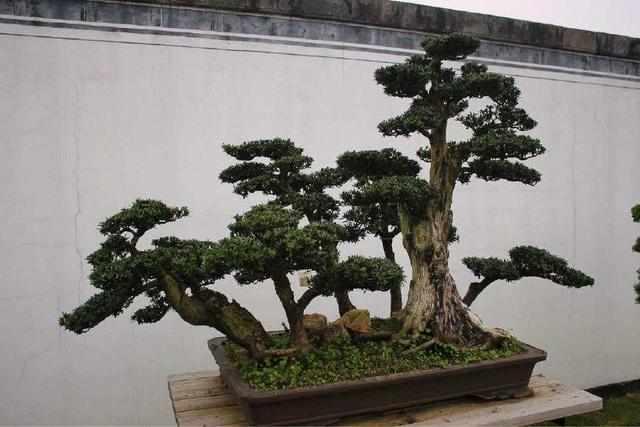
Penjing is scenery in a pot: it is the taking of unusual plants from nature and, through artificial cultivation and pruning, fixing them with tools into shaped plants with ornamental value and implied meaning. This kind of potted plant is suitable for moving and for placing indoors, in courtyards, and also in parks, residential compounds and so on.
The Qing dynasty literary figure Zhang Chao said: "Living in a city, one should treat paintings as mountains and waters, and treat penjing as gardens." What does that mean?
Penjing uses natural rocks and living trees, flowers and grasses as its material, and is characterized by abundant vitality, making it an artwork that fuses pictorial imagery and artistic conception. It is a combination of trees, flowers and grasses from nature and natural rocks, yet it also contains the thoughts, feelings and ideal hopes of its maker. It is the product of people's desire to yearn for nature, return to nature and embrace nature
China's penjing art has several thousand years of development history, and Huizhou's more than 900 years of penjing art development history has also seen development in every district and county, but the longest-developed are Maihua Yucun from She County and the Bao Family Garden Huizhou Penjing Museum!
Maihua Yucun, the first village of She County, is originally named Hongling Village. It is located 7 km southeast of She County town, in the hinterland of a valley on the south bank of the Xin'an River. At the end of the Tang dynasty the Hong family moved here, and a village gradually formed. The village is shaped like a fish: the village head is pointed like a fish mouth; the middle of the village gradually widens like a fish belly; the houses at the foot of the village spread out to both sides like a fish's forked tail. The villagers' surname is Hong, suggesting surging water; a fish in water is full of vitality, so three dots of the water radical were added beside the character for fish, calling it Yucun, the fishing village.
The village sits in a mountain hollow. After crossing the Xin'an River, the whole way is winding mountain road. If you are from out of town, it is best not to drive there, because it is very dangerous and the road is very sharp; even we locals sometimes cannot adapt to it and can only inch along slowly. After the car reaches the top of the mountain, you can see a stone archway for Maihua Yucun, and then slowly descend the mountain and arrive at this village. On both sides of the road you can see plum tree stumps of every kind planted everywhere: various red plums, green plums and so on. Some are thick and sturdy, others are twisted and coiled, with all kinds of different shapes, utterly fantastic. Speaking of these plum blossoms, seen from above this is a sea of flowers! Whenever it is blossom season, tourists from all over the country come here to admire them, and traffic is jammed everywhere. Today's outdoor travel, backpackers and photographers all spare no effort in promoting this Huizhou penjing art, letting more people know about this beautiful world in a mountain gully!
The Huizhou-style penjing shaping technique is unique. For young plum shoots, flower farmers use palm leaves to set the embryo and shape it, readjusting it once every two years; for larger branches they switch to coir rope binding; after the trunk has roughly taken shape they then work the side branches, and for small branches they only prune without binding, forming the shaping art technique of "coarse binding, coarse pruning, combining pruning and binding." Huizhou-style penjing are mostly shaped in the ground, and after taking shape a pot and stand are selected to match. On the slopes of Maihua Yucun, covering dozens of hectares, various plum stumps and tree stumps of all sizes are cultivated, reaching as many as several hundred thousand in number, making it truly the "number one village" in the country for growing and selling flowers; in propagation, it adopts the method of layering and stump cultivation together, which is also rather rare in the country.
Walking along the village paths, simple and tranquil, filled with fragrance, gazing at the beautiful mountains, lovely waters, withered vines, old trees, rare flowers and unusual grasses condensed and elevated in pot after pot of penjing not even a foot across, is like reading poem after poem without words, admiring painting after painting in three dimensions; each step changes the scene, and the scene shifts as the person moves, giving people the enjoyment of beauty while also inviting deep thought and reverie.
In our own homes we also grow some penjing, such as black pine, Buddhist pine, elm, plum trees, azalea, Elaeagnus, Sageretia, wisteria and so on. It seems that in every household in Huizhou, anyone with a courtyard loves this kind of penjing, because flowers and plants, like calligraphy and painting, are all part of Huizhou culture, all an expression of feeling and a passing on of spirit!