Aimu Bonsai Appreciation of Cliff Bonsai: From the green peaks above the ground, ten thousand layers of cliffs
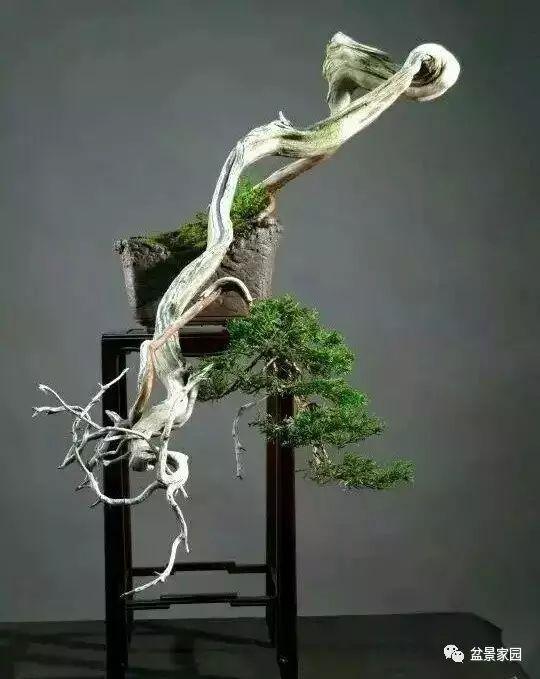
All trees can be used as material for cliff-style tree bonsai. Cliff-style bonsai is simply one form of bonsai in the classification method by tree shape; in fact, it is not absolute in relation to tree species. The so-called cliff-style tree bonsai mainly has a trunk that droops down, with most branches and leaves extending beyond the surface of the pot, like trees hanging upside down growing on sheer cliffs. Commonly used tree species include five-needle pine, black pine, Buddhist pine (Podocarpus macrophyllus), creeping juniper, elm, Chinese trumpet creeper, Sageretia thea, boxwood, Serissa japonica, winter jasmine, and so on.
Cliff-style tree stump is a general term. It is further divided into large cliff, half cliff, upside-down head-raised cliff, probing-branch cliff, hook cliff, double-trunk cliff, three-trunk floating-branch half cliff, downwind-style floating-branch cliff, wall-hanging cliff, and moon-scooping cliff. They share the same characteristics, yet each also has its own features.
For the positioning of cliff-style bonsai, taking the general cliff (left-hanging or right-hanging) as an example, the trunk's directional flow is slanting upright -- twisting and turning -- plunging downward.
The difference between a large cliff tree stump and a half cliff tree stump lies in whether the tip of the trunk extends beyond the bottom of the pot. In terms of trunk posture, the trunk of a large cliff tree stump bends downward and then plunges rapidly, with a flowing, steep momentum. The trunk of a half cliff tree stump bends and droops, then drifts steadily sideways, with rises and falls that are less intense than those of a large cliff tree stump.
In shaping, both place particular emphasis on developing the first supporting branch at the curved, drooping part of the root. The main vein points upward, serving as the highest point of the entire stump and playing the role of the crown; the secondary veins follow the trunk and extend sideways, and at times may also take a contrary direction to enhance the sense of movement and variation. Because of the phototropism of plants, after the trunk drifts and droops to a certain low position, the tip must finally turn upward following the sunlight in order to conform to the laws of growth. Therefore, for large cliff tree stumps and half cliff tree stumps, the lowest point of the branches is not the tip but the side branch developed as a key branch.
The best way to show approval for Aimu Bonsai -- share,
The best way to top Aimu Bonsai -- follow,
Follow Aimu Bonsai, and enjoy bonsai together with Aimu.