Succulents for Lazy Beginners: Ten Cheap, Easy-to-Grow Varieties That Fill a Pot Fast
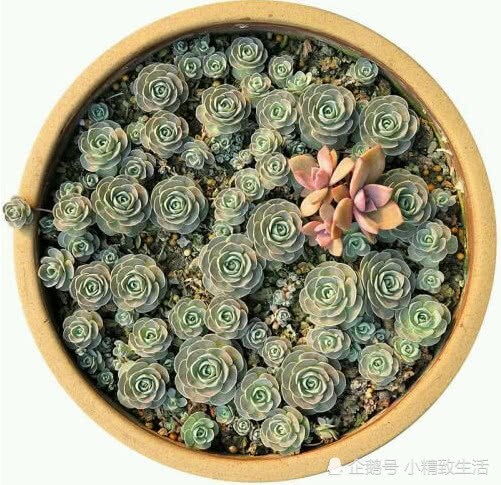
Many beginners fall into the succulent rabbit hole, but because they lack care experience, they end up killing one batch after another - grow a batch, lose a batch, lose a batch, grow another. So, are there any succulents that fill a whole pot without deliberate care and are also cheap? Here are ten such succulents we recommend:
1. Orostachys boehmeri
Orostachys boehmeri belongs to the genus Orostachys in the Crassulaceae family. It is native to Japan and Russia. It grows to about 3-4 cm, and sends out numerous side shoots by creeping stolons, quickly forming a spectacular scene of rosettes filling the whole pot. In spring and autumn it blooms with small, fragrant yellow flowers, and the flowering period can last two to three months.
In winter the leaves of Orostachys boehmeri wrap up and go dormant, then slowly sprout again in spring. The cabbage-like rosette stretches out little hands one by one, the little hands take root, and in summer and autumn it grows rapidly. In September it begins blooming and continues until November. After blooming the mother plant dies, but by then it has already produced many offspring.
2. Sedum dasyphyllum
Sedum dasyphyllum belongs to the genus Sedum in the Crassulaceae family. It is native to the arid regions of West Asia and North Africa. Its leaves are alternate, and it readily produces small side shoots that grow into large clusters. In spring it blooms with pale pinkish-white flowers.
The simplest way to get Sedum dasyphyllum to fill a pot is to take fresh cuttings, because if you only have one stem, getting it to fill a pot may be more than a little difficult for beginner growers. Re-cuttings let you arrange the planting density reasonably, and then you just have to fatten it up and it will fill the pot.
3. Sedum hispanicum
Sedum hispanicum belongs to the genus Sedum in the Crassulaceae family. It is native to Spain. Sedum hispanicum is miniature in form, with tiny blue rod-shaped leaves wrapping around the stem. The lower leaves easily drop off over time, but because the stems of Sedum hispanicum creep easily, the parts touching the potting soil produce adventitious roots and then new Sedum hispanicum plants. In summer it blooms with white, slightly pinkish six-petaled star-shaped flowers.
The most striking feature of Sedum hispanicum is its extremely fast growth cycle - one splits into two, two into four, growing in all directions at a tremendous rate. Many growers use Sedum hispanicum as a pot-covering plant to add scenery alongside other succulents, but if you are not careful it may squeeze the other succulents until they have no room to grow, which shows how tenacious Sedum hispanicum's vitality is. However, Sedum japonicum 'Tokyo Sun' is very prone to scale insect pests and then spreads them to other plants, so pay attention.
4. Sempervivum tectorum (Common Houseleek)
Sempervivum tectorum belongs to the genus Sempervivum in the Crassulaceae family. It is native to the mountainous areas of Spain, France, Italy and other European countries. Its leaves are flat and slender, arranged in a ring in a rosette shape, looking like a lotus seat. The leaf tips are sharply pointed, the leaf margins have fine fuzz, and under full light the leaf tips and margins develop a very beautiful coffee or purplish-red color.
Sempervivum tectorum has extremely strong reproductive capacity. Even if you put it on a tile roof and ignore it, after a while it will produce a large patch.
5. Kalanchoe daigremontiana hybrid (Mother of Thousands)
Kalanchoe daigremontian hybrid, also called Mother of Thousands, belongs to the genus Kalanchoe in the Crassulaceae family. It is native to Africa. The plant has round or oval pinnate compound leaves with rounded teeth along the leaf edges. The teeth readily sprout buds, and when the buds grow larger and fall to the ground they become new Mother of Thousands plants.
Since the leaf edges are covered with countless small rounded teeth, and each tooth that falls becomes a Mother of Thousands plant, one Mother of Thousands can propagate thousands upon thousands of them.
6. Sempervivum arachnoideum ssp. tomentosum (Cobweb Houseleek)
Sempervivum arachnoideum ssp. tomentosum belongs to the genus Sempervivum in the Crassulaceae family. It is native to southwestern Europe. A single plant measures 1.5-3.5 cm, is rather short in form and nearly spherical, with large amounts of spiderweb-textured fuzz tangled around the leaf tips.
Sempervivum arachnoideum ssp. tomentosum clusters easily and grows very fast, making it another succulent that fills a pot very easily.
7. Portulaca gilliesii
Portulaca gilliesii belongs to the genus Portulaca in the Portulacaceae family. As the name suggests, its leaves look like grains of purple rice. In summer it blooms with pink flowers, and the flowers are larger than the plant itself.
Portulaca gilliesii fills a pot very effectively - fallen stems and branches can take root right on the surface of the potting soil. Those with trypophobia should enter with caution.
8. Senecio rowleyanus (String of Pearls)
Senecio rowleyanus, also known as String of Pearls, belongs to the genus Senecio in the Asteraceae family. It is native to southern Africa and gets its name because its plump, round leaves look like prayer beads or pearls. The flowering period is generally from December to January.
The vines of String of Pearls produce aerial roots very easily, and it is also a common succulent that fills a pot.
9. Sedum rubrotinctum (Jelly Bean Plant)
Sedum rubrotinctum belongs to the genus Sedum in the Crassulaceae family and is a man-made hybrid variety. The more sun the leaves of Sedum rubrotinctum get, the redder they become; because of differences in light intensity, it produces a scene of alternating red and green that is very beautiful.
Every time I round up succulents I have to mention Sedum rubrotinctum. It is cold-tolerant, drought-tolerant, unafraid of intense sun, and extremely easy to propagate. Personally I consider Sedum rubrotinctum the number one introductory succulent for beginners.
10. Graptopetalum 'Mirinae'
Graptopetalum 'Mirinae' belongs to the genus Graptopetalum in the Crassulaceae family and is also a hybrid variety. A single rosette can reach 3 cm in diameter, a clustered plant can reach more than 25 cm in diameter and 15 cm in height, and it is much branched.
Graptopetalum 'Mirinae' is also a succulent that survives when tossed on the ground, thrives with a bit of sunlight, and fills a pot in no time.
The ten succulents above are cheap and easy to grow. Are you tempted?
Compiled and published by Little Exquisite Life.