The vine peony blooms in astonishing numbers, covering an entire wall with flowers
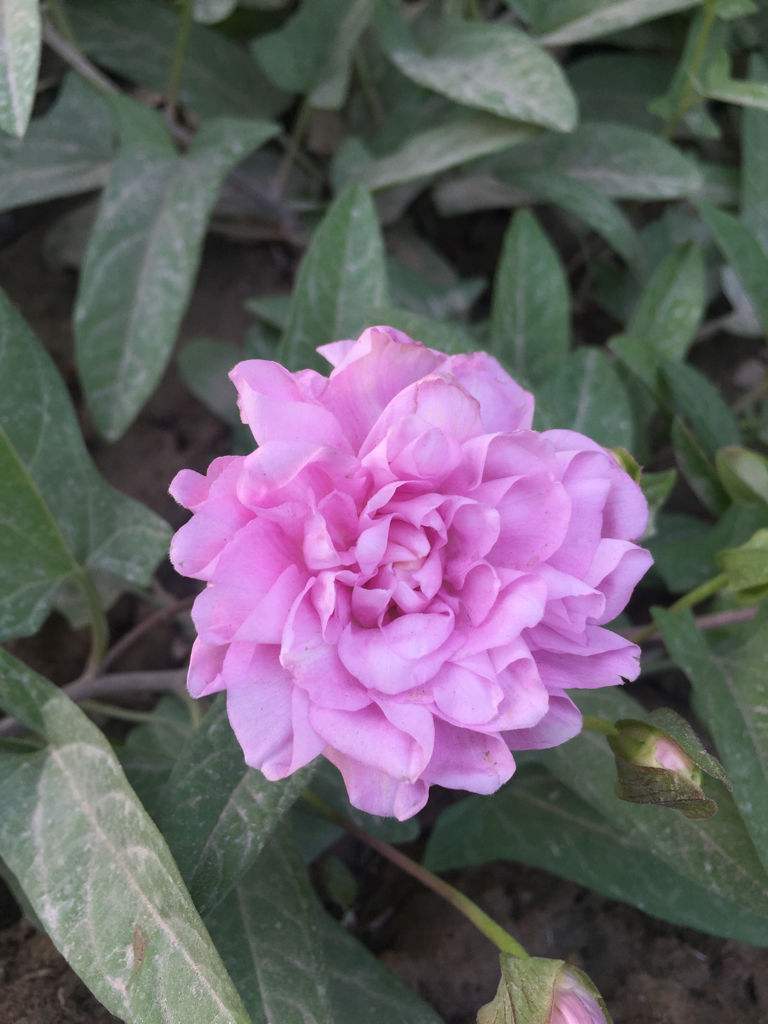
The vine peony, botanically named Convolvulus repens (also known as climbing peony), is a plant of the genus Calystegia in the family Convolvulaceae. Its stem twines counterclockwise, the main vine can reach a thickness of 0.3 cm to 0.4 cm, leaves are alternate and simple, and its lotus-shaped flower base bears flowers resembling tree peonies, pink in color, with double petals (40 to 50 petals) that are laciniate and irregular in shape, the petal lobes narrowing inward, with no stamens or pistils. It begins blooming in mid-June, and even when frost arrives there are still many flower buds on the vines. The vine peony withstands both severe cold and high temperatures, and likes both full sun and light shade. Seedlings moved with their roots take hold very easily, with no need for transplant recovery. It is native to China and is commonly found along roadsides and on mountain slopes at altitudes of 1500-3100 m. The vine peony has a long flowering period; at peak bloom it opens nearly a hundred flowers per day, like a brightly colored tapestry, magnificent and beautiful, making it an excellent choice for many forms of landscaping.
Vine peony
The stem twines counterclockwise, the main vine can reach a thickness of 0.3 cm to 0.4 cm, with 5 to 7 branches, internodes 2 cm to 3 cm long, leaves alternate and simple, petioles 2 cm to 3 cm long, leaf blades 6 cm to 8 cm long and 1.5 cm wide, with entire margins. From the leaf base, conjoined leaf extensions 1.5 to 2 cm long extend out to both sides, and the base of the leaflets is slightly two-lobed, botanically called a hastate leaf. Flower stalks are 5 cm to 8 cm long, and the lotus-shaped flower base bears flowers resembling tree peonies, pink in color, with double petals (40 to 50 petals) that are laciniate and irregular in shape, the petal lobes narrowing inward, with no stamens or pistils. The flower color is gorgeous and the leaf shape is attractive. In the same year it can grow as tall as 4 m to 5 m, and planted in the same year it blooms in the same year, one flower per node, each flower staying open for 3 days, and at peak bloom a single plant can open nearly a hundred flowers per day. It begins blooming in mid-June, and even when frost arrives there are still many flower buds on the vines.
Vine peony
Growing environment:
The vine peony withstands both severe cold and high temperatures, and likes both full sun and light shade. Seedlings moved with their roots need no shading, take hold very easily without transplant recovery, and are not fussy about soil. After planting, sturdy seedlings show flower buds at the 5th to 6th node.
Distribution range:
It is native to China and is found in Heilongjiang, Hebei, Jiangsu, Anhui, Zhejiang, Sichuan and other provinces. It is cultivated or naturalized, and is seen along roadsides and on mountain slopes at altitudes of 1500-3100 m.
Main value:
The vine peony has a long flowering period. A plant grown from a single basal bud can spread its vines to a canopy over one meter wide, and at peak bloom it opens nearly a hundred flowers per day, like a brightly colored tapestry, magnificent and beautiful; stirred by a gentle breeze it is like a flock of butterflies dancing. It is a good material for flower hedges, flower pergolas and flower corridors, and can also be used for ground-creeping flower passages and flower lawns, making it an excellent choice for many forms of landscaping.
Vine peony