With proper year-round care, potted Haworthia cooperi (Haworthia cooperi) easily grows into a full, overflowing clump, and the watering and fertilizing method is simple yet has its finer points.
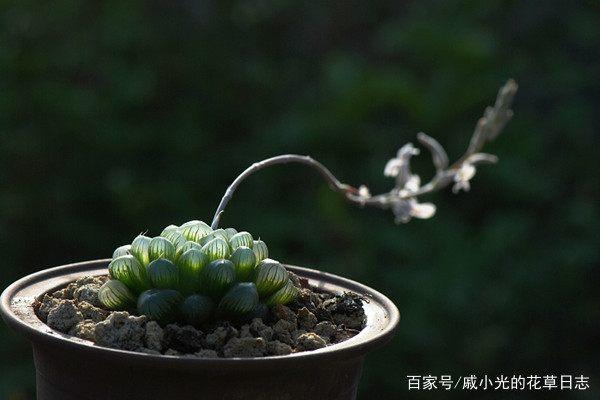
Potted Haworthia cooperi is the most common member of the Haworthia genus and a soft-leaved variety among succulents. It is extremely rich in species, with crystal-clear leaves whose bright windows look like living works of art, especially when viewed from a backlit angle, when the whole plant takes on a soft, hazy beauty.
Haworthia cooperi is characterized by its love of cool seasons and strong light; when grown with higher humidity, its windows stand out more and become relatively more transparent, but the water must not be excessive. Grown this way, the plant looks like green jade, pure and ice-clear.
Under these conditions, or under cold, extreme heat, or strong light, the plant's color can also change from green to red, which is very interesting too. Another key point in daily care is light: if the light is poor, the leaf stalks at the lower part of the plant will become leggy, ruining the overall shape and making the plant very prone to rot.
The beautiful windows of potted Haworthia cooperi come from sufficient light: the chlorophyll in the plant converts into carotene that accumulates in the leaf stalk area, tinting the windows purplish-red, while the gelatinous substance inside the windows gives off a blue luster. This is also the best state for growing Haworthia cooperi. Daily management of potted Haworthia cooperi should also be divided by season, so that it can be grown to its best condition.
For potted Haworthia cooperi, the first thing to consider is the growing medium. Generally it is pure akadama, or pure kanuma soil, which is very simple, yet the plant still grows quite well. If these materials are hard to find, you can also use orchid stone, or a mix of peat soil + perlite + large-grain vermiculite as the medium. As for the pot, glazed ceramic pots have poor air permeability and are not recommended; other types such as plastic pots, clay pots, and earthenware pots are all fine.
Spring is the season of vigorous growth for Haworthia cooperi, and at this time light and humidity should be artificially increased. If the growing environment is too shady, the plant's shape will become loose and not compact, the leaves will become thin and elongated, and the transparency of the "windows" will be much worse. You can apply some diluted liquid fertilizer appropriately, but be careful not to make the concentration too high.
Summer is the dormant period for Haworthia cooperi, and what needs attention is strictly preventing bacterial infection. By autumn, the plant's new roots have generally grown in well, and this is also a peak growing season. In winter, you should pay appropriate attention to keeping it warm; note that low temperatures will stop its growth and affect the growth rate of the whole plant. It can be placed behind glass to receive direct sunlight, and then Haworthia cooperi can be grown plump and lively.