How to Identify Orchid Petal Types? A Complete Guide to Practical Methods
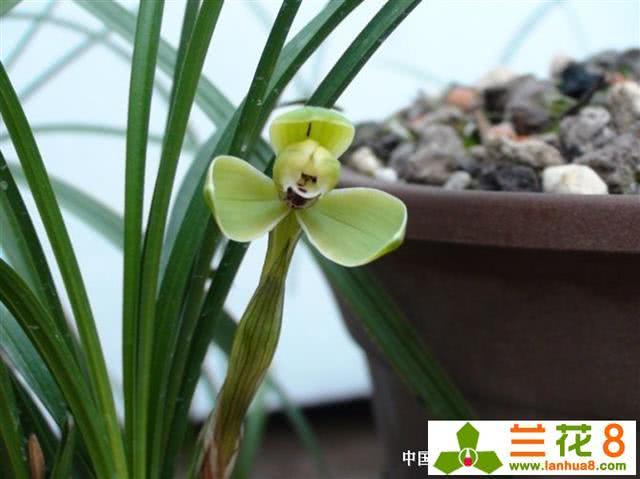
The theory of orchid petal types, after being founded by Mr. Bao Weisheng in the early Qing Dynasty, was continuously refined by many orchid scholars, and it was not until Mr. Xu Qilou that it was discussed in detail in his famous work "Lan Hui Tong Xin Lu." This book is difficult to understand, so I now present my learning experience and explain it as follows.
(1) Plum Petal Flowers
Essential conditions for plum petal flowers:
1. The flower appearance must be dignified, the structure rounded and compact, and the texture thick and softly lustrous. "Dignified flower appearance" means that every part of the corolla is not distorted or twisted, and the arrangement is neat and well-proportioned. In particular, the sepals, the column, and the middle to the tip of the lip must not be slanting or twisted. "Rounded and compact structure" means the structure is tightly arranged and symmetrical. With the base below the column as the center and the length of a petal, lip, or sepal as the radius, draw a circle; the column and lip should be able to touch the inner circle tangentially, and the three sepals should be able to touch the outer circle tangentially. Only then can it fully express the elegance of plum roundness and the meaning of roundness. "Thick and softly lustrous texture" means each part is full and rich, with a strong sense of three-dimensionality, and the color is fresh and lustrous rather than dull or aged, able to evoke a sense of beauty.
2. The sepal tips must be broad and round, the sepal body short (striving for a length-to-width ratio of more than 2:1), and the sepal base (root) must be noticeably narrowed.
3. The sepal edges must be tightly rolled, that is, the sepal edges contract into an inward-curling form.
4. The petals (column) must have a pouch, that is, the edges contract and rise into an inward-curling form, or harden into a fist-like "hard pouch."
5. The lip (tongue) must be firm, short and round, and held flat or upturned.
Among the above five essential minimum conditions, items 2, 3, and 4 should be especially strictly adhered to. Otherwise, it cannot be called a plum petal flower.
If items 1, 2, 3, and 5 are all present but only item 4 is not, that is, the petals (column) have no pouch, then it is not a plum petal flower and can only be called a round petal flower.
If items 1, 3, 4, and 5 are all present but only item 2 is not, that is, the sepal tips are slightly pointed, the sepal body is relatively long, and the sepal base (root) is relatively thick, then it can only be called a plum petal narcissus petal, and absolutely cannot be called a plum petal.
The requirement of plum petal flowers for sepals lies mainly in the sepal tips, namely whether they are round in shape and tightly edged. If so, they may be called such; if not, they cannot be called such. As for the length and width of the sepals, a ratio of more than 2:1 is best. Those that do not reach this proportion naturally have a lower grade.
2 Lotus Petal Flowers
Essential conditions for lotus petal flowers:
(1) The ratio of sepal length to width must be within 2:1. The closer it is, the higher the grade.
(2) The sepals must have distinct angles and narrowed bases. This is an important marker for distinguishing lotus petals from bamboo-leaf petals.
What are angles? Angles mean that there is a distinct obtuse angle on each side of the sepal tip or the middle part of the sepal. In most lotus petal orchids, the two sides of the sepal tip are obtuse-angled, such as Da Fu Gui and Huan Qiu He Ding. But some varieties have angles on both sides of the middle part of the sepal, resembling rhombic sepals, such as Futian Da He and Tai Ji.
What is a narrowed base? A narrowed base means that from the angle it gradually and noticeably narrows toward the sepal base, and the width of the sepal base is about 1/3 of the width at the angle. Narrowed bases differ in short narrowed base, long narrowed base, and narrowed bases at both ends. A short narrowed base appears because the sepal body is short and the angle is especially large, such as Gai He and Taiyuan He; a long narrowed base appears because the sepal body is relatively long and the angle is at the front end of the sepal, such as Gao He; narrowed bases at both ends appear because the angle is in the middle of the sepal, such as the dragon-character lotus-form narcissus petal.
(3) Wavy protrusions are allowed at the center of the sepal tip, but the protrusions must curl slightly inward.
(4) The edge of the sepal tip must be tightly contracted and slightly curled inward, that is, tightly edged. If it is not tightly edged, it can only be called a lotus-form narcissus petal.
(5) The petals (column) are required to be relatively broad, short and round, or slightly oblong. That is, the petals should resemble half an empty mussel shell, concave inside and convex outside, covering the column. The state in which the two columns are close together and tightly cover the column is best; "opening a skylight" is second; petals that are thin-fan-shaped and have a pouch are also excellent.
(6) The lip is required to be large in shape, allowed to droop, and slightly curl backward, with a large round tongue or large spread tongue being best.
The bud covering (botanically called the receptacle) has rich color; the petal type of this flower will certainly be stable.
3 Narcissus Petal Flowers
Essential conditions for narcissus petal flowers:
(1) The sepal width is broad, approximately long-rhombic, the sepal tips may have a sharp point, and the sepal base must be narrowed.
(2) The petals (column) must have a pouch or shallow pouch. Whether the petals have a pouch is very important. Only with a pouch can it be called a narcissus petal; if there is no pouch, it can only be called a bamboo petal.
(3) The lip droops and curls slightly.
4 Round Petal Flowers
Essential conditions for round petal flowers:
(1) The three sepals and two petals (column) must be short with round or elliptical (ovate) tips.
(2) The lip must be short and round.
5 Bamboo-Leaf Petal Flowers
Essential conditions for bamboo-leaf petal flowers:
The sepals resemble the shape of bamboo leaves, appearing band-like, thick at the base and pointed at the tip. The sepal tips taper smoothly to the end; the petals have no pouch; the size and form of the lip are not restricted.
Bamboo-leaf petals are divided into broad and narrow types. The narrow type is the willow-leaf shape, or willow-leaf petal.
Although bamboo-leaf petal flowers are not high in grade, they also have extraordinary ornamental value. For example, the following types are also highly favored.
(1) Those in which the sepals, petals, and lip are all broad and large, the color is emerald green, the shoulders are flat and extended, and the flower appearance is dignified.
(2) Those in which the front and back sides of the sepals and petals have five-color brilliance.
(3) Those in which the sepals are broad and large, resembling a rhombus, often called lotus-form bamboo-leaf petals.
(4) Plain lips, that is, single-colored, without any differently colored spots or patches.
6 Chicken-Claw Petal Flowers
Characteristics of chicken-claw petal flowers: the sepals are shaped like chicken claws, narrow and long with long pointed tips, and some sepal tips are also hook-shaped.
Although this petal type belongs to the lowest grade, it also has its own unique elegance, delighting the eye and pleasing the heart.
(1) The flower shape is especially large, with a normal flower diameter of 10-16 cm, and especially large ones with a flower diameter above 20 cm.
(2) The sepal forms are diverse and rich in curvilinear beauty. There are horse-step shoulders, flat shoulders, flying shoulders, long drooping shoulders, dancing shoulders, reflexed sepals, folded-crane main sepals, and encircling sepals, truly colorful and varied.
(3) The column forms are diverse, including scissors column, cat-ear column, reflexed column, upright column, mussel-shell column, and flying column.
(4) The lip is large in shape and brilliant in color.
The lips of chicken-claw petals are mostly long and broad, diverse in form, with both plain lips and colored spots, and the colored spots are gorgeous.
7 Butterfly Petal Flowers
So-called butterfly petal flowers are those in which part or all of the flower's sepals and petals become lip-like, called lip petal flowers, commonly known as butterfly transformation. They can be divided into three major categories:
(1) Sepal lip petal flowers, that is, part of the lower half of the flower's sepals, either 1/3, nearly half, or more than half, becomes lip petal. Recently, a case has been found in which the main sepal is entirely lip petal, such as Cangshan Qi Die, registration number 063.
(2) Petal lip petal flowers. Most are partial lip transformation near the side of the lip, and some are partial lip transformation on the side near the main sepal, such as Bi Long Qi Die, registration number 03. There are even those in which the entire petal is lip-transformed, such as Bao Dao Xian Nu.
(3) Sepals and columns fully lip-transformed. That is, in the same flower, the sepals and petals simultaneously show full or partial lip transformation. Abbreviated as full butterfly.
8 Super Petal Flowers
Super petals refer to sepals and petals whose width exceeds the ordinary, or whose petal form is abnormal. Generally there are 3 basic forms:
(1) The petal base is not narrowed and is equal in width to the petal tip.
(2) The petal base is broad, and the petal tip is even broader.
(3) The petal width is abnormally broad, and the petal form is even more unusual.
If a super petal flower can at the same time have a short and round flower, a super-large lip, a straight-line shoulder or flying shoulder, or a strange form, it naturally belongs to the rare and precious.
9 Peony Petal Flowers
The outer whorl of sepals resembles chrysanthemum petals, with a noticeably increased number, and the number of petals is also increased, and they often show lip transformation. Such as Guo Xiang Mu Dan and Da Tun Qi Lin among Cymbidium sinense.
10 Chrysanthemum Petal Flowers
The sepals and petals are whorled and increased in number, resembling chrysanthemum petals. Such as Jiu Zhou Cai Qiu and Yu Hu Die among Cymbidium sinense.
11 Strange Petal Flowers
What are strange petals? Strange petals are strange flowers. First, they refer to the various parts of the flower increasing or decreasing away from the standard type; second, they refer to the form and structural shape of the various parts of the flower being bizarre; third, they refer to the flower's color being especially gorgeous; fourth, they refer to a certain part of the flower having a finishing touch-like inlay.
(1) Increase or decrease in the number of petals. The increase or decrease in the number of each part making up the flower must be basically similar in every flower on the same scape; only when every flower has some increase or decrease can it be called a strange flower. Generally people prefer an increase in number, calling them multi-petal strange flowers, to imply prosperity and development; a decrease in number should also belong to strange flowers, but it is understood as a sign of decline and is not welcomed. Those with an increase in number may further differ in whether one part, several parts, or all parts increase; those with a decrease in number mostly have a decrease in one part, or several parts decreasing at the same time, but it is impossible for all parts to decrease to nearly zero.
(2) Bizarreness of form. Those with bizarre forms are called strange-form flowers, and there are 4 situations:
a. A certain part of the floral organs is transformed. For example, the main sepal is especially long and unusually broad, the lateral sepals are shaped like streamers; the lip is broad and long, shaped like an apron; the column becomes like a Buddha image; the petals are shaped like a longevity peach, like a bee or butterfly; the lateral lobes are especially raised, resembling multiple lips, etc.
b. Several parts of the floral organs are transformed together.
c. All parts of the floral organs are transformed simultaneously.
d. Mother-and-child flowers in which small flowers open again from the flower stalk; double-tiered flowers in which multiple flowers open again on the flower, etc.
(3) Gorgeousness of color. First, the entire flower appearance is especially bright and gorgeous, astonishing people; second, a certain part has just the right embellishment, especially eye-catching; third, the coloration is peculiar, mutually enhancing, elegant in charm, making people linger. These can be called strange-color flowers.
(4) Heteromorphic inlay. For example, the sepals or petals are inlaid with crystal lines of varying lengths, like a waterfall pouring down; the petals are inlaid with symmetrical eye-like beads; the anther cap has a bright red dot or double bright red dots; the lip is inlaid with pearls and dragons, and there are even those in which every part of the whole flower is inlaid with patterns; and so on. These are called inlaid-pattern and inlaid-pearl flowers.
In summary, strange petals must be strange with artistic sense, connotation, and spirit, and able to enhance beauty, only then can they be called good flowers; those that are strangely chaotic, ugly in appearance, gloomy in coloration, and lacking beauty have no value.