What are the traditional characteristics of Tong-school bonsai?
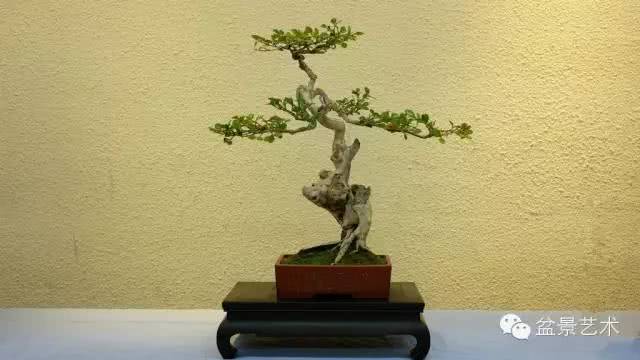
Bonsai art has a long history in our country. Because our country is vast, the soil and climate environments across the country differ greatly, and together with the local customs and cultures of each place, over time, different schools formed in bonsai art, and Tong-school bonsai is one of them.
Traditional Tong-school bonsai has roughly the following characteristics in pruning and wiring:
1. Refined material selection
The quality of a bonsai is inseparable from the creator's thinking, culture and artistic processing, and material selection is a prerequisite. For traditional Tong-school bonsai, trees that are "full, remnant, clear, strange and ancient" are generally chosen.
Full means the upper and lower branches and leaves are full. After shaping, the bonsai's pads are flat with distinct layers, the crown forms a "steamed-bun top", and the pad trunks form a "crucian carp back".
Remnant means choosing trees that look incomplete, but with slight processing such trees have a natural conception, thick trunks and curved branches, and are full of vitality.
Clear: choosing relatively quiet and elegant trees.
Strange: choosing some trees with peculiar shapes. Some trees originally grew in the cracks of rocks in deep mountain gorges, and their roots and trunks are in a thousand postures and a hundred shapes, towering and vigorous, or shaped like chicken claws, or like coiling dragons and gliding snakes. After processing, some of these trees look like they are "welcoming guests", some like they are "seeing off guests", some like "tigers", and some like "phoenixes", full of delightful charm.
Ancient: choosing trees with a long tree age.
2. Beauty of shape
1. Traditional Tong-school bonsai should have a ground-sitting bend, a second bend and a half bend.
Ground-sitting bend: that is, the trunk is made into a "bend". For example, if the trunk is required to bend to the left first, the trunk should be planted in the pot slanting down to the right, with the trunk close to the soil, bending to the left. This bend must be made in a hunched-camel shape, making the trunk feel vigorous and powerful.
Second bend: at 1/2 the height of the ground-sitting bend (depending on the trunk), the second bend begins, that is, the trunk continues to bend to the left, then turns to bend to the right. The distance between the most curved point and the most curved point of the ground-sitting bend should be slightly higher than the height of the ground-sitting bend.
Half bend: at a place where the transition distance from the ground-sitting bend and the second bend is basically equal, the half bend pruning and wiring begins. Special attention should be paid to the fact that the center point of the half bend should be on the same line as the center of the ground-sitting bend.
2. Crawling roots, teapot spout
Crawling roots: traditional Tong-school bonsai should have crawling roots, with roots forming claws, creating twisted and interlocking roots, making the tree appear old and strong, stable and firmly rooted.
Teapot spout: the starting trunk and the extending trunk, together with the main trunk, should all be wired into a teapot spout shape at a certain angle. The teapot spouts should differ in height, vary in length, and have rises and falls.
3. Highs and lows, distinct layers, full pads
A perfect traditional Tong-school bonsai should achieve complete posture (form), momentum (the direction the branches point) and spirit (spiritual charm). Seen from the front, it leans left and right, with an upright top, and a vigorous and archaic main trunk. Seen from the back, the pad trunks have distinct layers, solemn and full. Seen from the side, it is natural and unrestrained.
Traditional Tong-school bonsai also has high requirements for the "pad" surface. The crown should form a "steamed-bun top", the tree pads should form a "crucian carp back", and the back should be fuller than the front.
Therefore, predecessors used four sentences to summarize the characteristics of traditional Tong-school bonsai: namely;
Belly drawn in to form a hunchback (ground-sitting bend)
Leaping horse galloping, turning back to look (second bend)
Lined up in formation, glancing sideways at the "army flag" (half bend)
Upper and lower centers form one line (overall)