Growing a terrace garden into its 2nd year, I lost so many plants
Spring is a season full of hope for gardening friends, but my April and May were spent entirely in anxious unease.
The reason is that last winter was the first winter my terrace plants experienced, and under thermal insulation protection, whether they could survive a cold winter of more than minus 30 degrees depended on whether there were signs of life when spring began.
After finally waiting until nighttime temperatures stayed above zero for several consecutive days, I could not wait to peel off the cotton quilts and plastic, clear away the thick layer of dry leaves, and all the plants were fully exposed to the dry early-spring wind. Here I made my first mistake. I knew this point myself, but when the moment came, I forgot it. As a result, so many died!
The correct approach is that after removing the cotton quilts, the plastic film should be kept in place, and only when the buds on the branches begin to develop normally into new shoots can the covering be completely removed.
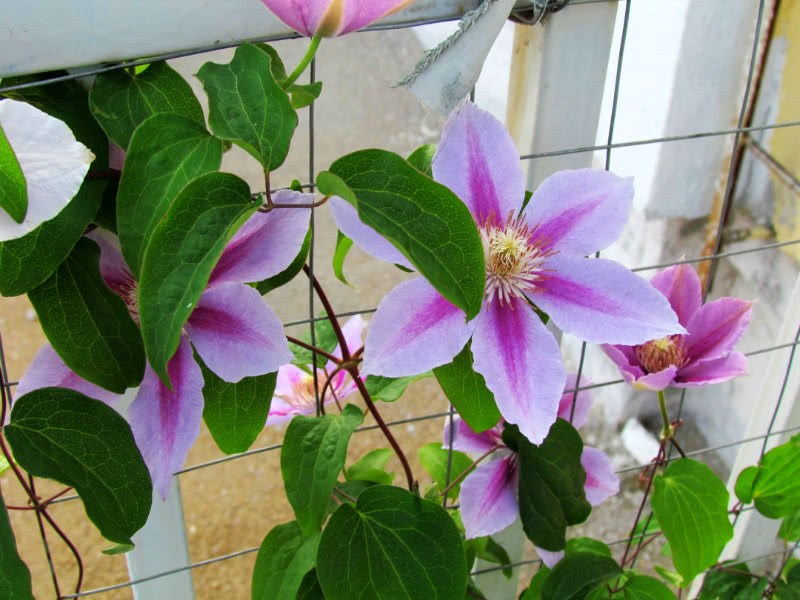
Clematis: last year it was over-fertilized, and the branches were all distorted. This year I added less fertilizer, and as a result, the bowl-sized flowers other people had did not appear in my home. The flowers of Bees' Jubilee were quite small.
Clematis: Bees' Jubilee's flowers were too small, and I do not know how much fertilizer would be considered appropriate. Fuji Blue grew quite a bit taller than last year, but its flowers were not as elegant as last year's, just one big silly oversized bloom (I am really hard to please, small is no good, big is no good either)..
Utopia is, after all, a small seedling, and I was already very happy that it could offer flowers this year. It is just that last winter the community added exterior wall insulation and actually painted it bright yellow, and the more I look at it, the uglier it seems, making the flowers look unpleasing too. As for Ru Meng, I did not train the branches and just let them climb naturally, and as a result the dense mass of flowers all bloomed at a height of more than three meters, making it impossible to photograph them at all. Next year I will try winding the branches around and tying them, so at least they should bloom a bit lower.
Climbing roses: Pink Dawn was also a small comfort. It was a newly planted seedling last year, opened only two flowers, and produced only three branches the whole year. This year, on those three branches, it burst out with dense buds, and every new short shoot carried a flower bud at its tip. But strangely, no new long branches came out, and I wonder what to do next year. However, I found that Pink Dawn's flowering period is super long, with a single flower lasting 7 days, while other European roses basically fade in one or two days. But Pink Dawn's flower stalks are very short, so they cannot be put in a vase.
Graham Thomas: I had high hopes for it. Last year it took only a few months to grow from a small seedling to a strong plant, with so many strong branches and such large flowers. Unfortunately, when spring began, the wind took away half its life, and it only grew a few new shoots at the base. Although it did bloom, the flowers were small and the color was much paler.
Rose Eden: a medium seedling bought in spring, with astonishing growth speed. It is now almost one and a half meters tall, and many thick new branches have emerged. It also bloomed twenty or thirty flowers in succession. Because it was a newly planted seedling, I was afraid of burning the roots and did not dare to apply base fertilizer, so the first flowers were still fairly large, but later ones became smaller. The perfectly formed bloom shape did not appear. This winter I plan to add more fertilizer, hoping it will bloom better next year. In addition, based on my experience of more than a year, roses are heavy feeders. No matter how much is added, other plants may suffer fertilizer burn, but roses will not.
Charlotte: last year it was planted in the wrong spot. From a small toothpick-like seedling, it grew thin and long, obviously weak. This year I moved it to a sunny spot, cut those few thin branches short, and in spring it also produced many flowering branches. The color was good, and the size was slightly small. The drawback is that a single flower's flowering period is too short, basically fresh for only one day. The overall flowering period was still fairly long, and it never stopped blooming even in midsummer.
White hydrangea (Bella Anna): the photo below was taken last year. The sickly one on the left with a cane is the newly planted white hydrangea from last year. After uncovering the covering in early spring this year, I cut the branches short to ten cm, and as a result, on those short ten-odd cm, more than a dozen buds burst out. Later it grew to one and a half meters tall, and when the flowers were in full bloom, their diameter was more than twenty-odd cm, changing from green to snow white, then back to green. Cut them off, hang them upside down indoors, and in a few days they become dried flowers, and the color does not fade. I love them greatly. The pink one is Endless Summer. The scene of last year, with flower balls all over the branches, did not repeat, and this year it opened only one flower.
This year the only comforts among the plants seemed to be lavender and the white hydrangea Bella Anna. They overwintered successfully, grew into a big clump, and had an extremely long flowering period, still blooming sporadically even now.
Succulents: I had been paying attention to succulents for a long time, and the reason I kept hesitating to start was that I wanted to get familiar with them before choosing, so as to avoid buying things I would stop liking after a few days and wasting money.. As a result, I watched succulent prices shoot up. Ordinary varieties that once sold for two or three yuan were being sold for ten or twenty yuan, so I quickly bought more than twenty kinds. Fortunately, I got in before prices went through the roof, and the whole lot cost only more than two hundred. This is how they looked when first planted last year. Because I had no pots, I had to cram them into two pots:
After spring began, these two pots of succulents were placed in full light, and throughout spring, summer, and autumn they were never moved. Sun and rain, everything southern friends fear, I did it all, relying on the fact that the north is naturally suited to growing succulents. The succulents also lived up to expectations and suffered basically no damage. They had vivid colors in spring, came through summer unharmed, and by autumn every one of them had burst out a cluster of pups. It looks like they will need to be divided into separate pots before winter begins.
Below are some miscellaneous flowers, so I will not ramble on.
Loving flowers is everyone's nature, but growing flowers is by no means something everyone can do, and making flower growing a hobby is even less easy. Because it changes not only one's attitude toward life, but also a habit. In this age of rampant materialism, who is willing to change a habit for flowers?