Learn how to water succulents so they don't rot and grow fatter and fatter
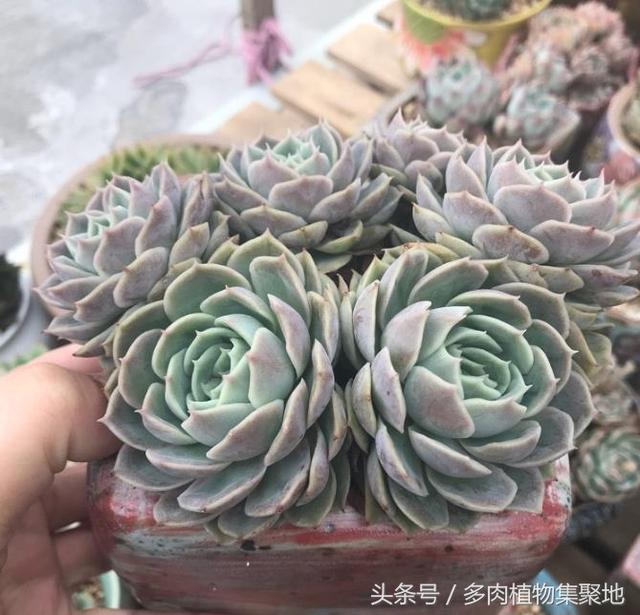
Spring and autumn are relatively cool, but when there is plenty of sunlight, the water in a clay pot almost dries up completely in 1-2 days. At this time, watering once a day or once every 2 days is no problem. However, ceramic, metal, plastic and other flower pots have relatively poor breathability, so the watering interval is generally 2-3 times that of clay pots. Succulents grown in these containers hardly need much care; after watering once, you can go out with peace of mind. The so-called water cutoff in summer also refers to these poorly breathable containers, because after watering, a large amount of water will still remain at the bottom of the pot.
Succulents that have grown for many years and are very robust, because their root systems are already very developed, can also be watered once every 2-3 days in continuously sunny conditions when planted in ceramic-type pots with poor breathability. If planted in a clay pot, they can even be watered once a day. In an outdoor growing environment, even continuous rainy or heavy rain weather has no effect; on the contrary, they will grow even better. For this kind of succulent, I always water with a heavy drenching method.
Some succulents have fuzz or fine powder. If you spray the leaves with water and the fuzz falls off, it is easy to cause damage. For outdoor-grown succulents, if there is water on the leaves, strong sunlight will scorch the leaves. Usually it is best to pour water at the roots, along the edge of the pot. If you don't know how to water, you can use a special squeeze spray bottle for succulents, which can water at 360 degrees and is very convenient.
Newly planted succulents have a weaker ability to absorb water because they have fewer roots, are adapting to a new environment, and are recovering from damage, so they do not need much water. For this type of succulent, the better watering method is: frequent but small amounts of water. Now there are special liquid flower fertilizers for succulents on the market. Mix them into the water and pour together, and the effect is especially good. Using a special organic nutrient solution for succulents can not only promote root growth, but also help succulents color up.
If you are just preparing to grow succulents in a container without holes, the best way is still to drill holes in the container. An ordinary handheld electric drill can solve this problem, but if the container is ceramic or glass, the drill bit must be a special drill bit for ceramic and glass. In fact, growing succulents in a container without holes also has a little-known benefit: it makes plant lovers feel a sense of awe about the problem of water accumulating at the bottom of the pot. Since they are afraid of black rot, they naturally control their hands and do not water casually. But then a new problem arises: under such conditions, the succulents are often always in a state of water shortage. Not watering because of fear of black rot is overcorrecting.
Many granular volcanic rock-type growing media have the effect of improving alkaline soil. For example, akadama soil, pumice, volcanic rock and other growing media. Perlite also has the effect of regulating alkaline soil. In addition, what is very worth mentioning is maifan stone. Its characteristic is that it can adjust both acidic and alkaline soil toward neutral. This property is very good and cannot be matched by growing media of the volcanic rock series. When we have already used these acidic growing media, if the water is not strongly alkaline, it basically has little effect on the succulents.
This is a gathering place for succulent lovers, sharing succulent care tips. Welcome to follow and exchange ideas.