The better the sunlight, the more vigorously it grows. This flower is gentle and lovely, fresh and elegant, and is an excellent choice for potted plants.
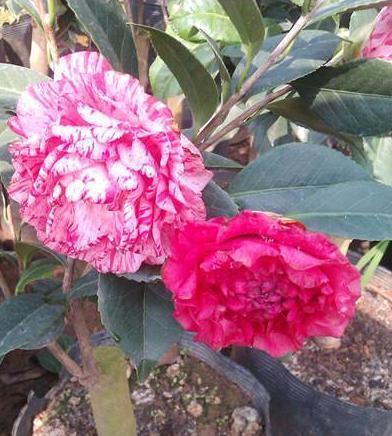
Flowering potted plants are truly excellent greenery. Once they bloom, they catch the eye, and they can also absorb harmful substances indoors. In particular, some flowers can even absorb formaldehyde, making them a wonderful hobby. Many friends who love flowers have also placed lots of beautiful flowers at home. Today I will recommend a very beautiful flower to everyone. Although this flower is not as gorgeously showy as other flowers, it has a different kind of beauty, with a fresh and elegant feel instead.
This time I am recommending a camellia variety called 'Jiaozui Ganbeier' (Ganbeier). Camellias are already very beautiful, and cultivated camellias have much stronger disease resistance. This flower is one of the more outstanding camellia varieties.
The Ganbeier's leaves stay emerald green year-round. After blooming, it is gentle and charming, with a leisurely and elegantly understated flower color and a beautiful hue. After blooming, the entire flower is pink with red, and some top-grade plants can even produce fully red varieties, with extremely high ornamental appeal.
Actually, there are many camellia varieties, all very beautiful, and each variety has a large group of flower enthusiasts who love it. If you like this Ganbeier or other camellias, you can go for it now. Camellias really are all quite beautiful.
Guaranteed true-to-variety recommendation: 4-year camellia saplings, shipped with flowers, free shipping
Camellias really love fertilizer, but you must apply light fertilizer frequently; too much fertilizer will surely kill them.
Put sheep horns, pig trotters, bones, fish intestines and stomach, poultry manure, fish offal, meat bones, fish bones and spines, fish scales, crab shells, shrimp shells, hair, nails, livestock hooves and horns, and miscellaneous bones into a vat, add an appropriate amount of EM bacteria, then add a small amount of water, keep humidity at 60%-70%, seal it, and after a period of rotting and fermentation it can be mixed with water for use. It is an excellent base fertilizer for potted flowers. If it is further soaked and fermented, it becomes a phosphorus-rich vegetable fertilizer. These are phosphorus-rich miscellaneous materials. After crushing these materials, evenly stir them into the soil, or place them in a container to ferment, and they become an ideal phosphorus fertilizer. The fertilizer effect can last for more than 2 years.
In addition, flower enthusiasts should understand that everyone's environment, humidity, temperature and ventilation are different, and growing methods vary, so do not get hung up on what kind of soil others use, what kind of pot they use, or how often they water. That will only leave you more confused. As long as you carefully observe and learn from your own camellia growing, you will quickly find the knack for growing camellias. Put simply, it is about mastering the right degree. Use the pot you want to use, the soil you can find around you, master the timing of fertilizing, and master the timing of watering, and you will find that growing camellias is not very difficult.
Here I wish everyone success in growing camellias and beautiful blooms.
When I have time, I will reply to everyone's questions under this article. I also ask the experts on Toutiao to show some kindness and help answer some questions for beginners, and to contribute to the promotion and popularization of camellias.