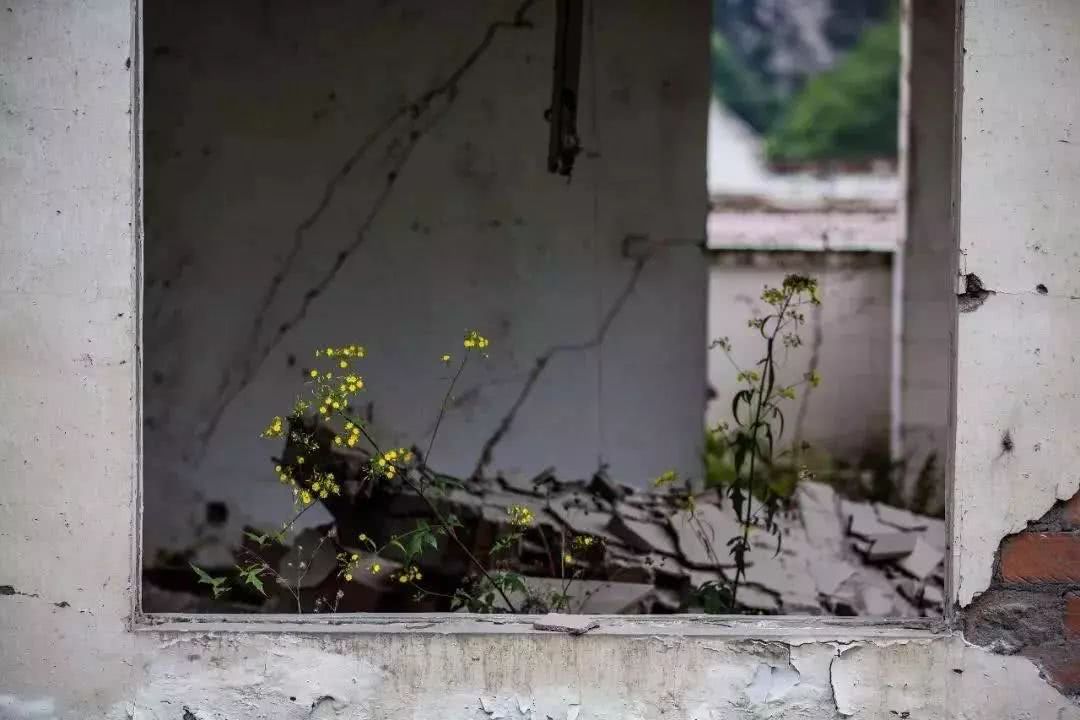
Flowers blooming in the ruins are the most comforting sight of all
Today the media are all commemorating "5-12" in their own ways, leaving everyone in a daze - it turns out that ten years have already passed since that deeply etched sorrow of 2008.
An earthquake ten years ago destroyed so much, whether people or plants. But plants always seem to heal earlier than the human heart. They grow wild upon the ruins, and they give us comfort and encouragement. Seeing them, we remember what those disasters took away, and what they could not take away. Perhaps more than plants depend on us, we depend on plants.
Ten years after the Sichuan earthquake, we hold fast to remembrance, and we must also keep living on.
When the wind blows through here home already feels so far away
Mo Xi Zi Shi
00:00/06:26
{Peony Girl Vol.734 }
x
Waiting to heal
A month ago, in Aba, Sichuan, at the former Xuankou Middle School,
the dormitory building had already grown full of green grass and shrubs.
On the ground, on the walls,
in every other crack they could find, they took root and sprouted,
bravely and fearlessly claiming this place.
Without people, without the sound of reading aloud, without laughter and roughhousing,
only the silently growing plants have become the masters here now.
On May 12, 2008, at 14:28 Beijing time, an earthquake of magnitude 8.0 struck Wenchuan. The earth split in two, the soil and rocks that burst forth buried everything, and this middle school was forced to stop teaching, until ten years later, when it gradually recovered and became a natural wonder.
Around it, more than ten thousand lives lie in eternal rest.
A tree grows wild on the rooftop, as if continuing the life here.
The ruins still hold cars destroyed in those years.
The Tangjiashan barrier lake formed after the earthquake completely submerged Xuanping Township.
In recent years the water level has receded, and shrubs several meters tall have grown on the rooftops.
This is a natural wonder brought by the earthquake, and also a manifestation of healing after pain.
Many young people who visited these ruins later wept when they saw them. They could still feel what had once happened there, and feel the emotional tremor shared by all humanity.
In the face of natural disasters, humans are all insignificant passers-by. The dead were destroyed and harmed, while the living must endure their grief and keep living.
In the Ya'an earthquake of April 20, 2013,
the home where an elderly woman had lived her whole life collapsed in an instant,
and she sat on a floral-print sofa weeping silently.
On April 25, 2015, after the Nepal earthquake,
outside a hospital packed with the injured lay a famous victim,
with fresh flowers and money placed upon the body.
And that terrible nuclear leak at the No. 1 nuclear power plant.
Inside the exclusion zone of the nuclear power plant, flowers are slowly withering and dying.
Whenever these natural disasters strike, apart from praying for the dead, shedding tears, and silently laying down a bouquet of flowers, people seem to have no other more effective recourse.
Chrysanthemums grow tall at the graveside, and this flower has also become our
first choice of flower when commemorating the dead.
An 88-year-old man from Sichuan
walks ten kilometers up the mountain every day,
to sing and dance for his departed wife.
His wife died in the 2008 Wenchuan earthquake. In that earthquake, a total of 69,227 people died, 374,643 were injured, and 17,923 went missing.
The earthquake took away his family and his home, but he survived,
and every day he goes to see his departed wife in this way,
as if she had merely gone on a long trip and would always come back.
Two-year-old Ayaka and her family pray for her grandmother in an open lot,
for she went missing in the earthquake.
In front of the Tangshan earthquake memorial wall in Hebei,
a little girl holding flowers gazes at the words on the wall.
After the massive November 15 fire in Shanghai,
large numbers of citizens and ordinary people came spontaneously from every district,
holding flowers to mourn the souls lost in the fire.
On the day of the "first seventh," not a single bunch of white chrysanthemums could be bought near the fire-stricken neighborhood.
After the memorial ceremonies comes the long period of recovery.What is visible is the healing of the land, but the healing of the human heart is even more unfathomable, with no deadline.
Some people survived, yet their hearts remained forever on that day, unable to go on as if their souls had been drawn out. Some people dried their tears, packed their bags, and left the places they once knew, going to distant lands to seek the meaning of life anew. And some people took action, persevering in one thing, to comfort the dead and soothe the living.
After the Fukushima nuclear power plant leak,
a glider researcher who graduated from the architecture department of a prestigious university
threw aside a high-paying job and decided to plant cherry blossoms on the mountain.
This is the story of the "Ten Thousand Cherry Trees Planting Project" (Review | A billionaire gives up his fortune and goes into the mountains to plant 99,000 cherry trees, just to "atone"), after a disaster, food and warmth can no longer make people happy, and it seems only then can one see clearly that the glittering world pursued in ordinary days is utterly meaningless.
So then, choose to plant trees and flowers. Seeing the trees grow and the flowers bloom feels like life has been continued.
"I hope that the children 20 or 30 years from now
can see cherry blossoms covering the mountainsides here.
Let future people know how deeply we love this land.
Seeing more and more cherry blossoms come into bloom,
people should feel happy."
After many people heard about it, they came from far and wide,
joining this "Ten Thousand Cherry Trees Planting Project."
Last year a "Cherry Blossom Festival" was even held here,
and they invited nearby musicians to come and perform.
People gathered here joyfully, with music, good food, and wine.
Flowers and green plants always symbolize a connection to the earth, hope, and the continuation of life.When the earth blooms again, life must surely be getting better too.
If for now it has not yet, then let us paint one.
Volunteers from the architecture department came to Yanmen in Wenchuan,
and personally painted a tree for the people rebuilding their new homes,
just like "The Last Leaf" by O. Henry.
Beneath the hard broken stones of the ruins,
a butterbur seedling quietly poked out its head, shooting up half a meter tall.
The old table is no longer lonely either,
as a climbing plant quietly crept up and wrapped itself around it.
Shuimo Town in Wenchuan is completely different as well,
where people have planted the land full of corn poppies,
and an elderly woman walks through the flowers, carrying a hoe and a basket on her back,
looking just like ordinary life as it used to be.
Never actively recalled, yet never forgotten,
this is our attitude toward
natural disasters and accidents, represented by the Wenchuan earthquake.
Disasters remind us that humanity is truly insignificant,
yet grass and trees comfort us through their cycles of withering and flourishing:
"When the wind blows through here, everything has been reborn."
Live well, and pass life on,
pass hope on,
for the sake of those who have passed away.
END