What to do when roots grow on the stems of your kalanchoe? Two tricks to solve it instantly
Xiao Qi
Walks you through growing flowers
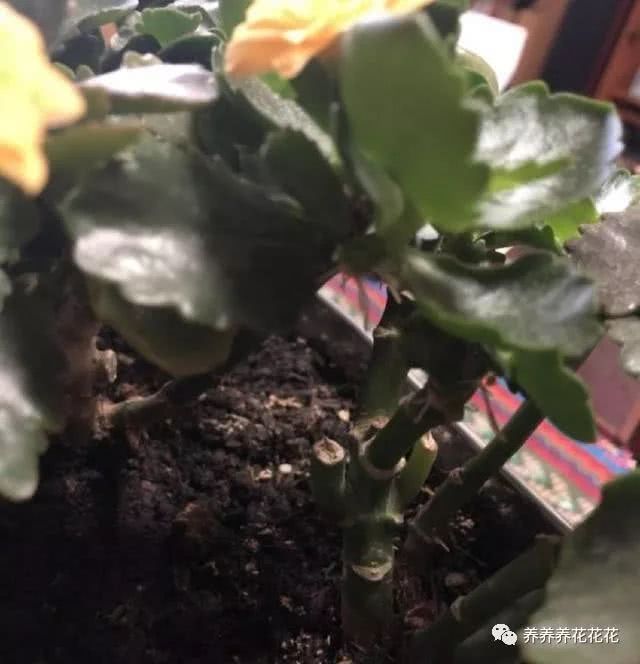
What to do when roots grow on the stems of your kalanchoe? Looking at your picture, it should be aerial roots growing on the stems of your kalanchoe. What is going on? If you find roots growing on the stems of your kalanchoe, let me teach you two tricks to instantly solve a big problem. Because there are only two situations in which roots appear on kalanchoe stems!
One situation is that the potting soil is too dry and lacking water. When the water shortage is severe, it has to grow aerial roots to absorb moisture from the air to supply its growth. This is a survival instinct. When we grow succulents, we often see aerial roots growing from the stem nodes, and that is the same principle. Kalanchoe belongs to the Crassulaceae family. Most succulent varieties also belong to the Crassulaceae family, so kalanchoe is also a succulent. If you have not watered it and it is short of water, or if watering does not penetrate and only the soil surface dries out, then roots appearing is normal. As long as you give it enough water, it will grow normally with no problem at all.
Another situation is root rot. After the roots of the kalanchoe rot, there are no roots to absorb nutrients to supply growth. It can only be forced to grow aerial roots from the stem nodes to absorb moisture from the air. If you discover it early, the first thing to do in the initial stage is to check whether its roots are rotting or whether the lower part of the stem nodes is rotting. If you confirm there is none, then it is the first situation.
To avoid aerial roots appearing on your kalanchoe, it is actually very simple. First, the soil mix should be loose and breathable. Loose, breathable soil is good for root extension. On the premise that the potting soil is loose and breathable, once the potting soil is dry, water it thoroughly. Supplementing water in time can effectively prevent aerial roots from appearing, so that it can grow normally and bloom abundantly. Loose, breathable soil is not prone to compaction, and after watering it will not become waterlogged, so root rot is unlikely to occur, and only then can it grow well.
Generally speaking, when this happens to a kalanchoe, it is mostly caused by a lack of water, so there is no need to worry too much, just water it. As long as there are no problems such as rotting leaves, there is no issue. When watering, keep to the principle of either not watering at all, or watering thoroughly. If you give only a little each time you water, the soil at the bottom stays dry all the time. The kalanchoe also has roots at the bottom, and if the bottom roots cannot get water, it is easy for root absorption to fail. This is not advisable! So if aerial roots grow on the stems of your kalanchoe, this is a distress signal. If it is not a lack of water, then it is root rot. Timely remedies are the key.
If you like growing flowers, followWeChat public account: Yangyangyanghuahuahua (hcqzj521)More flower-growing knowledge is waiting for you